
Tesla fell out of the top 10 most innovative EV manufacturers. For the first time since 2016
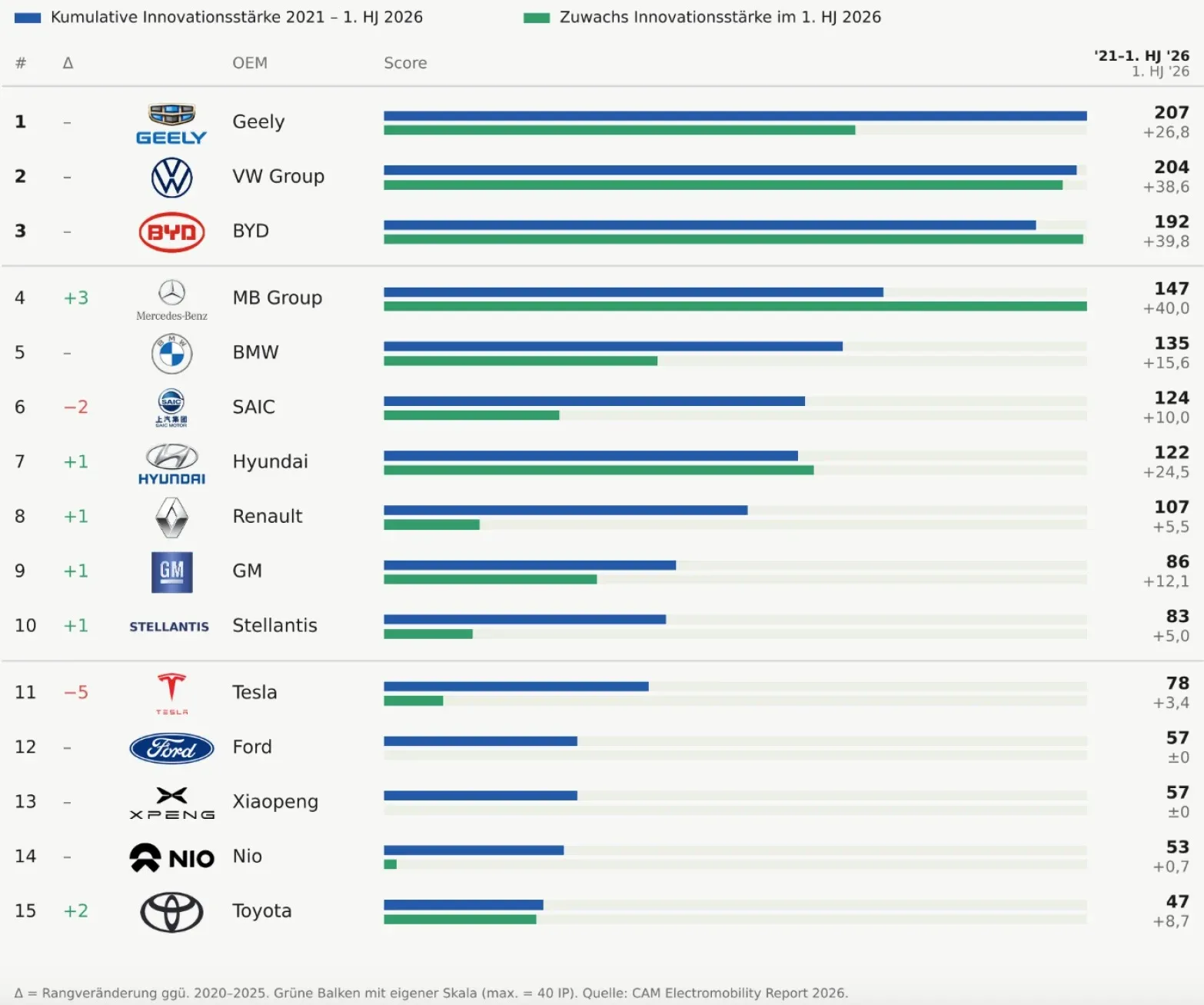
The Center of Automotive Management (CAM) in Bergisch Gladbach released a new Electromobility Report that ranks innovations solely in electric vehicles. Tesla dropped from 6th to 11th place in it. This is the first time since the ranking was established in 2016, when the American brand was the leader, that it has not made it into the top ten.
CAM, led by Prof. Stefan Bratzel, publishes two series of reports. Automotive Innovations covers all types of powertrains, and in April, BYD won there for the first time. The Electromobility Report focuses only on electric cars.
The podium order remained unchanged from the January edition. Geely leads with 207 index points, followed closely by Volkswagen (204 points) and BYD (192 points). Mercedes-Benz made the biggest leap, rising three places to 4th place with 147 points. Behind them are BMW, SAIC, Hyundai, Renault, GM, and Stellantis. China and Germany clearly dominate the top ranks.
Tesla has more points but still dropped
Tesla scored 78 points, 3.4 more than before. Therefore, the drop does not mean the Austin-based company has regressed. Its competitors introduced significantly more new models during this time. The gap to 4th place is now almost twice Tesla’s score.
Bratzel is direct: “Leadership in electric mobility innovation is still primarily shaped by Chinese and German manufacturers. Mercedes-Benz’s efforts to catch up are particularly noteworthy, while Geely and BYD demonstrate consistently strong innovation capabilities. Tesla, on the other hand, is clearly losing ground in the innovation race.”
As examples from the first half of 2026, CAM cites several specific implementations. Mercedes scores points for its wide range of models across different segments (EQS, VLE) and two-way charging capabilities for V2H and V2G, just like BMW. BYD is a pioneer in so-called flash charging. The Denza Z9 GT can accept up to 1500 kW through a single connector, and according to the manufacturer, its European version can charge from 10% to 97% in about nine minutes, even at minus 30 degrees. The VW ID.3 Neo was recognized for its efficiency thanks to its new APP350 engine and improved temperature management. With a 79 kWh battery, it has a WLTP range of 629 km and consumes 14.3 kWh per 100 km.
What CAM Awards Points For
The study covers the period from 2021 to the first half of 2026. CAM collected 910 mass-market innovations from 38 automotive groups. The evaluation is based on CAM’s so-called triad: range, energy consumption, and charging speed. Additionally, coverage of different vehicle segments is considered, such as the first introduction of electric drive in a particular car class, as well as progress in batteries, charging control, and system components.
This methodology rewards manufacturers that frequently release new models and enter new segments. This explains part of Tesla’s decline, as the company has relied on a very limited range of models for years. The ranking does not measure sales or software maturity, however.
Bratzel adds another perspective, a market-focused one: “It’s no longer about who offers electric cars, but rather who provides the most compelling package in terms of range, charging speed, efficiency, and cost. Chinese manufacturers are increasingly proving they can turn their technological strength into market share, even in Germany.” He adds that doubling the number of registrations for their new electric vehicles is a clear warning sign for established brands. Tesla doesn’t even appear as a reference point in this statement.
Order your Tesla and take advantage of bonuses for purchasing through the referral link!
LovEV Newsletter
Want more content like this?
Sign up — we’ll send you a weekly summary once the newsletter starts.