
Tesla has launched Cybercab in Austin. It is also seeking buyers for fleets, although FSD owners are still waiting.
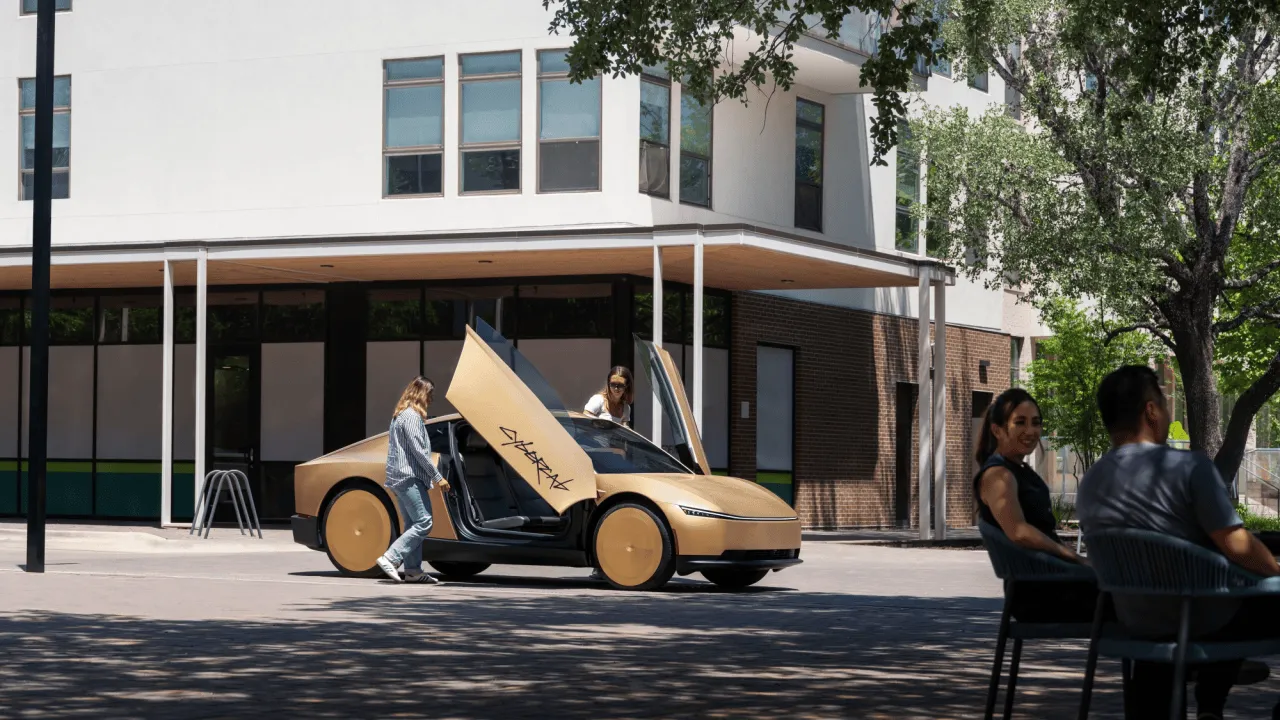
On September 3, Tesla rolled out the first production Cybercabs in Austin and simultaneously launched a form for companies interested in purchasing fleets of these vehicles. This is an important moment for the robotaxi project, but also quite bitter for customers who have heard for years that their own Teslas would one day start earning money on their own.
Table of Contents
Show
Hide
The launch itself was unusual for Tesla. Without a livestream, without broad media coverage, and with quite strict guest selection. What is louder today than the actual launch is something else: Tesla is beginning to consider fleet partners before allowing regular FSD owners to get involved in the business.
The Cybercab is on the streets, but the scale is still small
Cybercab is a two-seater robotaxi designed from scratch for autonomous driving. It has no steering wheel, pedals, or traditional mirrors. Inside the cabin are only two passenger seats and a 22-inch central screen.
The first rides started in Austin, within Tesla’s geofence. Event attendees could order rides in a designated area of the city. Tesla also claims to have exceeded 1 million miles of autonomous driving without human supervision across its robotaxi service, though this applies to the entire service rather than just Cybercab.
Texas records show that Tesla had 420 autonomous vehicles, of which 45 were Cybercabs. This clearly illustrates the scale. We have a operational start, but not yet a mass rollout. If anyone expected hundreds or thousands of vehicles on the streets, this is not that stage yet.
In practice, the core of the service still relies on Model Y vehicles that were previously used as robotaxis in selected areas of Texas and Florida. Cybercab is only now being added to this fleet.
Cybercab’s specifications seem reasonable, but range is a concern
Tesla has finally released some more detailed technical specifications. The Cybercab features a battery with a capacity of 47.6–48 kWh, front-wheel drive, and an engine producing 163 kW of power, which is approximately 219 horsepower. Its weight is 1,412 kg, or 3,113 pounds.
According to EPA documents, the car is supposed to offer a range of about 290-300 miles, while Tesla’s materials and some publications mention a figure of 418 miles, or 673 km, in combined or laboratory cycles. Here it’s important to note that these figures are not equivalent. 673 km sounds great on a slide, but it’s difficult to reconcile with a 48 kWh battery and an advertised consumption of around 10.2 kWh/100 km in normal driving conditions. This is more of a laboratory result under highly favorable conditions than something that should be considered real-world range today.
Tesla also states an efficiency of 10.2 kWh/100 km. If this holds true in urban driving at low speeds on an optimized route, it would be a very impressive figure. The Cybercab is small and lightweight for an EV with only two seats, so on paper it has the advantages to achieve this.
Below are the key specifications:
Parameter
Tesla Cybercab
Seats
2
Steering system
no steering wheel or pedals
Battery
47.6-48 kWh
Drive type
front-wheel drive
Power
163 kW
Weight
1,412 kg
Declared fuel consumption
10.2 kWh/100 km
Range per various sources
about 290-300 miles or up to 673 km in lab tests
ADAS/autonomy hardware
8 HD cameras, AI 4 platform
Tesla focuses on cameras, AI 4, and new solutions in the car
Technically, the Cybercab is very “Tesla-like.” It uses 8 HD cameras and an end-to-end neural network. It has no lidar and does not rely on HD maps. The calculations are handled by the same AI 4 platform we see in current Model 3 and Model Y vehicles.
This is both the greatest advantage and the biggest risk of this project. The advantage is that Tesla is trying to scale a hardware-software integrated approach across a large fleet. The risk lies in the fact that competitors like Waymo are pursuing a path with much more sophisticated sensor sets and highly controlled deployments. Tesla chooses a cheaper model, but cheap doesn’t necessarily mean it’s ready for use everywhere.
The mechanical aspects also look interesting. The Cybercab features a steer-by-wire system and a braking solution that, according to descriptions, doesn’t require conventional brake fluid. This represents a bigger change than just another interior upgrade. However, new solutions in a fleet vehicle must first prove themselves in terms of durability and maintenance needs.
Elon Musk also added a promise of integrating Starlink V5 directly into Cybercab. In theory, this is supposed to support 4K, gaming, and entertainment while on the road. It sounds impressive, but for robotaxis, what’s more important than a “car with a lounge” today is whether the vehicle can drive stably, safely, and affordably.
The fleet form reveals a lot about Tesla’s plans
Alongside launching the service, Tesla published a page with the slogan “Help Us Build Our Robotaxi Network.” This is a form for companies that want to join the Cybercab ecosystem.
Interested parties provide their name, email, phone number, company name, and deployment region. They then select a category: purchasing a Cybercab fleet, mobility hubs and infrastructure, event collaboration, or others. Some sections indicate the need to choose one option, while others allow selecting multiple options. Regardless, the meaning is clear: Tesla is gathering leads from operators and partners.
This is the first public channel for commercial orders of Cybercabs. Previously, there was no configurator or traditional purchasing process. However, an approximate price target of $25,000 to $30,000 per vehicle had been mentioned on several occasions.
This is where the most interesting part of the entire story begins. Tesla appears to be considering a model in which external companies purchase or co-finance fleets, which are then integrated into Tesla’s ride-hailing network, likely with a platform fee charged by the manufacturer. This would be a model more akin to a marketplace rather than just having its own fleet.
The problem is that private FSD owners are still excluded from this business
For years, Tesla has promoted the idea of a private Tesla owner buying FSD and then using their car as an autonomous taxi. There were talks of a “growing asset” and passive income, with the FSD package costing as much as $15,000.
Tesla has been transporting passengers for money for over a year now, but no ordinary Tesla owner has had the real opportunity to earn money from their car through a robotaxi service. Instead, there is a form specifically for companies and potential fleet operators.
The order of things looks particularly poor. First, promises to retail customers, then the development of a closed service, and only finally the search for business partners. If anyone bought FSD with such a scenario in mind, they have every right to feel at least overlooked.
Tesla can certainly argue that fleets are easier to control, service, and insure. And that is true. But it still doesn’t address the issue of earlier promises made to customers.
China and Asia will get a demo, not an actual rollout
Tesla has also confirmed an Asian tour for the Cybercab. Hong Kong is set to host a demonstration on September 9, while Beijing and Shanghai will see it on September 18. Tokyo was mentioned in some of the communications as well.
It’s important to clarify what this entails. It’s not about selling or launching the robotaxi service in China or Japan, but rather a demonstration of the product and technology. Tesla itself emphasizes that these events are exhibition-based.
This makes sense. The Chinese market for autonomous transportation isn’t empty. There are local players, regulations, and a completely different pace of implementation. Showing the Cybercab in Asia today serves more to generate buzz and familiarize the market with the brand than to achieve rapid commercial rollout.
Tesla also claims that the first production model rolled off the assembly line in February 2026, with full-scale manufacturing beginning in April at the Gigafactory Texas. If this pace continues, 2027 could be the first real test of scalability. For now, it’s more of the beginning of pilot production rather than a revolution in the transportation market.
Tesla has finally unveiled the Cybercab as a real service, but what’s even more important is to whom it plans to sell it first. What do you think? Will Tesla allow large fleets of partners or private FSD-equipped car owners onto the network sooner?
Order your Tesla and take advantage of bonuses for purchasing through a referral link!