
Tesla is hiding data on fatal accidents involving FSD and Autopilot. One involved a mother of five children.
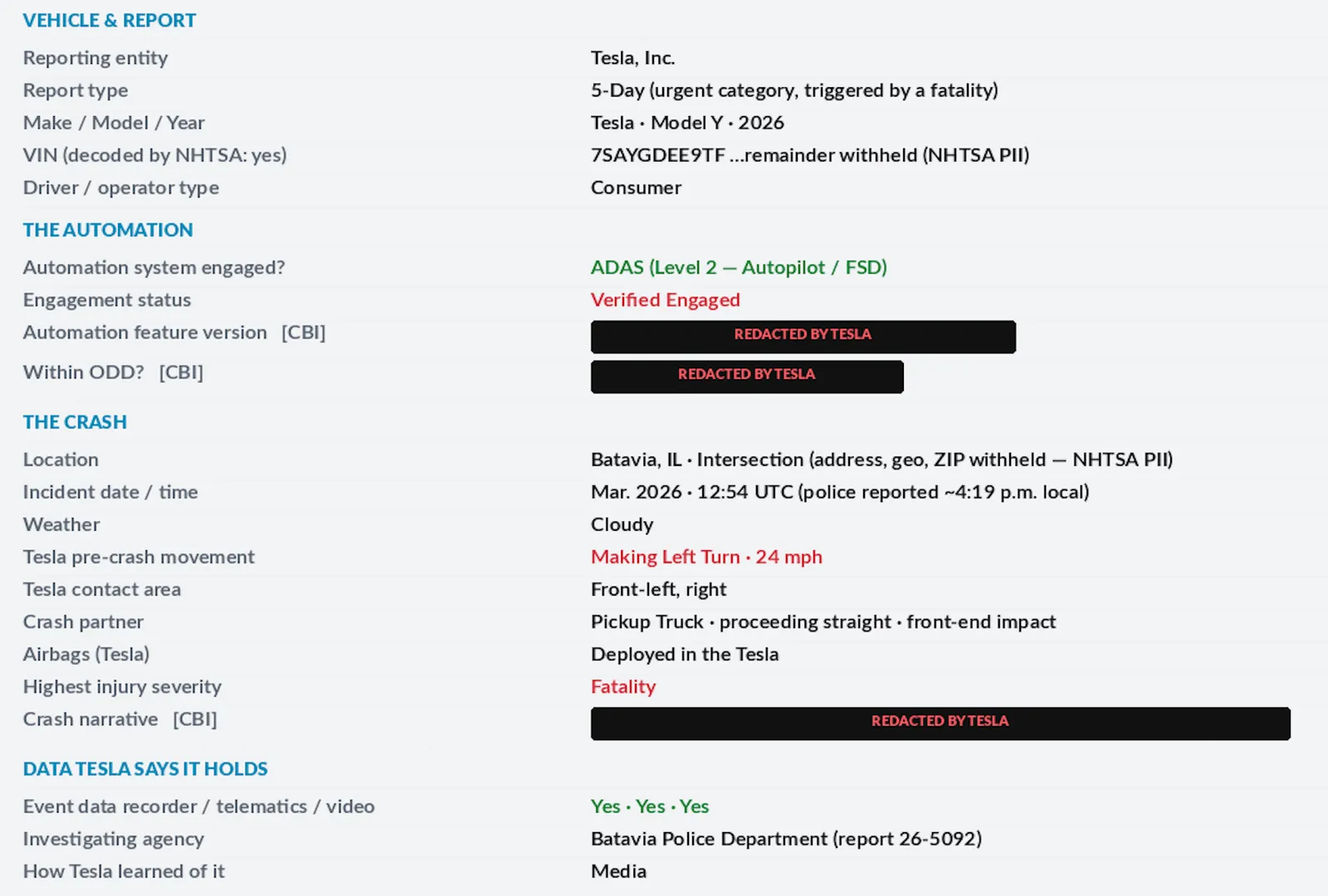
Tesla confirmed in a filing with U.S. regulators that the driver assistance system was active in the fatal Model Y accident in Batavia, Illinois. This refers to the collision on March 25, 2026, in which a 37-year-old passenger, a teacher, and mother of five died.
Table of Contents
Show
Hide
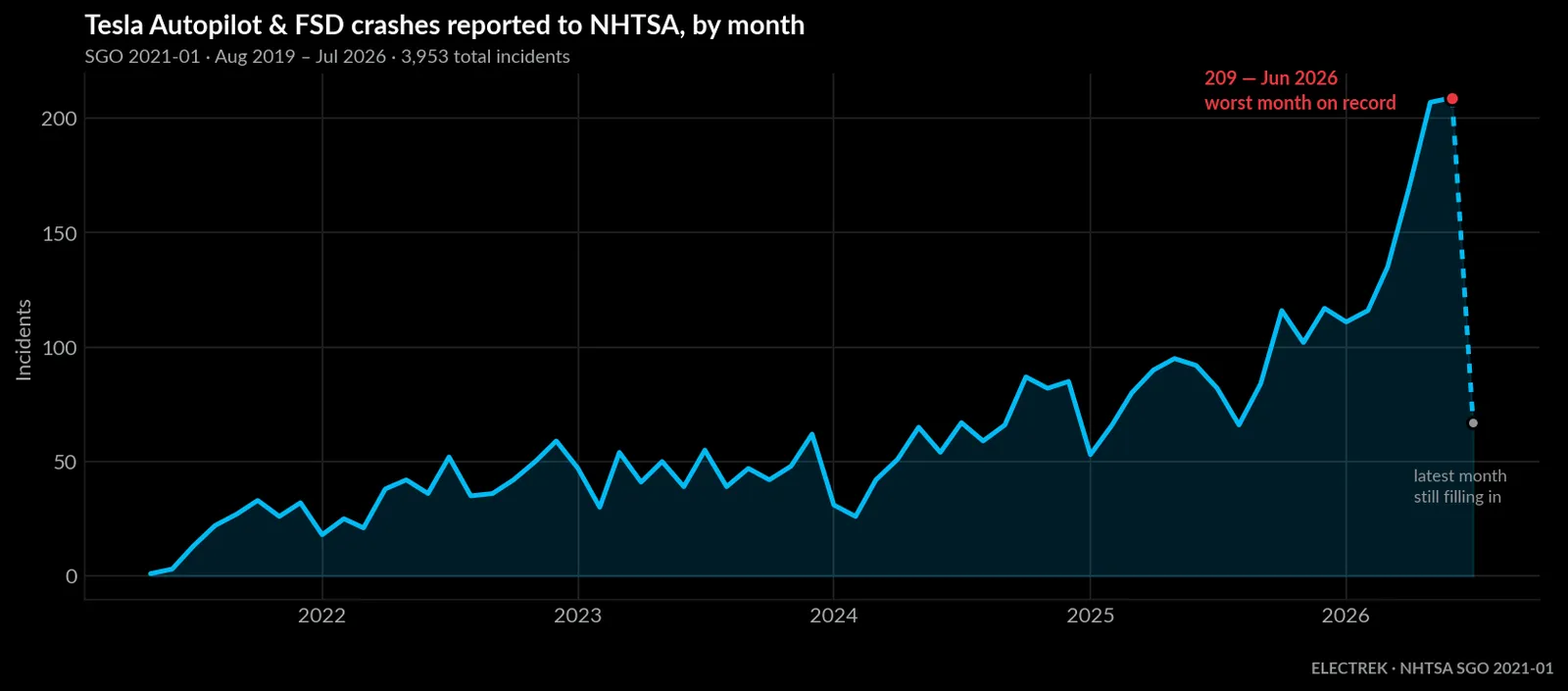
This is not an isolated case. Data submitted to NHTSA shows that Tesla reports thousands of collisions and accidents involving active ADAS, but it almost always leaves out fields that would indicate exactly what the vehicle did and whether it was operating within the system’s designated area.
Fatal Model Y accident in Illinois. System was active during left turn
The collision occurred around 4:19 p.m. local time at the intersection of Randall Road and McKee Street in Batavia. A Tesla Model Y was heading south and turning left when it struck a Dodge pickup coming from the opposite direction. A Nissan SUV was also involved in the accident.
Maggie Espinosa, the front-seat passenger, died at the scene or later. The Tesla driver and two other people were injured. The incident is still under investigation, and the case has been referred to the Kane County prosecutor’s office. No charges have been filed yet.
The most interesting part, however, doesn’t come from the police but from Tesla’s mandatory report to NHTSA. The manufacturer indicated there that the system status was “Verified Engaged,” meaning it was active and confirmed. The vehicle was supposed to be turning left at 24 mph, or about 39 km/h, at the intersection.
This greatly narrows down the interpretation. Tesla’s basic Autopilot does not perform such maneuvers in urban traffic. Turning left across oncoming traffic is a typical task for the Full Self-Driving package, or FSD. In other words, everything suggests that this system was active at the time of the accident, rather than just the standard lane-keeping feature on the highway.
The problem is that Tesla does not disclose the most important information. The description of the incident, the software version, and whether the road was part of the system’s approved operating area have been omitted. The company does confirm, however, that it has footage from the dashcam, telemetry data, and video of the accident. So the data exists—it’s just not public.
How This Reporting System Works and Where Tesla Hides the Details
Since 2021, the so-called Standing General Order NHTSA has been in effect in the U.S. Manufacturers must report an accident if a Level 2 driving assistance system was active 30 seconds before the collision, and if someone was injured, killed, or the vehicle needed to be towed.
Tesla has by far the most such reports. It accounts for about 85 percent of all industry reports and nearly 4,000 incidents. The sheer number alone doesn’t necessarily indicate the quality of the system. Tesla has a huge fleet, many vehicles equipped with ADAS, and numerous users who actually use these features. But another issue is harder to defend.
Tesla obscures almost everything that could help understand the course of an accident. According to an analysis of these reports, the company has hidden the narrative behind incidents in 99.9 percent of cases since 2019. GM, Ford, Honda, and Toyota do not employ such practices on this scale; there, the descriptions are usually made public or only slightly edited.
The effect is simple. In local media, such an accident is reported as a regular collision, rollover, or hit-and-run. It is only by combining data from the NHTSA report with information about the location, car model, month, and type of incident that it becomes clear whether Autopilot or FSD was active.
This is problematic for another reason as well. Tesla is very willing to release data when it favors them. When things get uncomfortable, they hide behind trade secrets.
It’s not just Illinois. There are other fatal incidents involving active ADAS as well.
The Batavia case isn’t the only one. Subsequent reports identified several other fatal accidents that hadn’t previously been linked publicly to Tesla’s systems.
In Clute, Texas, a 23-year-old driver of a Model 3 died after losing control and crashing into a parking pool. Police mentioned a possible health issue with the driver. However, Tesla’s report showed that the system was active and the car was traveling at 104 mph, or about 167 km/h. This speed figure wasn’t included in the public account of the incident.
In Lake Mary, Florida, a 43-year-old driver of a Model 3 died when his car was parked on I-4 and struck from behind by a truck. Police reportedly were unable to explain why the car came to a stop. Tesla’s data showed 0 mph and an active assist system.
A very similar incident occurred weeks later in Mesa, Arizona. Again, a 2020 Model 3, again 0 mph, another nighttime accident on an expressway, and another rear-end collision. Tesla once again confirmed an active ADAS system and once again kept the video to itself.
Here, the issue is less legal and more informational. If two very similar fatal accidents share the same pattern—stalled car, active system, and no clear explanation for why it stopped on a busy highway—the questions are obvious. Only the answers remain on the manufacturer’s servers.
FSD is still Level 2, even though the name suggests more
The biggest issue here is the discrepancy between the marketing and the system’s technical status. Full Self-Driving sounds like true autonomy. Officially, it remains Level 2, meaning a human is still in control at all times.
This isn’t just a semantic detail. The driver must monitor the car continuously, with hands and eyes ready to react. Meanwhile, the name “Full Self-Driving” has created the exact opposite impression over the years. And when an accident occurs, the same old message comes up: supervision was required by the system, so the user is at fault.
Of course, simply activating FSD or Autopilot doesn’t prove the software is to blame. The driver might have ignored the situation, misjudged priorities, or taken over control too late. The problem is that without complete data, it’s impossible to assess this fairly. And Tesla has both logs and recordings.
From the user’s perspective, this is a more important conclusion than another promise of autonomous driving. If a manufacturer sells a feature under a name suggesting self-driving capability, they should provide the full timeline of the incident after a fatal accident. Not PR, just data.
One thing is becoming increasingly clear here. Tesla today has a problem not just with safety or marketing, but with trust. What do you think: should manufacturers publish full logs of such accidents, or is regulatory oversight sufficient?
Source: Electrek, Electrek
Order your Tesla and take advantage of purchase bonuses using the referral link!