
The Tesla Semi will enter Europe in 2027. It has a range of 550 km and can be charged at 800 kW.
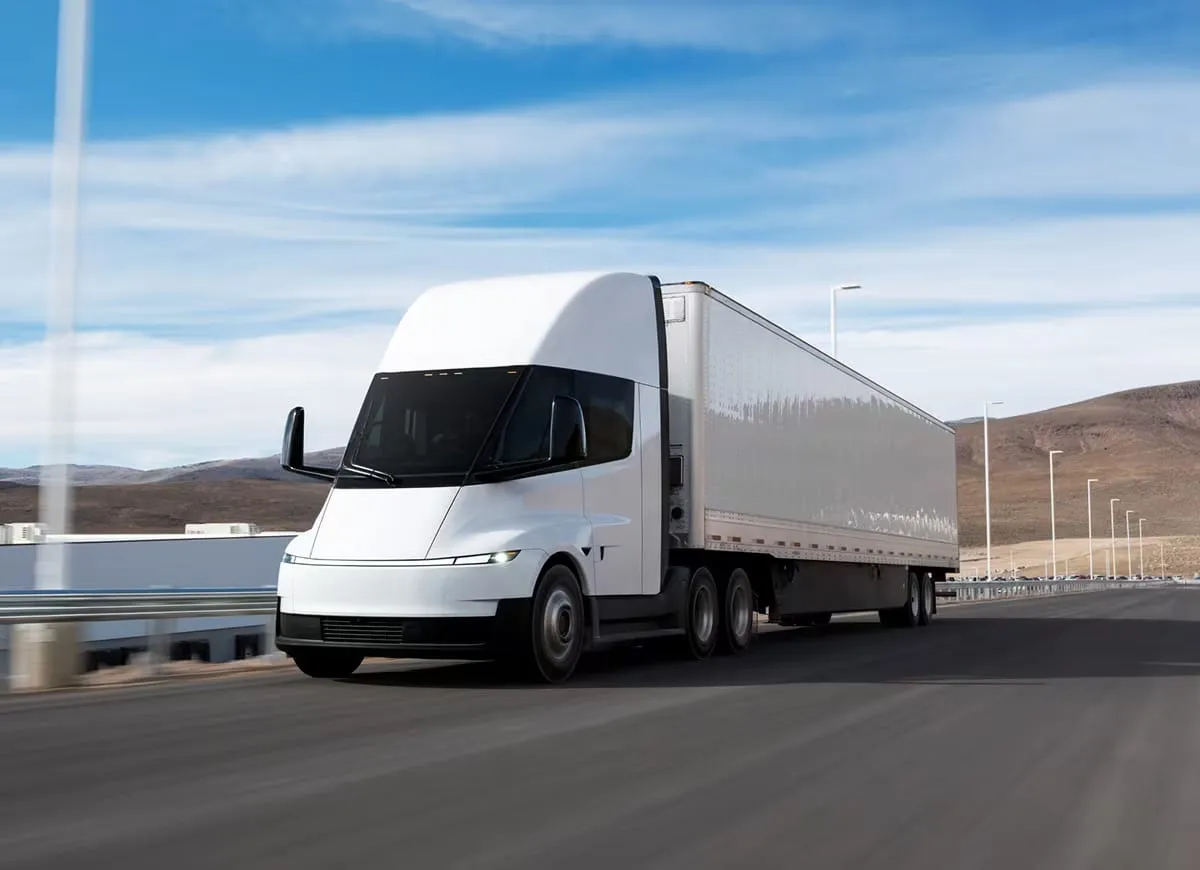
Tesla officially unveiled the European version of the Semi truck and provided its first specific specifications. It is set to hit the market in 2027, with a claimed range of 550 km and a payload capacity of 40 tons, along with MCS charging at up to 800 kW. This sounds reasonable, but there are also several questions, especially when comparing this version to the American Semi.
Table of Contents
Show
Hide
Before its European debut at the IAA Transportation show in Hanover, Tesla launched local pages for the model and revealed its specifications. For freight operators, three things are most important: actual range under load, charging time, and price. The price has not been disclosed yet.
Specifications
Tesla Semi Europe
Range
550 km
Energy consumption
1.0 kWh/km
Total weight of the vehicle
40 t
Empty weight
9,100 kg
Powertrain
3 independent motors on the rear axles
Power output
up to 800 kW
Fast charging
up to 60% in 30 minutes
Standard charging
MCS 3.2
ePTO
up to 25 kW
What exactly Tesla announced in Europe
The European Tesla Semi is expected to offer a range of up to 550 km under full load, meaning with a total weight of 40 tons. The manufacturer also states an energy consumption of 1.0 kWh/km. This seems plausible as it is close to the figures reported over time from Semi operations in the US.
The drive system relies on three independent electric motors on the rear axles. The maximum power of the system is said to reach 800 kW. In addition, there is ePTO with a power of up to 25 kW, which provides electric power for trailer accessories such as refrigeration units. In transportation, this isn’t a minor detail but rather a standard functional feature.
The cabin remains characteristic of the Semi, with a centrally positioned driver’s seat and two large screens on either side. Tesla also adds noise insulation, acoustic glass, a heated and ventilated seat, as well as the ability to stand freely inside the cabin. It sounds premium. This makes more sense in a long-haul truck than in a passenger vehicle.
Charging at 800 kW, but less than in the US
In Europe, the Semi is supposed to use the MCS 3.2 standard, also known as the Megawatt Charging System. Tesla claims the truck can accept up to 800 kW and regain about 60% of its range in 30 minutes. Meanwhile, a weaker base charger with 120 kW capacity is provided for overnight charging at depots. In that scenario, 60% of the range should be restored in around 4 hours.
The first star appears here. The American Semi was shown charging at a rate of up to 1.2 MW, and in such a setup Tesla claimed to recover about 70% in 30 minutes. The European version’s 800 kW is still high, but significantly lower nonetheless.
There could be two reasons for this. Either it’s due to the truck’s European configuration, or simply the state of infrastructure and the rollout of MCS in our market. For fleet operators, the result is the same: the route math looks a bit worse compared to the American presentations.
550 km is a good result, but it seems closer to the Standard Range version
The most interesting aspect is the relationship between range and curb weight. The European Semi is expected to weigh 9,100 kg, or around 20,000 pounds. This is a value very close to the American Standard Range version, rather than the heavier Long Range variant.
In the US, Tesla advertises the Long Range Semi with a range of 500 miles, or about 805 km. However, that figure refers to a different reference point. The European approval applies to driving with 40 tons of load, while American materials usually mention around 82,000 pounds, which is roughly 37.2 tons. A greater load reduces range, so there’s no simple 1:1 comparison here.
Nevertheless, the numbers suggest that Europe will likely receive a version with a smaller battery or at least a different configuration compared to the American top-tier Semi. 550 km with 40 tons is a competitive figure, but not one that will overturn the market.
And this is important because Tesla’s marketing tends to give the impression that everything will be larger, faster, and better. Here, something different is evident. Europe is probably getting a version more tailored to local regulations and costs rather than a flashy presentation.
Europe Didn’t Wait for Tesla
Tesla is not entering a blank market. In Europe, electric trucks are already being sold by Mercedes-Benz, Volvo Trucks, MAN, Scania, DAF, and Renault. These brands not only have ready-made products but also offer service, financing, and relationships with large fleet customers.
A good reference point is the Mercedes eActros 600, which is said to offer around 500 km of range with a battery capacity of about 600 kWh. Against this backdrop, the European semi-truck with a claimed range of 550 km looks promising. However, specifications alone are not enough.
In heavy transportation, success doesn’t come from just impressive range numbers as shown in presentations. What matters are total cost, access to parts, service networks, financing options, repair times, and reliability of deliveries. Here, Tesla still has a lot to learn.
If I had to point out the area where Tesla could really make a splash, it won’t be the product itself. It will be the price, should the company decide to play aggressively with it. No prices have been announced yet.
Production first in the US, then possibly Berlin
The first units for Europe are likely to be produced at Tesla’s new Semi factory in Nevada. That’s where Tesla is developing large-scale truck production. Only later might production be moved to Europe.
The natural candidate is Gigafactory Berlin. Elon Musk has previously suggested that Semi could eventually be produced there for the European market. As of now, this remains a plan, not a reality.
This has practical implications for European customers. Importing from the US means a longer supply chain and potentially higher costs. Local production would shorten logistics and simplify after-sales support. However, this is more of a prospect for a later stage.
FSD in trucks is on the horizon, but slowly
Tesla has previously confirmed that Full Self-Driving (Supervised) will be available for the Semi. Theoretically, this aligns with the development direction of long-haul transportation, but it’s important to distinguish between demonstrations and actual implementation here.
Firstly, we’re talking about a supervised version, not an autonomous driverless truck. Secondly, European regulations for such functions are much stricter than the marketing videos from the US. Just because Tesla mentions FSD with the Semi doesn’t mean it will be quickly applied to daily operations across Europe’s fleets.
In short: an interesting addition to the model’s history, but not what Semi is selling to carriers today.
The European Tesla Semi looks like a solid battery truck, just without the edge that some in the market have hastily assigned to it. 550 km range, 800 kW power, and 2027 as the launch date are concrete details. The rest, especially the price and delivery scale, will determine whether Tesla aims to compete for market share in Europe or merely establish its presence there. What do you think—will 550 km of range convince carriers more, or will an aggressive price do it?
Order your Tesla and take advantage of purchase bonuses using the referral link!