
The Tesla Semi has begun mass production. Seven years later than scheduled
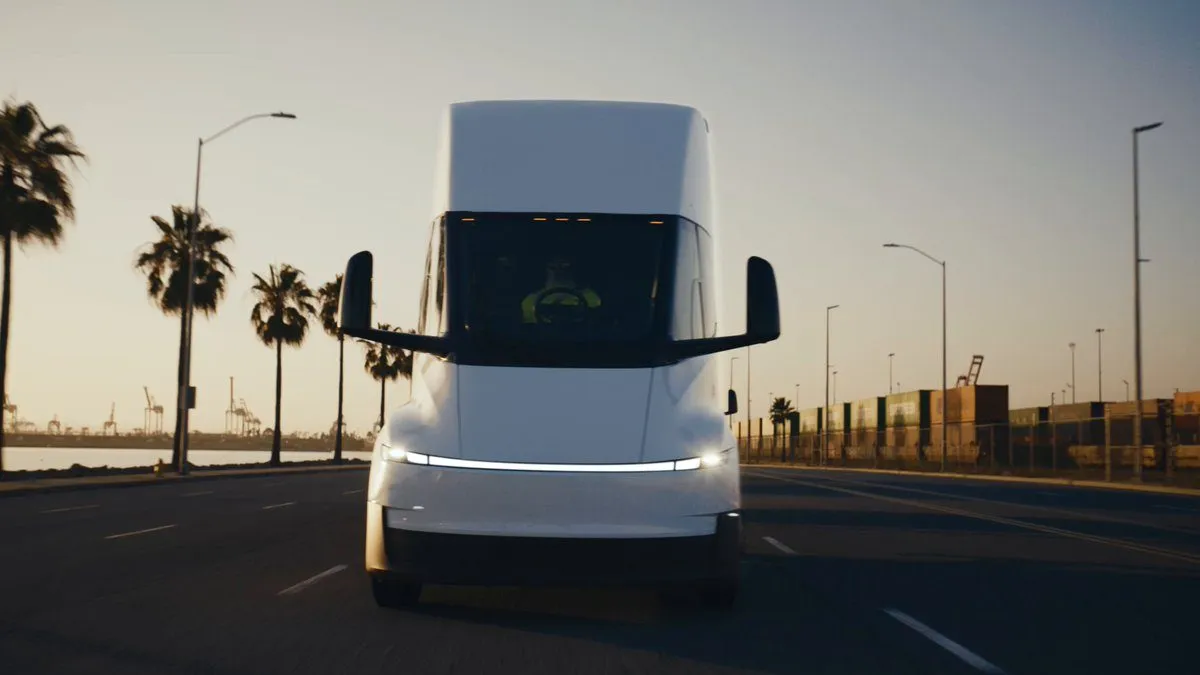
Tesla delivered the first production models of the Semi truck to customers and began manufacturing at its new plant in Sparks, Nevada. The facility is designed to produce 50,000 vehicles per year, but the company has not disclosed the current production rate. Deliveries to Europe are scheduled for 2027.
Table of Contents
Show
Hide
The Semi was unveiled in 2017, with production set to begin in 2019. The first manually assembled trucks reached PepsiCo only at the end of 2022. Now, Tesla is trying to transition from a pilot fleet to a product sold in thousands of units.
A plant for 50,000 trucks, but no plan for 2027
The new facility is adjacent to the Gigafactory Nevada and covers an area of about 167,000 m2. The first truck from the final production line rolled off in April 2026, with the delivery of vehicles to customers in September marking the official start of mass production.
The Standard, Long Range versions, as well as the model designed for Europe, will be produced on this single line. Tesla manufactures body components, batteries, drive axles, cooling modules, high-voltage systems, and seats. The manufacturer also highlights its highly automated battery production line and powder coating process, which are rare in Class 8 trucks.
The claimed 50,000 units per year represents the plant’s maximum capacity, not current production. Tesla has not provided figures for vehicles planned for late 2026 or 2027. After seven years of delays, the pace of production increase will be more interesting than the opening ceremony itself.
Tesla Semi
Standard
Long Range
Claimed range
325 miles, about 523 km
500 miles, about 805 km
Energy consumption
about 1.7 kWh/mile
about 1.7 kWh/mile
Adjusted consumption
about 106 kWh/100 km
about 106 kWh/100 km
Weight of the vehicle during testing
up to 82,000 pounds, about 37.2 tons
up to 82,000 pounds, about 37.2 tons
Range extension
up to 60% in 30 minutes
up to 60% in 30 minutes
Reported price, unofficial
about $260,000
about $290,000
4680 cells and a cheaper motor instead of the prototype’s design
The production Semi differs from the truck shown in 2017 as well as from the units delivered to PepsiCo. Tesla claims the redesign took four years and was intended to prepare the vehicle for larger-scale production.
The battery now uses cylindrical 4680 cells produced by Tesla. The company mentions lower battery weight and fewer kilowatt-hours without sacrificing range, but it has not disclosed the capacity of the battery packs. Based on the claimed consumption and range, a simple calculation suggests around 550 kWh for the Standard version and about 850 kWh for the Long Range version. However, this is not the official battery specification.
The engines have also changed. The rotor with a carbon fiber cover was replaced by a steel structure that is intended to be cheaper, more durable, and more efficient. The pole with the wire winding is shared with the Cybertruck, so Tesla already produces this component in larger quantities.
The Semi features an electric steering system without hydraulic pumps or fluids. This design aims to reduce maintenance needs while preparing the truck for future autonomous driving. This does not mean that current production Semi models are already autonomous.
The integrated Megamanifold with a heat pump is responsible for heating and cooling the cabin, batteries, and powertrain, similar to the system developed for Cybercaba. The cabin now features acoustic glass, a lowerable window, and space for the driver to stand. The truck also automates some pre-departure checks and records their completion in an electronic log.
Tesla claims a fleet availability of over 98% by 2026 and states that maintenance needs are virtually zero. However, this figure comes from a small, monitored group of vehicles. It will be the hundreds of Semi trucks in use with various carriers that will show how well the 4680 cells, suspension, and cooling systems perform under years of daily use.
Megacharger can restore 60% of range in half an hour
Tesla claims that the Megacharger charger can restore up to 60% of range in 30 minutes. The company still hasn’t disclosed the maximum power or the exact charging curve. For Long Range models, 60% of energy based on claimed consumption would correspond to approximately 510 kWh. Delivering this amount in half an hour would require an average power of over 1 MW.
The Megacharger network is primarily expanding in California, Texas, and along routes on the U.S. East Coast. Large gaps remain in states located between the Rocky Mountains and the central part of the country. The truck may have a range of 800 km, but carriers still need to find a megawatt-level power connection at their base or along the route.
Tesla compares the Semi’s fuel consumption of 1.7 kWh per mile to that of diesel engines, which use around 7 mpg, or approximately 33.6 liters per 100 kilometers. According to the company’s figures, electricity costs between $0.20 and $0.30 per mile, while fuel costs around $0.80. This results in approximately $12–$19 and $50 per 100 kilometers respectively. The difference is significant, but it does not include the costs of infrastructure, power capacity, vehicle financing, or downtime.
Orders Are Rising; Europe Awaits Until 2027
Trucks bearing the logos of PepsiCo, DHL, US Foods, ABF, Einride, IMC Logistics, and WattEV were on display at the event. Einride has placed orders for 500 units, while IMC Logistics has ordered 50.
ZET SCALE’s purchasing alliance has chosen Tesla as the primary supplier in a deal covering 2,500 electric Class 8 trucks in total. Not all of them have to be Semi models, as Kenworth, Volvo, and RIDE are also on the supplier list. Tesla has not disclosed the full scope of orders, though Elon Musk mentions a long queue of customers.
There is still no official price list. Reported figures are around $260,000 for the Standard version and $290,000 for the Long Range version. In 2017, the longer variant was priced at $180,000, so the unofficial price has risen by about 61%. It would still be lower than the approximately $435,000 cited as the average price for electric trucks of this class in the U.S.
European deliveries are set to begin in 2027, initially from a factory in Nevada. Production at Grünheide has been mentioned by Musk as a potential future option, not an approved project. The European timeline also does not guarantee that the Semi will be available in Poland.
Tesla finally has a factory, a redesigned truck, and customers. Now it must prove that 50,000 units per year is a real production plan, not just another figure from a presentation. At a price of $290,000 and with the need for megawatt-level charging, could it succeed in the Polish transportation market?
Order your Tesla and take advantage of purchase bonuses using the referral link!