
Tesla Semi for Europe: Decent range, top payload capacity
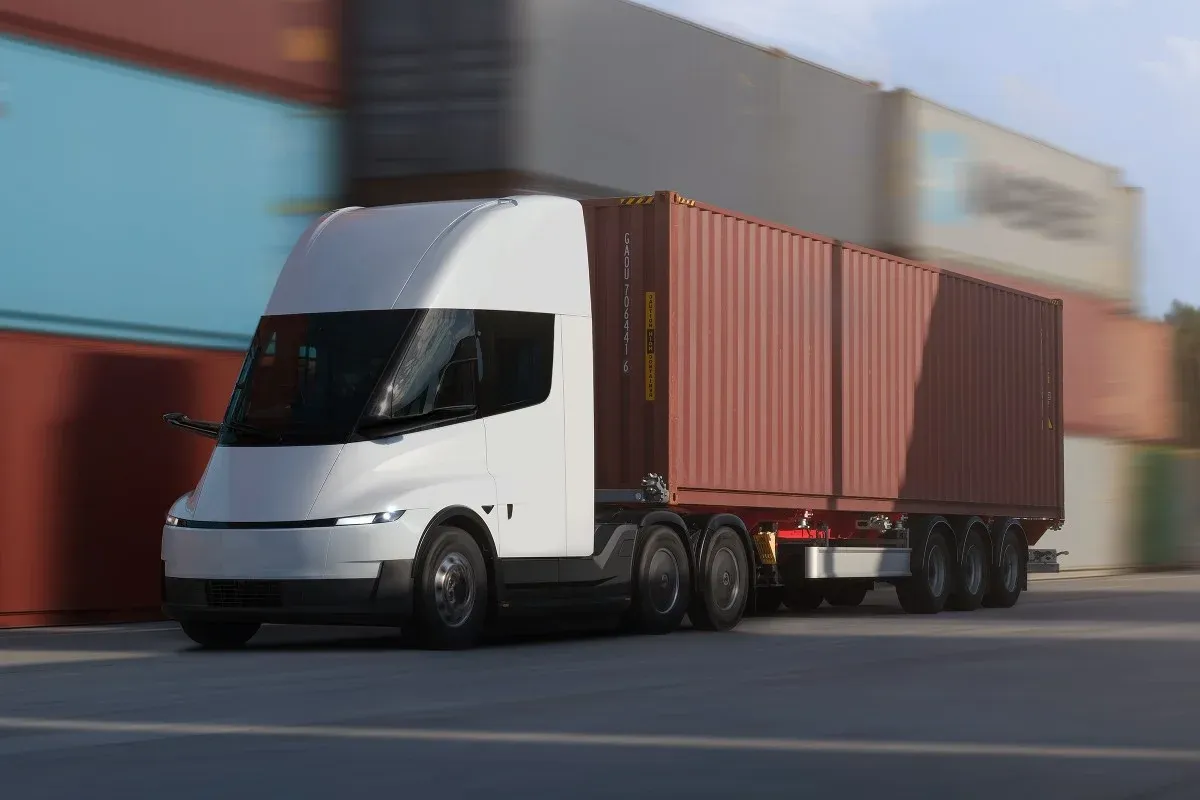
Tesla has released the performance specifications of its electric debut truck, the Semi, for Europe ahead of the IAA Transportation event. These figures roughly correspond to those of the U.S. version with standard range. Customers can expect up to 800 kW of power, approximately 550 km of range, and a relatively large payload capacity. Additionally, Tesla plans to develop its own truck charging network.
Image: Tesla
Tesla Germany GmbH reveals some details about the specifications for the European Tesla Semi, while also launching a German website for the new electric truck. The company remains quite reserved about the actual launch date. Tesla only states that it plans to deliver the Semi to fleets across the continent, with vehicle deliveries to customers in Europe set to begin in 2027. The email communication we received does not specify which markets will receive priority. What is clear, however, is that a network of so-called Semi Service Centers and licensed workshops will be established as part of the service support system.
But first, about the vehicle itself: Tesla is bringing the “Standard Range” model version to Europe. Whether a “Long Range” version with a range of up to 800 kilometers will be introduced later, similar to the US, remains unclear at this time. On the new German Semi website, the model is literally translated as “Semi Standard Reichweite.” Tesla aims to position this tractor-trailer as an efficient and powerful all-rounder for regional and long-distance transportation.
Tesla Semi: Cab with central driver position
Up front: The Semi features an unusual cabin design, notably with a central driver position for “improved visibility,” according to Tesla. The cabin is also intended to provide enough headroom to stand, a hook for jackets, and a heated and ventilated seat. Additionally, acoustic glass and soundproofing materials insulate the cabin to keep road noise largely out.
Technically, the Semi is a 6×4 tractor-trailer, meaning it has three axles, with the latter two being powered. The European version uses the drivetrain from the original US model, featuring three independent engines on the rear axles. Tesla has not disclosed the exact configuration or the contribution of each individual engine, but the total output is stated to be up to 800 kW. Additionally, Tesla emphasizes “instant torque and high performance at every speed,” which is an advantage when merging onto the highway.
Tesla Semi charges at up to 800 kW DC
Tesla does not comment on the battery ahead of the exhibition, but states that the Semi in Europe is capable of using Megawatt chargers with up to 800 kW DC. This allows enough electricity to flow in half an hour to recharge the battery to 60 percent capacity. The same specification applies to the U.S. version, so it is highly likely that the same 548 kWh battery is used. All Semis for both the domestic and global markets are produced at Tesla’s facility in Nevada. The batteries for the Semi come from the automaker’s own production and are based on 4680 cylindrical cells using NCMA chemistry.
Image: Tesla
- 1/4
- 2/4
- 3/4
- 4/4
The only minor differences from the largely identical U.S. Semi relate to range and fuel consumption: Tesla states an estimated range of 550 kilometers for the European version, while the U.S. model has a range of “about 325 miles,” which is roughly 523 kilometers. Tesla Germany reports an energy consumption of 1.0 kWh/km, whereas the U.S. version shows 1.7 kWh/mile, equivalent to 1.1 kWh/km. This can be attributed, among other factors, to the different weights and truck speeds in the U.S. and Europe: In the U.S., the Semi is a Class 8 truck with a maximum allowable weight of up to 80,000 lbs (about 36.3 tons), and trucks there can typically travel at speeds between 55 and 80 mph (approximately 88 to 128 km/h), depending on the state and road type. In Europe, the Semi is allowed to weigh up to 40 tons, and on highways, truck speeds are generally limited to 80 or 90 km/h.
Data sheet refers to 40-ton truck at 80 km/h
Tesla also notes in the fine print on its website that the 550-kilometer range and stated fuel consumption are estimates based on a total weight of 40 tons, a speed of 80 km/h, and 20 degrees Celsius on flat terrain — taking into account a special “Aero Kit” and a dry freight trailer according to California standards. This further highlights the export-oriented nature of the semi-truck. We will find out how the range and fuel consumption perform with standard trailers here by next year’s first deliveries at the latest. As for fuel consumption, Tesla adds that “the choice of tires and roof covering, as well as the configuration of the trailer, have a very significant impact on the projected fuel consumption.”
Two additional figures that Tesla revealed from the specifications ahead of the IAA Transportation are a curb weight of under 9.1 tons and an electric auxiliary drive system (ePTO) with a power output of up to 25 kW. The curb weight is particularly interesting as it allows estimation of the potential payload capacity. Using a standard European trailer with a weight of roughly 6.3 tons, the European version of the Semi would have a payload range of about 24.6 to 26.6 tons, depending on whether 40 tons or the special electric truck weight bonus of up to 42 tons is used as the allowable total weight.
Tesla Semi for Europe to be a load-optimized truck
If this claim proves true, Tesla will enter the European market first with a load-optimized truck, sacrificing range in favor of carrying capacity. The 550 kilometers cited by the manufacturer certainly isn’t a new benchmark in Europe: Volvo Trucks leads with its entirely new FH Aero Electric, followed closely by its parent company Renault Trucks with the E-Tech T 780. These trucks claim ranges of up to 700 and 660 kilometers respectively. However, range as a selling point for everyday usability quickly loses its appeal in logistics operations when it comes at the expense of payload capacity. For its European debut, Tesla chose a version with a smaller battery but greater load capacity. Another key factor is fast charging capability—Tesla aims to offer megawatt-level charging at up to 800 kW.
And here, Tesla makes a notable statement in its announcement: “Supercharging is designed for commercial use: The Semi is built to regain a significant amount of its energy during a short stop at the Tesla Megacharging network. This keeps trucks productive and ensures schedules are met. The Tesla Megacharger network includes ultra-fast charging stations that allow drivers to get back on the road more quickly.”
On its website, Tesla confirms its intention to offer such a network in Europe. It is intended to be an “expanding public” network with strategically located stations. Tesla distinguishes between “Megachargers” with a charging capacity of up to 800 kW and “Basechargers” with 120 kW charging capacity for longer stays at depots and overnight charging. The latter solution is likely to involve CCS systems, which are said to be able to increase the range of the Semi by up to 60% in four hours. Further details regarding the rollout plans have not yet been made public.
Operating costs as a selling point
Tesla Germany promotes the imported model primarily as a fully electric tractor truck that incurs lower operating costs compared to conventional trucks. Moreover, “The Semi was designed from the ground up as an electric truck and is intended to revolutionize freight transportation. It builds on Tesla’s expertise in battery technology, electric powertrains, software, and manufacturing to meet the demands of modern logistics.” Thanks to remote diagnostics, “over-the-air” software updates, and reduced maintenance needs, operators can also save time.
Regarding service and repairs, Tesla aims to establish a network of the Semi Service Centers mentioned earlier. This support is supplemented by an as-yet-undefined “Mobile Service on Site” option designed to assist drivers. In addition, there will be Tesla-certified repair shops that are also set to become available with the launch of the Semi. Tesla plans to keep spare parts in its Semi Service Centers. Moreover, “the distribution centers will also carry a complete range of spare parts to minimize any downtime,” the manufacturer explains.
Tesla also aims to make its fleet management platform called Tesla for Business available to future truck customers. The manufacturer first announced this platform in Europe last year for passenger vehicle fleet clients. This portal allows, among other things, managing vehicles and driver access, as well as displaying real-time vehicle data such as charging status, tire pressure, or energy consumption. It also enables booking service appointments, approving cost estimates, and processing invoices.
The Tesla Semi will be on display at the IAA Transportation in Hannover from September 14 (press day) to September 20. Visitors can see the European Semi at the Tesla booth and, depending on availability, even ride in the vehicle. The relevant locations are Hall 12, Booth B01, and Hall 14/15, Booth TD07.
Source: Information via email, tesla.com