
Tesla Robotaxi: Darkness Remains a Problem
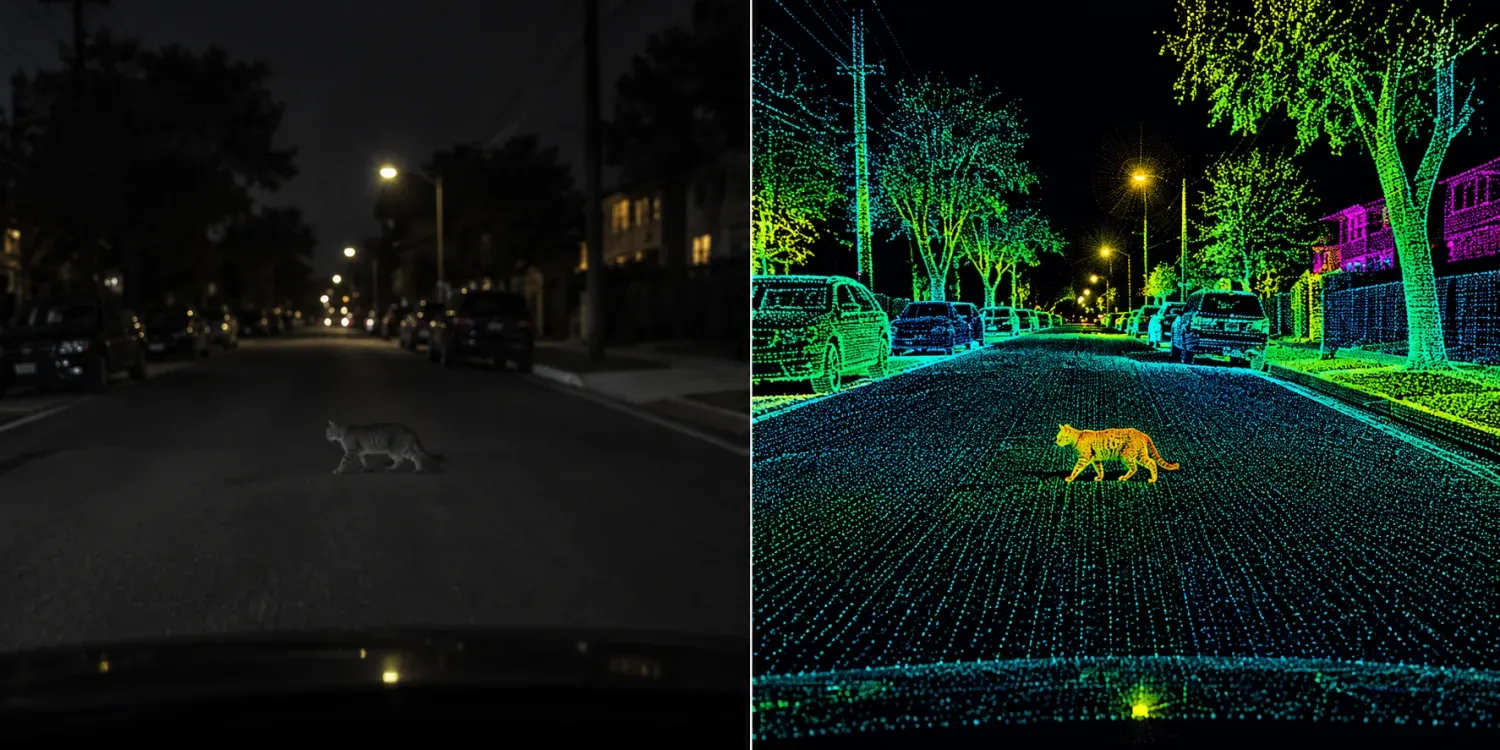
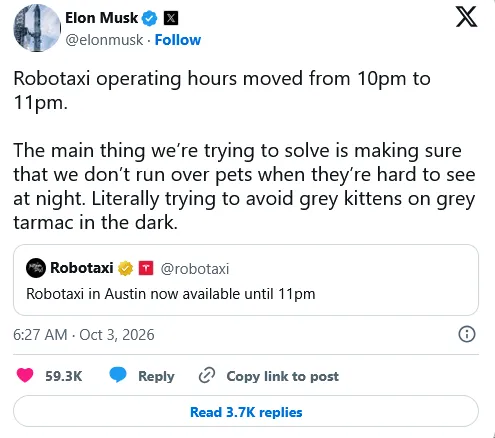
Tesla Robotaxi: operation hours of autonomous vehicles extended by one hour (to 11 PM) in Austin. But Elon Musk reiterates that the main obstacle to broader night-time service remains the cars’ ability to recognize objects that are hard to distinguish in darkness. This brings back discussions about the limitations of Tesla Vision, which relies solely on cameras without LiDAR or radar support.
The extension of Robotaxi service hours in Austin is significant, as it comes more than a year after the service’s launch, when app requests were expected to be possible from around 6 AM until midnight. Meanwhile, however, the expansion of the service has remained more limited compared to initial ambitions.
Elon Musk himself explained the reason through his social media channels. The issue mainly concerns the nighttime perception of small, hard-to-distinguish objects against a background. This is by no means a minor problem for an autonomous driving system that Tesla intends to operate around the clock.
The darkness poses a challenge to Tesla Vision: Musk mentions the “gray cats”
The issue raised by Musk relates to a fundamental characteristic of the cameras equipped in Robotaxis: they are passive sensors that must obtain information from the light available in the environment.
When an object has very low contrast against the background, identifying it can become more difficult, especially in poorly lit conditions. A small animal on the road surface—Musk cites “gray kittens on gray asphalt”—represents a particularly challenging “case” for the Tesla Vision system.
LiDAR and radar: Tesla says no again
The issue is interesting because Tesla has deliberately pursued a strategy opposite to that of various autonomous driving companies, which use LiDAR and radar instead.
The company removed radar from vehicles starting in 2021 and later also eliminated ultrasonic sensors. LiDAR has never been part of Tesla’s standard equipment. Meanwhile, its autonomous driving strategy has relied solely on cameras and software processing.
Musk has repeatedly argued that LiDAR is an unnecessary solution for achieving full autonomous driving. Over the years, he has described its use as a “fool’s errand” and emphasized the importance of neural networks and artificial vision.
The role of active sensors
Today, however, the problem identified by Musk himself relates precisely to one of the scenarios where active sensors can provide complementary information to images.
Lidar actually operates on a different principle. The sensor emits laser pulses and measures the time it takes for them to return, creating a three-dimensional representation of the environment. It therefore does not necessarily need to distinguish objects by color or contrast.
Radar, which relies on radio waves, also provides different information compared to cameras, including the relative speed of objects. It is less effective at detecting very small details but retains its detection capabilities in conditions such as fog, dust, or strong glare.
Autonomous Driving, Waymo: “This is why artificial vision alone is not enough”
The safety of autonomous driving is at stake
The technological difference becomes apparent when comparing it to Waymo, a U.S. company that uses a combination of cameras, Lidar, and radar in its autonomous vehicles.
The comparison does not mean that a multisensor configuration eliminates all risks. Even the most advanced systems can make mistakes, and urban environments present situations that are difficult to predict. The point is rather different: in autonomous driving, using sensors with distinct physical properties allows for at least partial compensation for the limitations of each technology.
A challenge for the Tesla Robotaxi
For a Robotaxi service intended to operate without a driver and without time constraints, the ability to function in darkness is not a minor detail. It is a normal condition of urban driving.
The real question then becomes understanding how quickly Tesla will be able to improve night vision through software and cameras. The company could achieve increasingly better results without adding new sensors, but the case of small objects with low contrast shows how central the relationship between algorithms and the physical limitations of sensors remains.
READ ALSO: Tesla Full Self-Driving: our test reveals how it works. And watch the VIDEO
TAG: Tesla Robotaxi
Previous Article
A useless luxury: this is how we see electric cars
Next Article
Wallbox for free? No charger bonuses
