
A Tesla Roadster with an interface inspired by fighter jets, with production set to begin in 2028.
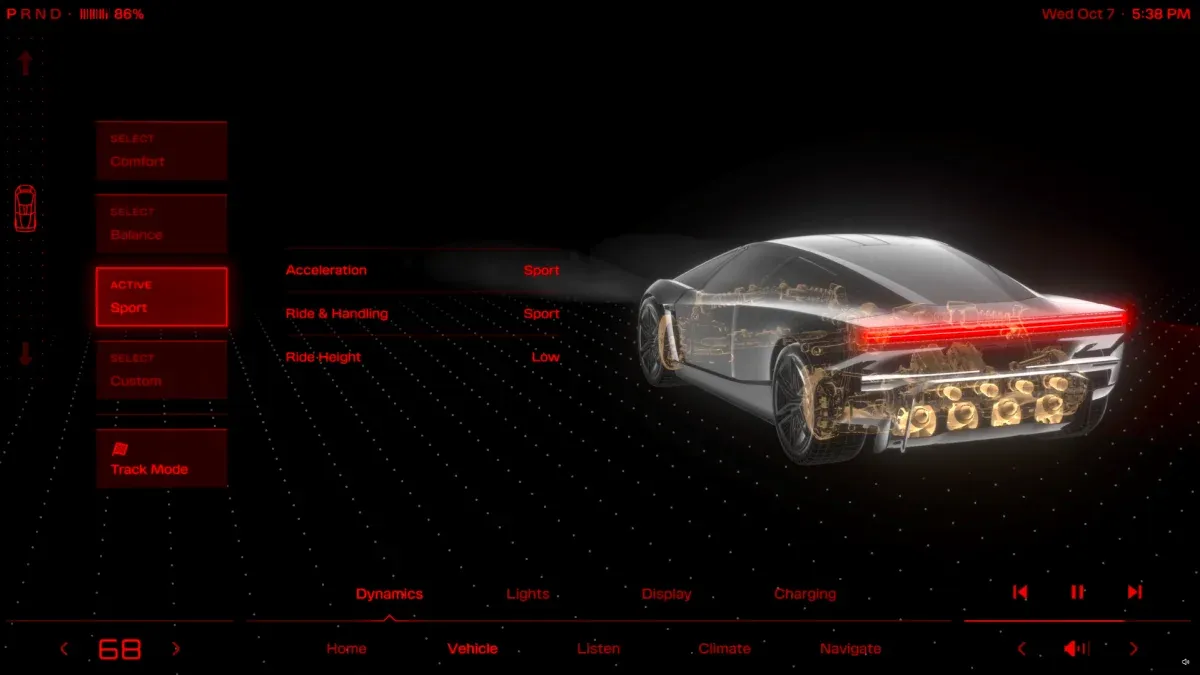
Tesla shared a video on X on October 23, 2026, showing the interface of the new Roadster. According to the company, the screen is “inspired by fighter jet cockpits” and “designed around the pilot.” Mass production is still a long way off, so what we see might change.
Red on black and a car that shows what’s moving
The overall design resembles Cyberpunk 2077 more than Tesla’s screens seen in the Model 3 or Y. Everything is red on a black background: the PRND indicator, battery level at the top, and a dotted grid beneath the Roadster’s skeletal model. The main menu is divided into Home, Vehicle, Listen, Climate, and Navigate. Under the Vehicle tab are options for Dynamics, Lights, Display, and Charging.
The driver can choose between Comfort, Balance, Sport, or Custom modes. Each one changes the response to the throttle, the suspension and handling characteristics, as well as the car’s height. There is also a separate Track Mode. Speed and lap times are displayed on a small red screen in front of the windshield.
The most interesting aspect is how the visualization responds to the settings. In Dynamics mode, the suspension lights up in gold. In Charging mode, a battery icon appears above the charging limit slider. Tapping on the rear spoiler lets you select Stowed, Low Drag, or High Downforce, with similar labels appearing for the “barge boards” and nozzles. With active aerodynamics, an air intake on the front bumper, and hidden headlights, it’s a practical way to see what each button actually does.
Track Mode instead of car visualization
When activated, the visualization is replaced by a detailed dashboard. It shows:
the activation of the brake and throttle.
battery and engine temperatures,
brake temperatures and pressure in each tire,
G-meter,
live track map with sector times,
lap log.
From here, it’s also possible to adjust aero balance, brake balance, and suction fan settings, as well as turn off ESC and traction control. Thrust and Rocket versions will additionally display cold gas pressure and the readiness of the nozzle system for “afterburning.” There’s a lot to display on a screen that the driver must glance at in fractions of a second.
Will this make it to the showroom?
Beneath the styling, the layout remains familiar. The climate control is located in the lower left corner, volume controls in the right, and multimedia controls at the bottom. This suggests that the Roadster will receive its own overlay on Tesla’s standard software, just like the Cybertruck.
History teaches us to be cautious. The early prototype of the Cybertruck’s interface combined a map with a vehicle visualization in one view, and customers received a system much closer to the rest of the lineup. The 2016 Model 3 prototype, with a map taking up half the screen and a speedometer overlaid on top, also looked different from what owners ended up with.
Production of the Roadster is not set to begin until 2028. Sawyer Merritt, who spent time with the car at the October presentation, praised its “retro-futuristic aesthetic.” However, we won’t be able to test the interface ourselves. The car is on display at the Petersen Automotive Museum in Los Angeles, but it’s available via a link.
Red on black looks impressive, but on a sunny day on a track, visibility will be more important than the movie-like atmosphere.
Order your Tesla and take advantage of bonuses for purchasing through a referral link!
LovEV Newsletter
Want more content like this?
Sign up — we’ll send you a weekly summary once the newsletter starts.