
Tesla will allow driving away with a Supercharger cable. Emergency departure could cost $25,000
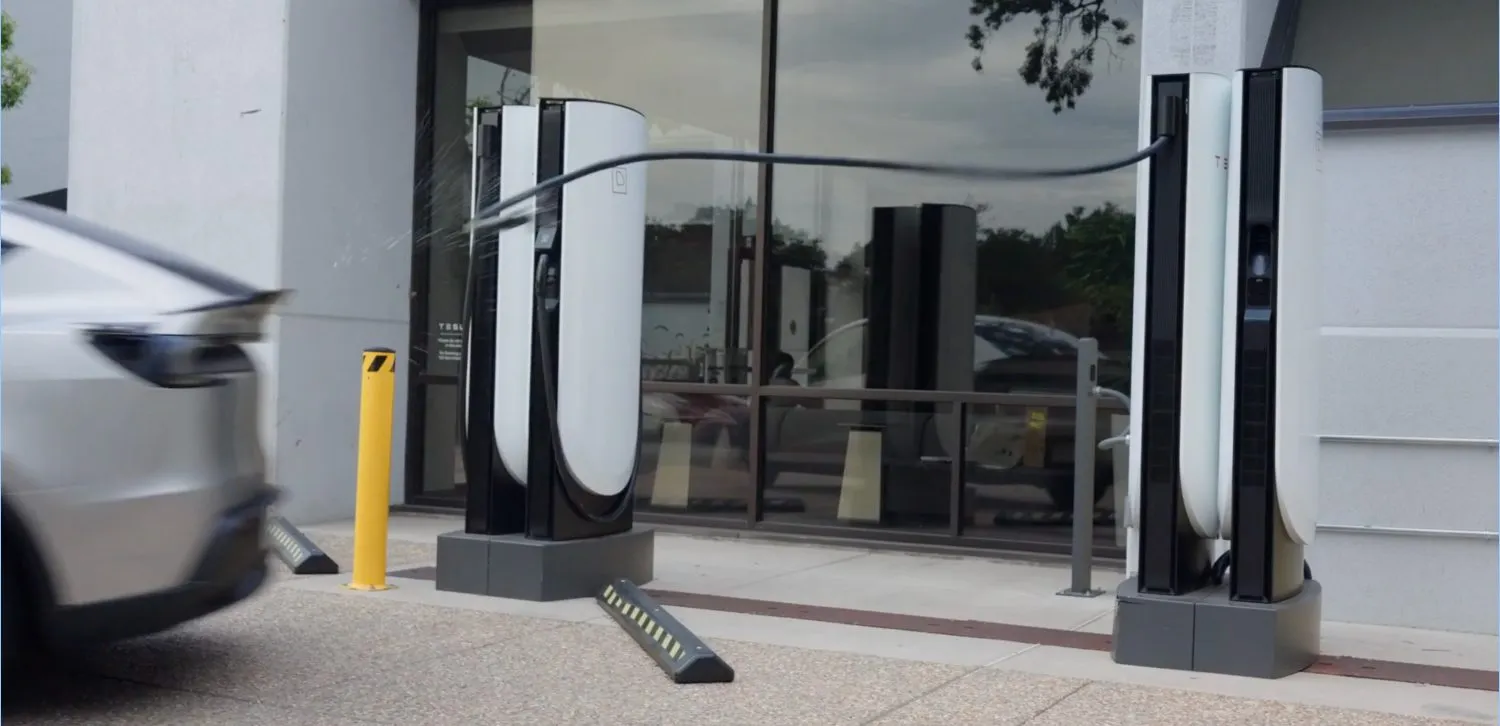
Tesla launched Emergency Drive Away in the US on October 1, 2026, a feature that allows drivers to move a car connected to a Supercharger. This solution is intended solely for escaping an immediate threat, as it damages the charging port and station, with repairs to the infrastructure potentially costing up to $25,000.
Table of Contents
Show
Hide
Until now, Tesla did not allow drivers to select a driving mode as long as the charging cable remained in the car. This restriction protected drivers from accidentally pulling out the plug, but in dangerous situations, it forced them to exit the vehicle. Emergency Drive Away enables drivers to intentionally bypass this safety measure.
A shooting incident highlighted the issue with the driving mode lock
The feature was introduced two months after the shooting in Twin Falls, Idaho. The shooter opened fire near an In-N-Out Burger restaurant, and the incident spread to a nearby Supercharger station. Cars parked at the chargers were shot at, including a Tesla that couldn’t leave with its cable still connected.
Max de Zegher, Tesla’s director of charging for North America, admitted that the company had discussed implementing such a solution for years. Tesla claims it selects Supercharger locations based on safety considerations and moves stations deemed unsafe. However, this does not eliminate sudden threats, where just a few seconds can determine the ability to escape.
Emergency Drive Away will be available for cars remotely with the update 2026.38.3. The feature currently works only in the United States and solely at V2, V3, and V4 Superchargers. It cannot be used with chargers from other providers or a home Wall Connector. According to available information, it supports modern Teslas but not older Model S and X vehicles produced before 2021.
Breaking: There is an active shooter incident happening in Twin Falls, Idaho. It's unknown if anyone has been injured or killed.
The surrounding streets near the shooting have been placed on lockdown.
Video posted on social media shows a young man with a long gun shooting… pic.twitter.com/KY9hBc273o
— Andy Ngo (@MrAndyNgo) August 1, 2026
The car will drive away, but the connector and port will be damaged.
Attempting to select Drive mode while charging triggers a red message on the central screen. The driver must confirm they understand the consequences, activate emergency unlocking, and proceed. The plug is then forcibly pulled out of the car, and the cable disconnects from the charging station.
The Tesla footage shows a damaged charging port and flap, along with coolant leaking from the liquid-cooled cable. After such an incident, the car must definitely be taken to a service center. The Supercharger also requires separate intervention, including the removal of the coolant fluid.
Tesla stated that electrical and structural repairs could cost up to $25,000. For comparison, the company estimates the equipment needed to build an eight-spot V4 station for business customers at $500,000, which is $62,500 per spot even before installation. Thus, the maximum repair cost represents 40 percent of that amount.
Tesla did not clarify who will bear the cost
The biggest uncertainty lies in financial responsibility. Owners asked Tesla whether a driver fleeing from an imminent threat would have to pay for the damaged charger. The company did not respond, though it confirmed the costs of repairs and the mandatory maintenance of the car’s port.
The short video recordings from cameras are supposed to be automatically sent to Tesla after each use of the feature. The manufacturer also announced “additional penalties” for intentional misuse, but did not specify their amount or the criteria for determining such incidents. Each Supercharger session is linked to the user’s account and payment method, but the information provided does not indicate whether Tesla can automatically charge the owner for any damages.
This is a last-resort solution, not a more convenient way to end charging. It gives drivers the ability to leave without getting out of the car, but it leaves behind a damaged port, a broken cable, and potentially a very high bill. Before rolling this out beyond the U.S., Tesla should clarify who is responsible for payment when its use truly saves health or lives.
Order your Tesla and take advantage of purchase bonuses using the referral link!
LovEV Newsletter
Want more content like this?
Sign up — we’ll send you a weekly summary once the newsletter starts.
