
Tesla unveiled a motor without rare earth metals. This is important for the supply chain, not for range.
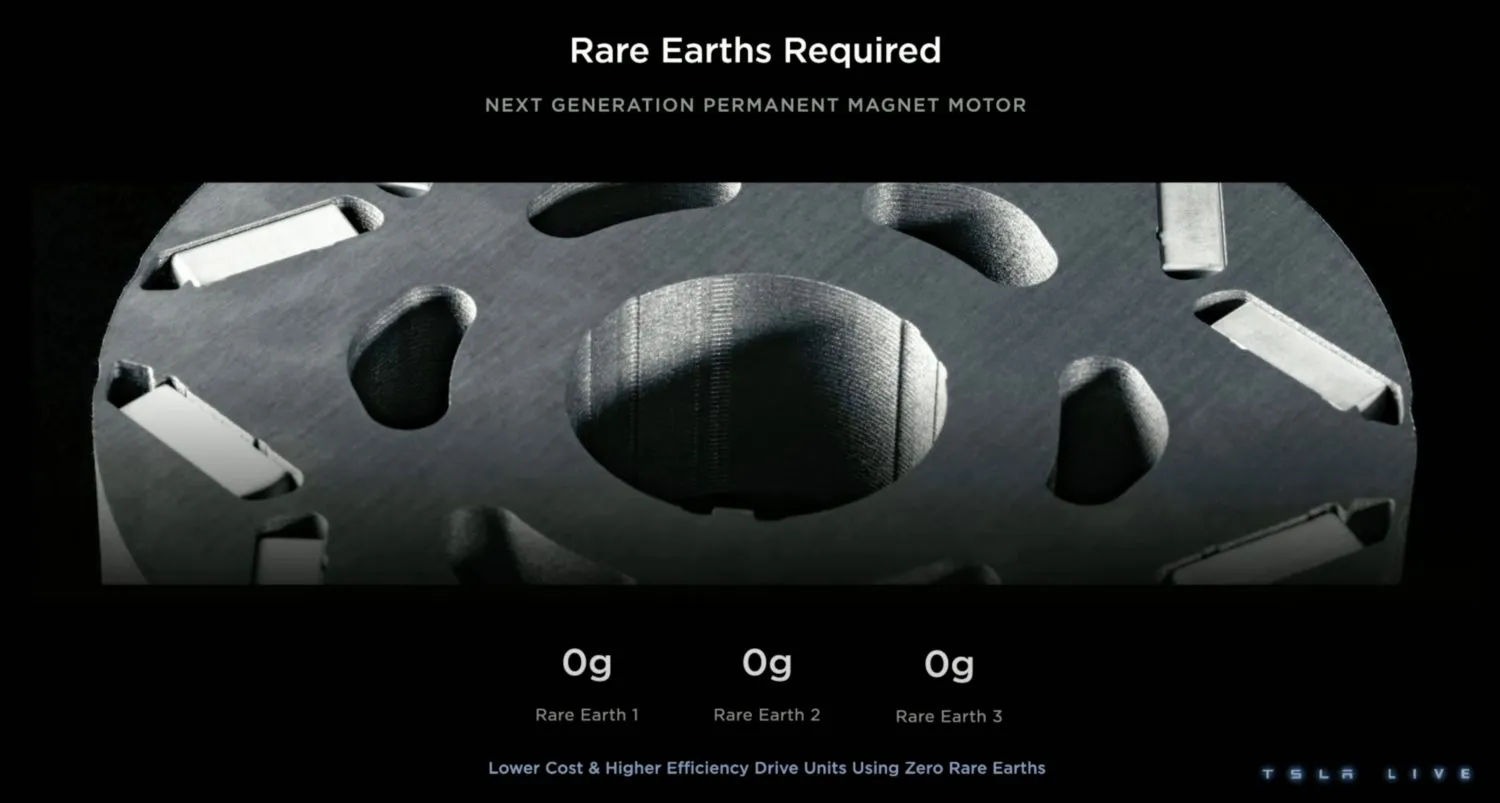
Tesla unveiled a new rare-earth-free traction motor during the Cybercab event. The company claims this engine is 18% smaller, 25% lighter, and more efficient than other top-tier drives, with the Cybercab itself reportedly using only 165 Wh/mi of energy.
For EV drivers, what’s most interesting here isn’t just a few extra percentage points in efficiency but whether Tesla can scale up this drive from a concept car to mass production.
What Tesla Actually Announced
The new drive was shown in the Cybercab. Elon Musk later added on X that the engine does not use rare earth metals. This builds upon a 2023 announcement where Tesla said it was working on a permanent magnet engine that avoids such materials.
This is the key point: it’s not about the battery. Rare earth metals are not a standard component of lithium-ion batteries in electric cars. It’s about the motor, more precisely the magnets. In a typical electric car, there is about 1 kg of such elements per vehicle. It seems small, but with millions of cars, it becomes a significant procurement issue.
The most important one is neodymium. Strong magnets used in motors, speakers, or hard drives are made from this material. Often, additives such as dysprosium, terbium, or praseodymium are also included. In fact, the “rare earth metals” themselves are not as rare as their name suggests. Neodymium is roughly 2/3 as common as copper.
Tesla once took a different path. Older models used AC induction motors that don’t require such magnets. Later, with the launch of the Model 3, the company shifted more heavily to permanent magnet motors because they are smaller and usually more efficient.
What this means in practice
It sounds like a big deal, but it’s not an exaggeration. Electric motors are already very efficient. Even weaker versions in EVs convert over 90% of the energy supplied into motion. So if someone is hoping for a boost in range of a few percent, this isn’t the area to look.
Something else is worth noting. Tesla mentioned improvements in size and weight but didn’t provide a specific percentage increase in the motor’s efficiency itself. This usually means the energy gain is fairly small. On the other hand, a smaller and lighter motor makes it easier to fit everything into the car. In a project like the two-seater Cybercab, every centimeter counts.
That’s why a figure of 165 Wh/mi seems impressive, but it’s not thanks to the engine alone. The car’s small size, low profile, aerodynamics, weight, and two-seater design also play a role. The engine is just one piece of the puzzle.
The second topic is more practical. Most of the world’s processing of rare earth metals goes through China. This issue resurfaced strongly last year after China imposed restrictions on the export of these materials. Suddenly, what was once a “someday” plan became urgent.
So far, we’ve only seen this powertrain in the Cybercab, and Tesla reportedly has around 45 such vehicles registered in Texas. So don’t worry, it’s still not at the scale of the Model Y.
If Tesla moves this engine to production cars, it will mainly gain greater resilience to politics and raw materials, with only a few additional benefits coming from the car itself. We buy cars, while manufacturers gain peace of mind in their supply chains. Do you think such a powertrain will first appear in cheaper Teslas or in the next generation of Model 3/Y?
Order your Tesla and take advantage of purchase bonuses using the referral link!
LovEV Newsletter
Want more content like this?
Sign up — we’ll send you a weekly summary once the newsletter starts.