
Tesla unveiled the Accordion Supercharger. Cheaper installation won’t hide that the network is growing more slowly
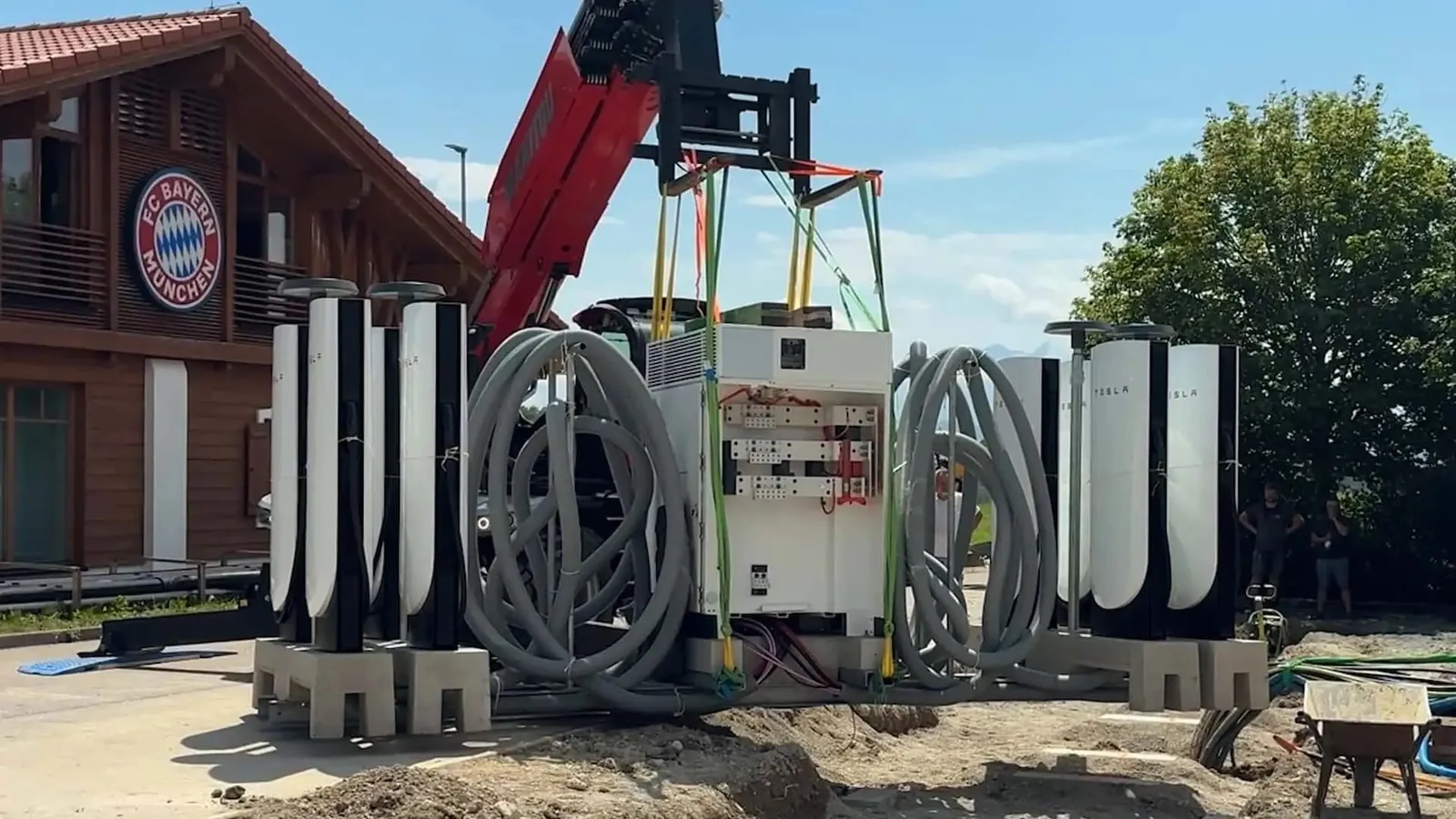
Tesla has deployed the first prefabricated Accordion Supercharger in Germany, which is a ready-to-use module featuring 8 charging stations, a V4 power cabinet, and wiring assembled in the factory. The company promises 20% lower installation costs and virtually immediate operation once the station is installed in place.
Table of Contents
Show
Hide
On paper, this sounds very promising. The problem is that Tesla needs such a shortcut not because it favors engineering tricks, but because the pace of Supercharger expansion has clearly slowed down.
What is an Accordion Supercharger
Tesla’s new module is a prefabricated charging station designed for parking lots where it’s not possible to place poles “behind the curb.” Instead of a traditional setup, the company arranges the charging stations between parking spaces in a foldable design similar to an accordion.
An such module contains 8 charging stations, a central V4 power cabinet, and a complete set of cables. Tesla states that one truck can deliver 2 sets, meaning 16 stations per shipment. On site, the entire unit is supposed to be quickly removed and installed using a forklift or a telescopic loader.
This is an expansion of earlier prefabricated Folding Unit Superchargers that Tesla demonstrated in the U.S. previously. Those solutions fit better in roadside settings. The Accordion is designed to address the more challenging scenario of shopping and urban parking lots, where chargers need to be fitted between rows of cars.
What exactly does Tesla promise?
The biggest advantages are cost and time. Tesla claims the installation is 20% cheaper compared to building a traditional station. The company also uses the term “instant commissioning,” meaning operation can begin almost immediately after installation and power connection.
It sounds ambitious, but one caveat is needed. “Immediate” doesn’t mean bypassing all the paperwork, wiring work, and excavation tasks magically. A site still needs to be prepared, high-power electricity needs to be supplied, and local procedures must be followed. The benefits lie elsewhere: less work on site, fewer individual installations, fewer tests, and a shorter stay for construction teams.
The hardware itself is also powerful. Tesla combines V4 dispensers with a V4 power cabinet capable of 1.2 MW, allowing the car to be charged at up to 500 kW. Of course, this is a peak value that depends on the vehicle and battery architecture. Most cars won’t utilize this full capacity, but the platform is ready for models that require higher power.
The first known location of such a station is in Irschenberg, Germany, near a FC Bayern store and adjacent to dining establishments. According to users’ reports and photos, the facility has been in operation since last month.
Our first Accordion Supercharger
Our goal is to pre-assemble all Superchargers in a factory. If we can’t install Superchargers behind curbs, we now have a pre-assembled solution for those placed between parking spaces.
16 stalls per truck shipment, 20% cheaper to install,… pic.twitter.com/KlmczpLoPR
— Tesla Charging (@TeslaCharging) September 15, 2026
Why is Tesla doing this?
The reason is simple: traditional DC station construction is expensive, slow, and full of minor issues. You have to dig, lay pipelines, pour foundations, install poles one by one, and wire everything in place. If most of this work can be shifted to the factory, scale plays a big role.
Tesla has been moving in this direction for years. As early as 2022, it boasted about very fast assembly of prefabricated stations, and in 2024 it talked about reducing installation time from delivery to operation to just 4 days and achieving cost savings of around 15%. Accordion is another step forward, only more tailored to parking lots that were previously less convenient for Tesla.
It’s hard to argue against this here. Prefabrication makes sense, especially for high-power charging, where every week of construction and every additional component on site increases costs.
The problem lies elsewhere. Tesla’s network has slowed down.
The new modules don’t appear as quickly as before. Tesla is now developing the world’s largest fast-charging network, but its growth rate isn’t as impressive as it was a few years ago.
By the end of Q2 2026, the company had 82,357 connectors at 8,704 stations. That’s still a massive scale. However, the year-over-year growth rate dropped to around 17%, compared to 35-45% annually during 2020-2021.
This is even more evident in quarterly additions. In Q2 2024, Tesla added only 2,017 new connectors, down from 2,687 in the previous quarter. Growth was uneven afterward: 1,821 in Q1 2025, a rebound to 3,865 in Q4 2025, followed by 2,236 and 2,439 in the first two quarters of 2026.
So the network is still growing, but not at the same rapid pace Tesla had accustomed the market to. This has a dual meaning, as Superchargers are increasingly opening up to cars from other brands.
The Shadow of Layoffs and Chaos in 2024
In the background lies Elon Musk’s decision in April 2024, when he laid off almost the entire Supercharger team, around 500 people, along with then-head Rebecca Tinucci. Some employees returned after a few weeks, and Musk also announced $500 million in spending on network development that year, but the gap in the organization was evident.
This is one of those decisions that, from the outside, look like shooting oneself in the foot. Superchargers had been Tesla’s strongest asset for years. If a well-oiled machine suddenly suffers such a blow, it becomes difficult to pretend nothing happened later.
The accordion feature can partially hide this mess. However, it won’t reverse two years of sluggish progress.
BYD Shows What Aggressive Expansion Looks Like
The most interesting comparison today isn’t between Ionity or Fastned, but rather BYD. From March to the end of August 2026, the Chinese company installed 10,000 stations for its flash charging system with capacities up to 1.5 MW in 325 cities across China. The goal for the end of the year is 20,000 stations.
If we assume 2 charging points per station, that amounts to around 40,000 charging points in less than a year. This is already close to half of Tesla’s global charging station count. Of course, the comparison isn’t perfect, as BYD operates mainly in China and its highest charging capacities are closely tied to compatible models from the brand. But the scale and speed are impressive.
This is where power comes in. Tesla claims 500 kW for the V4, while BYD states 1,500 kW. Again, this isn’t a simple “who’s better” test, as the charging curve, system voltage, and compatibility between the car and charger also play important roles. Nevertheless, Tesla’s marketing advantage in terms of infrastructure is no longer as undisputed as it used to be.
What does this mean for drivers in Europe?
For EV users, two things are most important. First, Accordion can accelerate the installation of charging stations in locations where parking arrangements previously made investment difficult. Second, lower construction costs can improve the viability of smaller or more challenging sites.
This could be particularly important in Europe, where many parking spaces near retail locations or in cities are simply too small and already designated for other uses. Tesla has not yet released a detailed rollout schedule, but the first facility in Germany suggests that Europe is indeed one of the natural markets for this design.
In Poland, the issue is similar. The more prefabricated an HPC station becomes, the greater the chance that the operator can move from planning to having a functional charger faster. However, everything still depends on power connections and local procedures. Just having the accordion design won’t solve these problems.
The Accordion Supercharger seems like a sensible solution to Tesla’s real-world challenges, but now the company must prove it can implement this solution on a large scale. What do you think — does Tesla’s engineering impress more today, or is BYD’s pace of building chargers more impressive?
Order your Tesla and take advantage of purchase bonuses using the referral link!