
Tesla Model 3 killed a driver after running over a pedestrian. Tesla’s data indicates that FSD or Autopilot was active
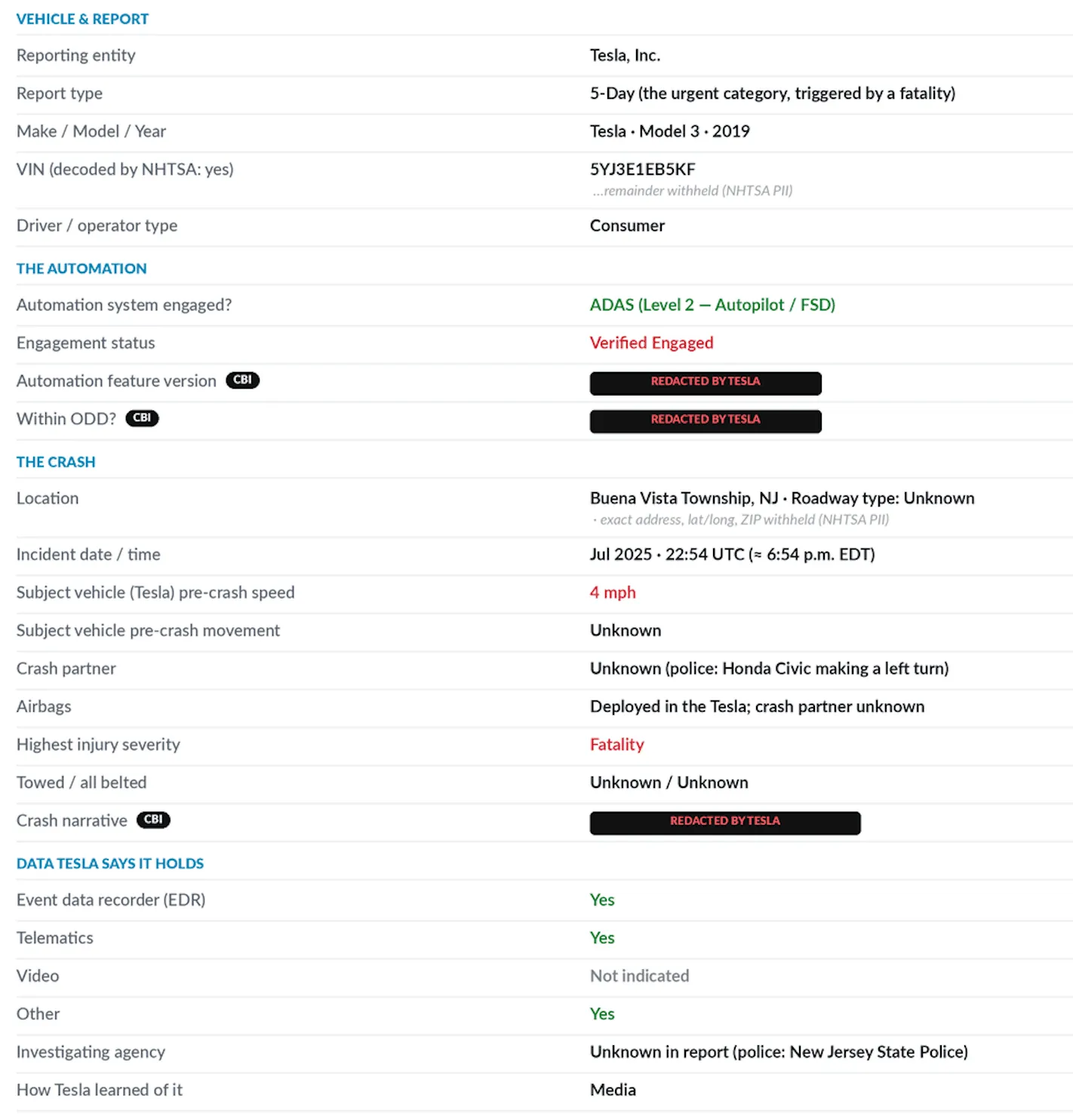
On July 6, 2025, at 18:57 in Buena Vista Township, New Jersey, a Tesla Model 3 ran a stop sign and collided with a Honda Civic that was turning left. Stephen Field, 82, died, and data submitted to NHTSA confirms that Tesla’s driver assistance system was active in the vehicle.
Electrek’s investigation is ongoing and has uncovered further issues with FSD. For Tesla owners, one thing is crucial today: the manufacturer has telemetry and event recorders, but it has obscured the fields that could explain what happened in just one sentence.
What is known from the NHTSA report
New Jersey police described the incident straightforwardly: The Tesla did not stop at a stop sign at the intersection of County Route 671 and Chestnut Avenue. The Honda driver died, while the Tesla driver and three passengers suffered moderate injuries and were taken to the hospital.
It is only Tesla’s report to U.S. regulators that provides more details. The company stated it involved a 2019 Tesla Model 3, labeling the automation status as “Verified Engaged,” meaning the system was active and confirmed via the car’s telemetry. The report also mentioned a fatality and that Tesla had both EDR data and vehicle telemetry.
The problem is that the three most relevant fields were redacted as trade secrets. The description of the incident, software version, and information about whether the road was within the system’s permitted operating area were missing. Electrek claims Tesla does this in 99.9% of its reports.
More FSD than regular Autopilot, but without certainty
This is where the second thread begins. The regular Autopilot is a highway system and does not respond to STOP signs. Reading the sign and deciding to stop is a function of urban driving, which falls under FSD’s domain. Therefore, an active system in a car that went through a STOP sign suggests FSD rather than the basic Autopilot.
However, there is no certainty. There have been cases where drivers activated the regular Autopilot in situations where it should not have worked, and the car simply drove straight through an intersection. Either way, this is a poor choice for Tesla: either the system was used outside its intended scope or the “Full Self-Driving” system the company sells is actually in use.
There is one more detail: Tesla recorded the speed before the collision at 4 mph, or about 6.4 km/h. This appears more like a vehicle rolling to a stop after hitting a STOP sign rather than entering an intersection at high speed. A similar behavior was already the subject of corrective action in 2022, when NHTSA pressured Tesla following issues with FSD’s “rolling stop” problem in around 54,000 vehicles.
However, this 4 mph figure does not perfectly align with information about the fatal outcome, injuries in the Tesla, and the deployment of airbags. It is possible that this is merely a reading from a moment before the crash, not the speed at the time of impact. It is precisely this that the incident report and full EDR data should clarify. The problem is that Tesla hid them.
Electrek matched the incident based on location, month, model, victim, and time. Tesla’s report shows 22:54 UTC, which is 18:54 local time, just 3 minutes after the police timestamp of 18:57. This was the only fatal accident involving a Tesla in that municipality that month.
Tesla still sells FSD as an L2 system, so technically the driver is responsible. However, marketing has long outpaced technology in this regard. Will regulators eventually force the company to disclose more data about such incidents?
Order your Tesla and take advantage of purchase bonuses using the referral link!
LovEV Newsletter
Want more content like this?
Sign up — we’ll send you a weekly summary once the newsletter starts.