
Tesla FSD in Bratislava: 32 minutes on a difficult route with several driver interventions
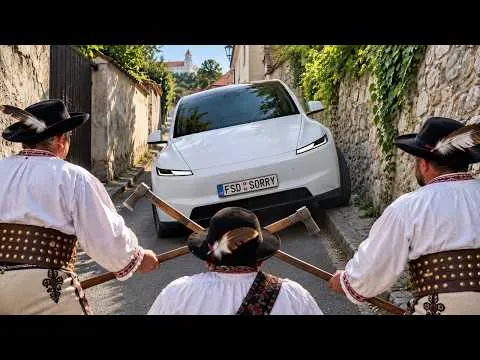
The robot*irl channel posted a 32-minute video of a Model Y driving with FSD through Bratislava. The route was chosen by local viewers, so it features steep hills, narrow streets, and awkward intersections. The car performs several tasks excellently, but the driver takes over the steering a few times and describes one situation as his worst experience with FSD.
The start is promising. Tesla turns very well around tram tracks, then navigates narrow streets on the hill, gives way to people near parked cars, and handles tight turns well. There are brief decelerations, which the host explains as being caused by a red turn signal intended for another lane.
Where the driver had to intervene
The first takeover occurs when Tesla tries to turn onto a street that the driver believes is off-limits. This is an intervention for legal reasons, not safety concerns. The car should still obey the rules.
On a steep dead end, Tesla begins to back out, but the driver worries about the clearance at the front corner and finishes it manually. He later admits that FSD would likely have handled it better. It’s no wonder he was nervous, as new Teslas rely solely on cameras for tight maneuvers, without the ultrasonic sensors that all other cars have.
The second dead end reveals a navigation error. After reaching an intermediate point, Tesla wants to continue down the same street once the route resumes. The driver turns manually to avoid having to reverse a long distance. The car reached the point, but had trouble exiting.
On the narrow passage, an arrow clearly indicates which way to drive, but Tesla chooses the other side several times. The driver turns off the system and steers the car manually. However, the biggest issue is the “vibration” of the steering wheel, which appears multiple times in the footage, especially when the car is unsure about which lane to take.
There are also strong moments. Tesla yields to a dog, reverses to make room for an oncoming Mercedes, and calmly drives down the seemingly dangerous slope. It also squeezes through an exceptionally tight gap next to a car with a trailer, and the driver comments on it as if landing an airplane.
This is a more difficult test than the September drive by the same driver through Aarhus in Denmark. There, Tesla handled cyclists, pedestrians, and café patrons well on the narrow cobblestone streets, with only minor mistakes. The drive in Brussels had mixed results: traffic and intersections were handled well, but maneuvering on the wrong lane ended in loss of control.
European rollout and new name
The European path for FSD began in April with approval from the Dutch RDW, after over 18 months of evaluation. Other countries may grant this approval individually, while broader EU authorization will go through a separate process. Tesla lists availability in ten European countries today, including Slovakia and Latvia. The system remains unavailable in another 17 EU nations.
Some authorities keep asking questions. Sweden has questioned the possibility of exceeding speed limits, while Finnish officials inquired about performance on snow and ice. Regulators also pointed out the driver’s attention requirement and whether the name promises too much.
Germany supported broader European approval after discussions with Tesla, agreeing that the deviation from speed limits would be limited to 10%. However, the country’s transportation ministry deemed the name “Full Self-Driving” misleading and emphasized that the driver must remain vigilant and responsible. Tesla proposed an alternative term already used by the German side: “Tesla Assisted Driving.”
Given this video, this name seems more honest than the previous one.
Order your Tesla and take advantage of purchase bonuses using the referral link!
LovEV Newsletter
Want more content like this?
Sign up — we’ll send you a weekly summary once the newsletter starts.