
Tesla FSD v14.1 Lite drove over a log at 51 km/h. HW3 continues to show its limitations.
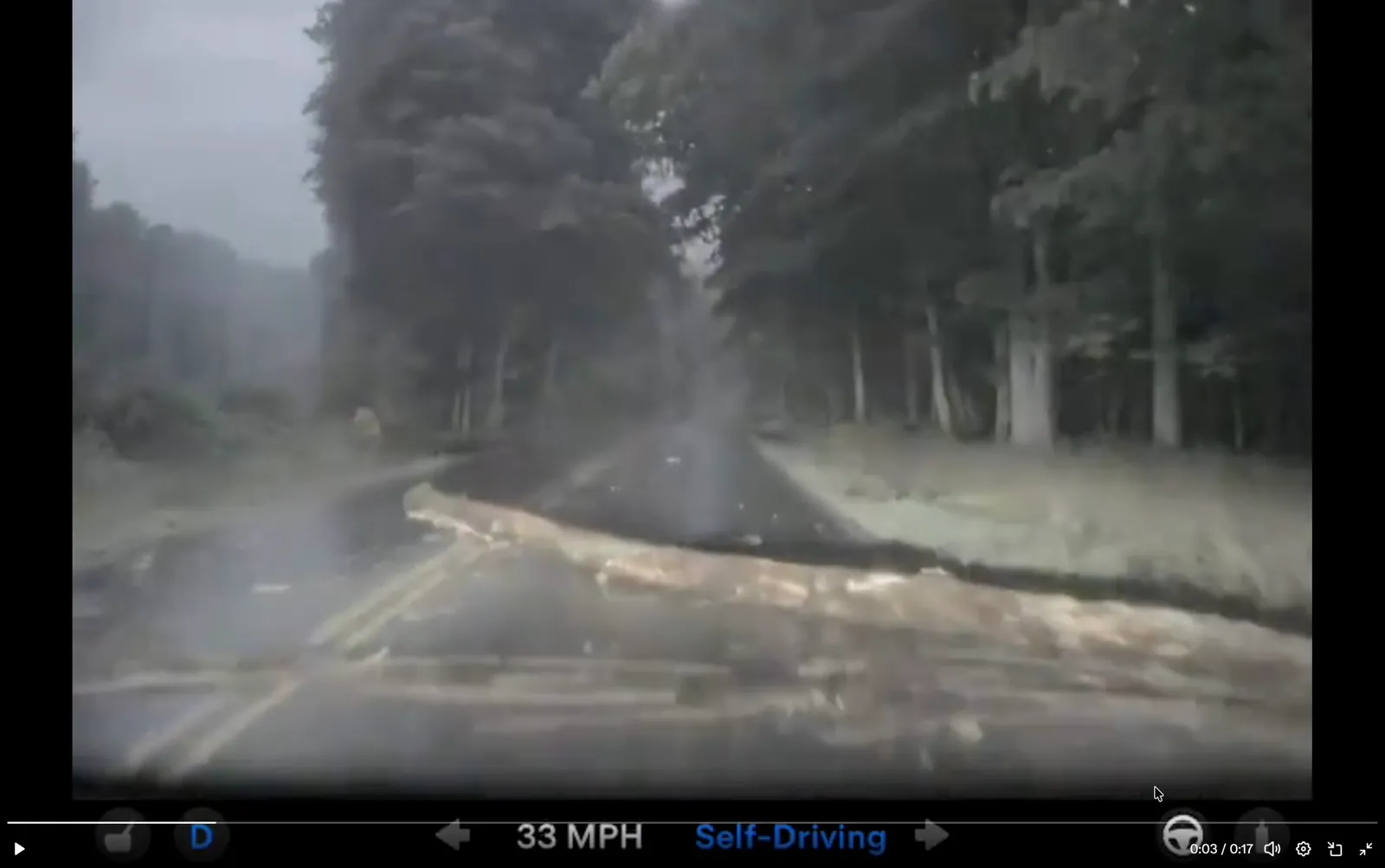
The Tesla with FSD v14.1 Lite drove straight over a log lying across the road without braking. The video, posted on August 21 by user @donvarri, has already received over 800,000 views, showing the car traveling on a wet, foggy road at 32 mph, or about 51 km/h.
This doesn’t seem like an isolated incident. It’s another sign that the reduced version of FSD for Hardware 3 cars still has issues, even though Tesla has released the newer v14.1 Lite build.
What’s visible in the video and why it hurts Tesla
The footage shows the “Self-Driving” visualization active. The car is on a rural road under poor conditions, but the obstacle isn’t tiny at all. A log lies across the road, and the Tesla doesn’t brake or swerve—it simply drives over it.
The owner wrote briefly: “My car drove over a log on the road; it definitely wouldn’t have stopped.” He then clarified that it was a car with Hardware 3 and the latest v14.1 Lite.
Here we come to the core issue. FSD v14 Lite is a compressed version of the HW4 model, run on an AI3 computer with 8 GB of RAM and roughly 1/8 the processing power of newer hardware. Tesla began rolling out this version to HW3 in June 2026. On paper, it’s feasible. In practice, however, it appears to be a compromise.
HW3 overheats, disconnects, and still falls short of promises
Since June, users have reported overheating in HW3 computers under heavy load. The APP_w141_ECU_Thermal_Issue error appeared when temperatures exceeded 90 degrees Celsius, and in some cases, temperatures reached up to 96 degrees. There were also “red hands,” meaning forced takeover of control, and several computers completely shut down, requiring replacement.
In addition, there were reports of phantom braking, system hesitation, and sudden brake pulls. Tesla released v14.1 Lite partly to address the temperature issue. The incident with the log happened on this updated version already. Not good.
The second issue is even more problematic for Tesla. The company sold around 4 million cars as “full self-driving capable,” with the package costing up to $15,000. At the same time, it admitted that HW3 cannot achieve fully autonomous driving without supervision, and there is still no clear plan to reach this goal.
In the comments, some people blamed the driver. And technically they are right, as it’s still a level 2 system. The car owner himself put it best: “Two things can be true—I should have been paying attention, but the car definitely should have stopped.”
And that’s exactly where the trap lies. The better FSD performs in 95 percent of normal driving situations, the more easily drivers let their guard down. Then the car fails to react to things that a human would notice much earlier. The system itself makes its supervisor lazy.
If someone bought a Tesla with HW3 expecting “full autonomy,” they now end up with an increasingly clever assistant but a hard hardware ceiling. What do you think? Should Tesla refund FSD money to HW3 owners, or find another way to solve the problem?
Order your Tesla and take advantage of purchase bonuses using our referral link!
LovEV Newsletter
Want more content like this?
Sign up — we’ll send you a weekly summary once the newsletter starts.