
Tesla delivered 486,532 cars in the third quarter and improved its margins, but earned 43% less revenue
Tesla concluded the third quarter of 2026 with results that revealed two distinct trends. The company managed to maintain its revenue and improve its gross margin, but its net profit was significantly lower. Meanwhile, it continued to invest in artificial intelligence, autonomous driving, and robotics—areas it hopes will expand its sources of revenue.
Revenues reached 24.965 billion euros, with little change compared to the same period in 2025. However, net profit was only around 701 million euros, a 43% decrease.
The automotive business remains Tesla’s main source of revenue. It contributed approximately 18.302 billion euros, although its sales volume declined by 3% on a year-over-year basis. Deliveries totaled 486,532 units, 2.1% less than the previous year but 1.3% higher than in the second quarter. The result exceeded expectations, which had forecast around 460,000 units.
Indicator
Third quarter of 2026
Year-over-year change
Total revenue
24.965 billion euros
Practically stable
Attributed net profit
701 million euros
−43%
Automotive revenue
18.302 billion euros
−3%
Deliveries
486,532 cars
−2.1%
Group gross margin
19.6%
+1.6 percentage points
FSD paid active users
1.74 million
+67%
The improvement in margins deserves attention. The group’s gross margin rose to 19.6%, while the automotive segment’s reached 18.5%. Excluding revenue from regulatory credits, the latter stood at 18.1%. Tesla thus achieves a higher gross margin relative to its revenue, but this improvement does not translate to the bottom line with the same intensity.
The explanation lies in operating expenses, which increased by 39%. Operating income dropped by 56%, leaving its margin at 2.6%. The difference is significant: gross margin does not account for all the costs required to run the company and develop its next products.
Despite that pressure, Tesla generated around 1.363 billion euros in free cash flow during the quarter, although that was 62% less than a year earlier. This is a useful indicator to track how much money the company has left after making investments, especially at a time when it is funding multiple projects simultaneously.
FSD grows by 67%, while Optimus and Robotaxi live up to their promises
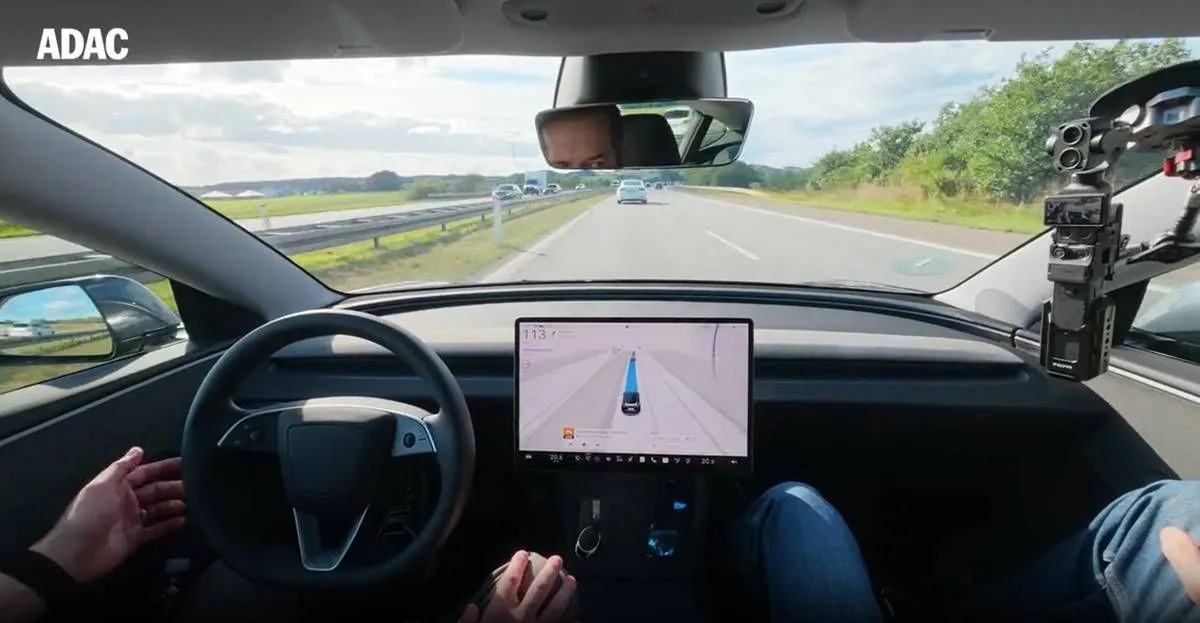
The company also claims that over 75% of new deliveries in North America come equipped with FSD. This figure reflects its growing commercial significance, though it refers only to that market and recent deliveries, not all Teslas in use. FSD Supervised still requires active driver supervision.
During the presentation, Elon Musk once again defended the system’s technological approach, and Tesla stated it continues to work with Chinese authorities to obtain broader approval. Such expansion could increase its potential market, but it depends on the necessary approvals.
Meanwhile, Optimus has begun production in Fremont, according to the company. The start of manufacturing does not mean it will be available for sale to external customers immediately: Musk set the first deliveries to companies outside Tesla around late 2027 and acknowledged that there is still work to be done for the robot to handle ongoing tasks with sufficient capability.
The initial uses would focus on industrial environments. Its arrival in homes would come at a later stage, once scale increases and the technology matures. For Tesla’s accounts, this means the project will still require further development before it can demonstrate significant commercial value.
Regarding Robotaxi, Musk announced plans to launch the service in Dallas in November before expanding the same software to other cities. Once again, this is based on the timeline set by the executive, whose adherence will need to be monitored in the coming months.
The presentation also included a corporate announcement: Tesla and SpaceX have formed committees of independent directors to explore a potential merger. Musk explained that he does not participate in their discussions due to a conflict of interest and made it clear that the deal is not yet decided, although he personally considers it a good idea.
The results show a company that maintains its revenue volume, improves its gross margin, and expands its FSD customer base, but earns significantly less. The challenge will be to turn that growth in software and investments in new businesses into sufficient profits to offset the pressure on its accounts.
Source | Tesla