
Tesla Cybercab: New details on the battery, propulsion, and the unusual production process.
We have recommended the YouTube channel Munro Live here several times already. Unfortunately, lately the channel often focuses on topics other than electric cars. But with a video about the Tesla Cybercab, the U.S. engineering company has once again delivered a masterful piece. Tesla engineers explain the Tesla Cybercab in it — not the autonomous driving technology, but rather production, batteries, and propulsion.
Tesla’s chief engineer Lars Moravy, the Cybertruck’s development lead Eric Earley, and other experts are surprisingly open about the technology. The video, shot at the Gigafactory in Texas where the Tesla Cybercab is built, is almost an hour and a half long and is in English. We have compiled the most interesting insights.
Unboxing Process | Battery/BMS | Thermal Management/Propulsion
Image gallery: The Tesla Cybercab in its first live encounter with a seat test
Unboxing process
First, we look at the unboxing process, namely the special manufacturing method for this model that Tesla has been talking about for a long time. The basic idea is that work can be done on individual body parts simultaneously, which is supposed to improve the workflow. For example, robots can work on the front module from all four sides at the same time. The number of workstations is said to have dropped significantly compared to the Model Y, to just 25.
Part of the unboxing process is also Gigacasting, a technique already used in other models, which involves pressure casting to produce unusually large body parts. With the Cybercab, Tesla takes this approach to its extreme: the car consists of one large cast aluminum part for the front underbody and another for the rear underbody. These parts are manufactured in a single casting process. In addition, there is the central section containing the battery and seats, along with doors that are designed as sliding doors in the Cybercab — mainly because it’s cool, as the video states.
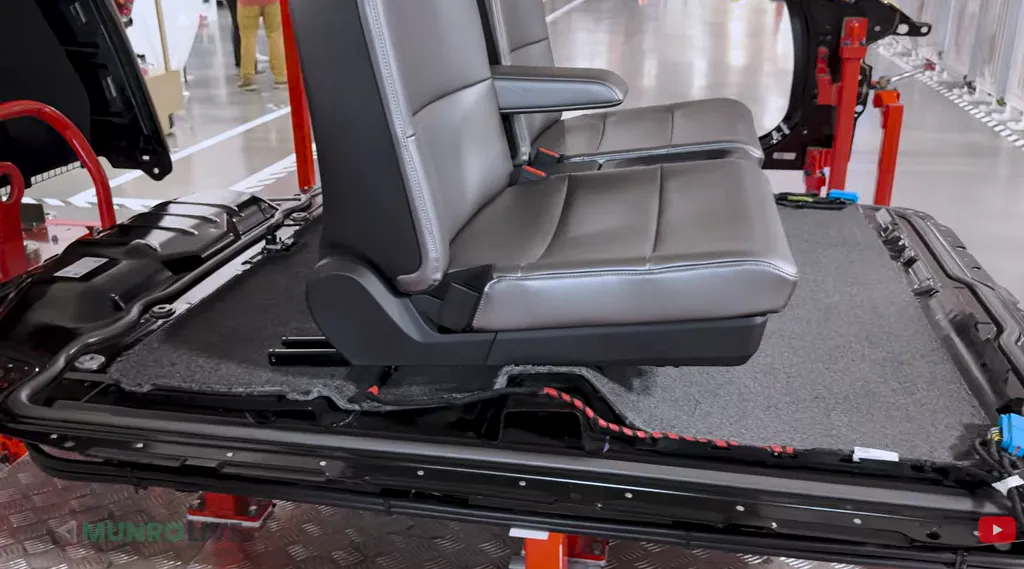
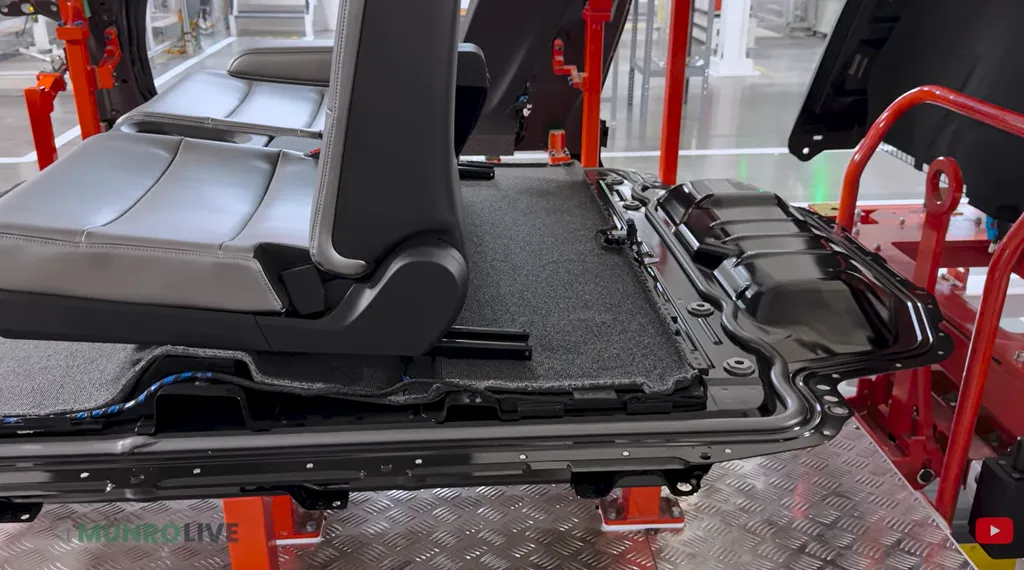
The two seats are screwed directly onto the battery
Image source: Munro Live (YouTube)
Tesla uses the same method as with the Cybertruck for installing the seats: they are screwed directly onto the battery pack. After that, the battery is placed into the chassis from below — avoiding the need to awkwardly maneuver it through the doors later.
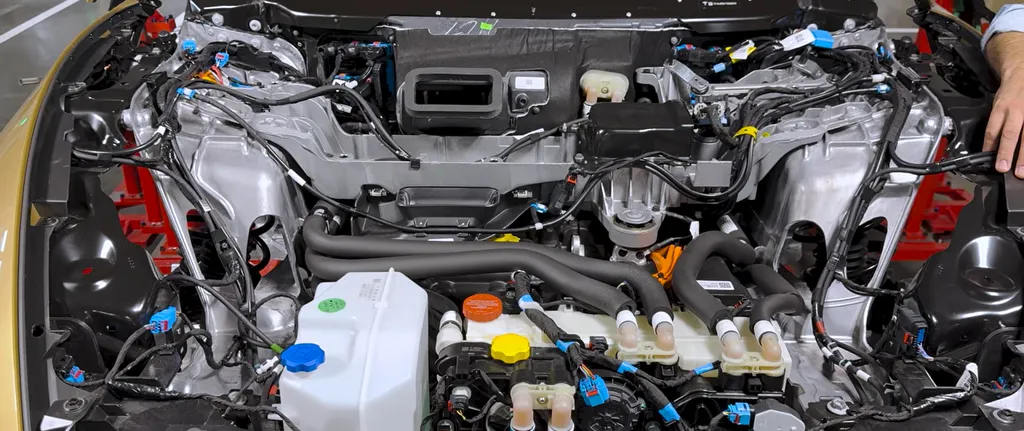
The front vehicle with thermal management at the very front
Image source: Munro Live (YouTube)
In the packed front compartment, alongside a small 48-volt battery and the thermal management system, the main component is the drive system — since the Cybercab is a front-wheel-drive vehicle — along with the inverter. The inverter is designed to be repairable without the need to disassemble the entire car. As a result, components like the thermal management system along with the air conditioning compressor can be easily removed, allowing access to the inverter from above.
Another key concept is modularity. This allows individual modules to be tested before being installed in the car. Additionally, Tesla avoids using high-voltage wires to connect to many components in the front compartment; instead, these are connected via the inverter.
Due to the low front hood, the shock absorbers were installed at a slight angle rather than vertically. The Cybercab also features Tesla’s first brake-by-wire system, allowing the brakes to be tested separately. This also eliminates the need for hydraulic lines.
Another simplification is that Tesla avoids traditional painting. Since large parts of the exterior are made of plastic, color pigments are directly incorporated into the plastic.
Battery and BMS (starting around 25 minutes)
The Cybercab is powered by a 48-kWh battery pack, as is well known. Like the Cybertruck and Semi, it consists of cylindrical 4680 cells. The battery configuration is 88s6p, as battery expert Robbie explains in the video. This means it consists of six groups connected in parallel, each with 88 cells connected in series. In total, this amounts to no less than 528 cells.
The cells are not firmly bonded with foam like in the “structural battery” of the formerly offered Model Y with 4680 cells, but are instead housed in four modules that are installed longitudinally. Part of the energy from a crash is absorbed by the battery’s steel casing and part by the modules. That’s why Tesla experts refer to this battery as “semi-structural.” As a result, the energy density decreases by about ten percent, but individual modules can be replaced.
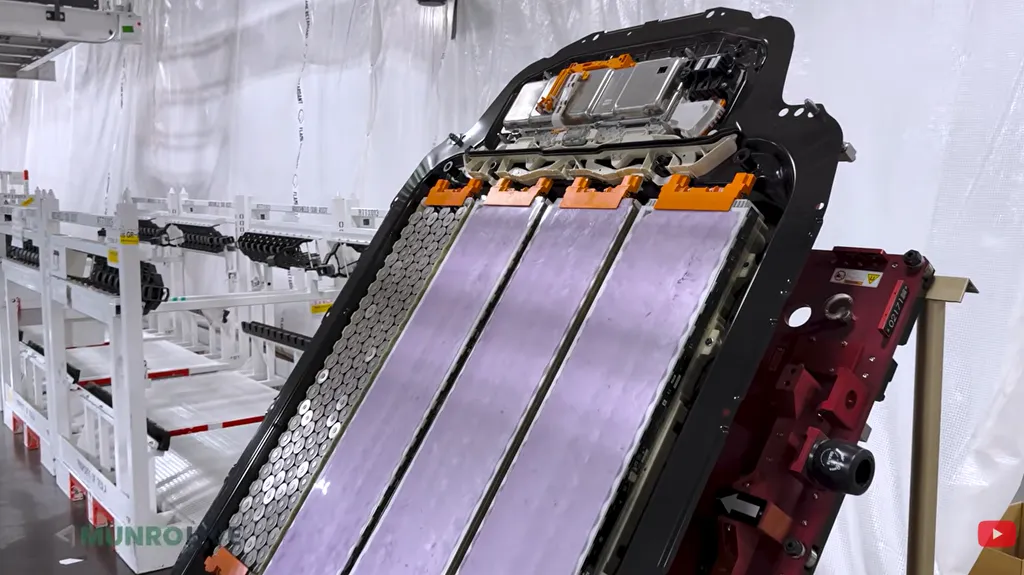
The battery consists of hundreds of cylindrical cells
Image source: Munro Live (YouTube)
Another innovation of the Cybercab is the absence of a wiring harness inside the battery — communication with the battery management system is done wirelessly via radio. Additionally, the battery management system is not located on top of the battery like a “penthouse” but behind it, at the same level, allowing it to be replaced from below. Experience shows that electronics tend to fail more often than the battery itself. Moreover, Tesla can do without a pyrotechnic safety device for the battery, as the electronics can cut power to it just as quickly.
The battery management system is located behind the battery, not on it
Image source: Munro Live (YouTube)
Thermal management and propulsion (starting around 42 minutes)
On the topic of efficiency, one of the engineers says that tires are usually the most important factor, followed by aerodynamics (with these factors swapping order at high speeds), and thirdly thermal management and climate control. For the heat pump, Tesla uses a pure ethylene glycol system. A conventional refrigerant cycle using a refrigerant like R1234yf or CO₂ is not used. Additionally, the climate compressor has been integrated directly into the thermal management system, eliminating heat loss through pipes.
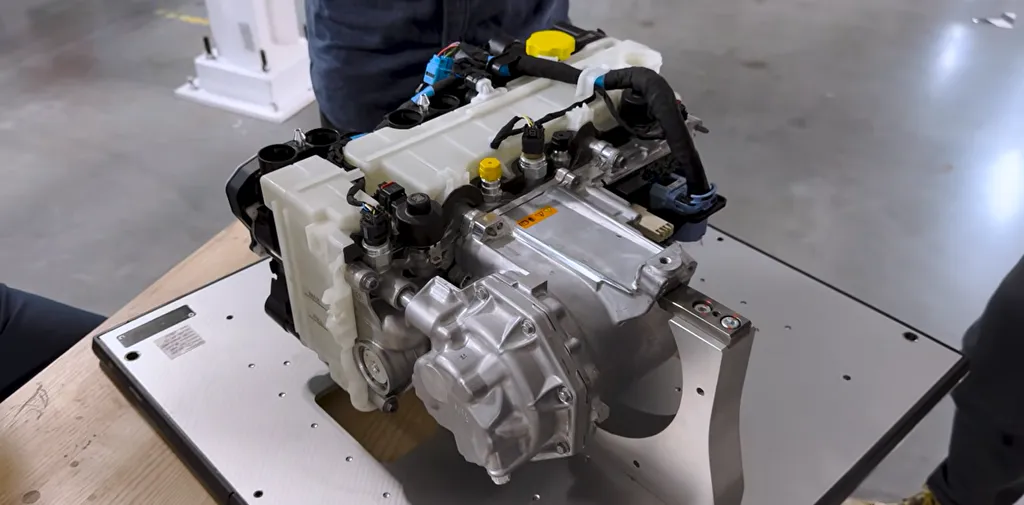
The Cybercab’s Thermomanagement
Image source: Munro Live (YouTube)
The Cybercab’s 163 kW front-wheel drive system is installed vertically. One notable feature is that the inverter is placed in front of the motor, on the side farthest from the cabin. This arrangement helps reduce vibrations. It also simplifies inverter maintenance and ensures a short connection to the thermomanagement system.
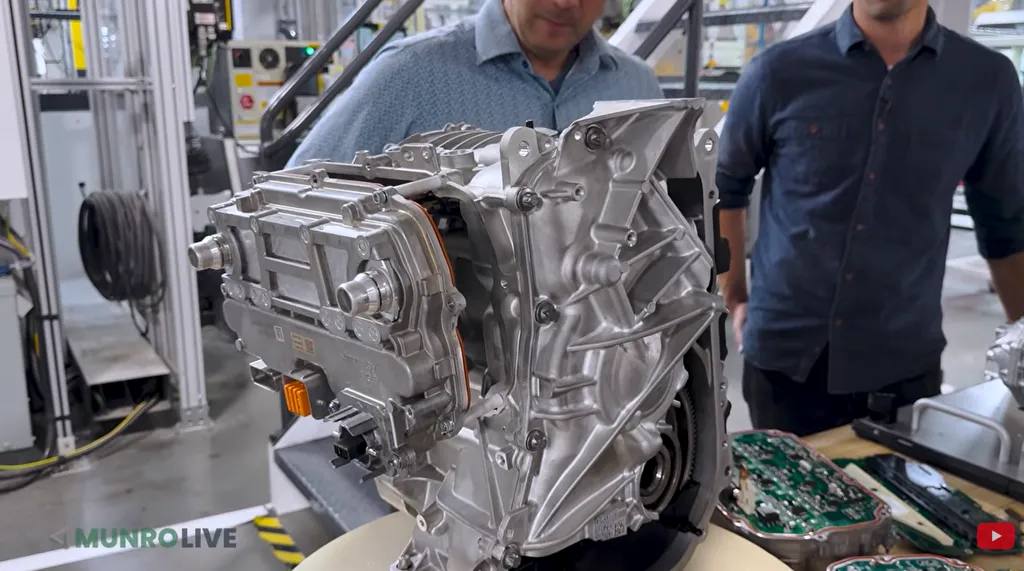
The inverter is the rectangular component on the left; it is located on the front side of the motor
Image source: Munro Live (YouTube)
Since the Cybercab generally moves at a low speed, the reduction gear ratio has been shortened: while most Tesla models use a ratio of 9, this model uses 11. The motor is still oil-cooled, but the cooling channels are now located in the stator housing’s aluminum rather than in the electrical housing. The inverter is water-cooled. The oil pump operates mechanically here, rather than electrically like in other Tesla models. This means the pump is driven by the rotating motor parts.
More on Tesla:
In summary
In the new Munro video, there are engineers talking among themselves. They use many abbreviations such as GA, GD&T, or IML and don’t always remember to translate them for the audience. We tried to make sense of as much of this jargon as possible, but experts will surely find even more interesting things in the video. If you have the time, watch it—it’s educational even if you don’t understand everything.