
Tesla Confirms October 1 Roadster Reveal After Years of Delays
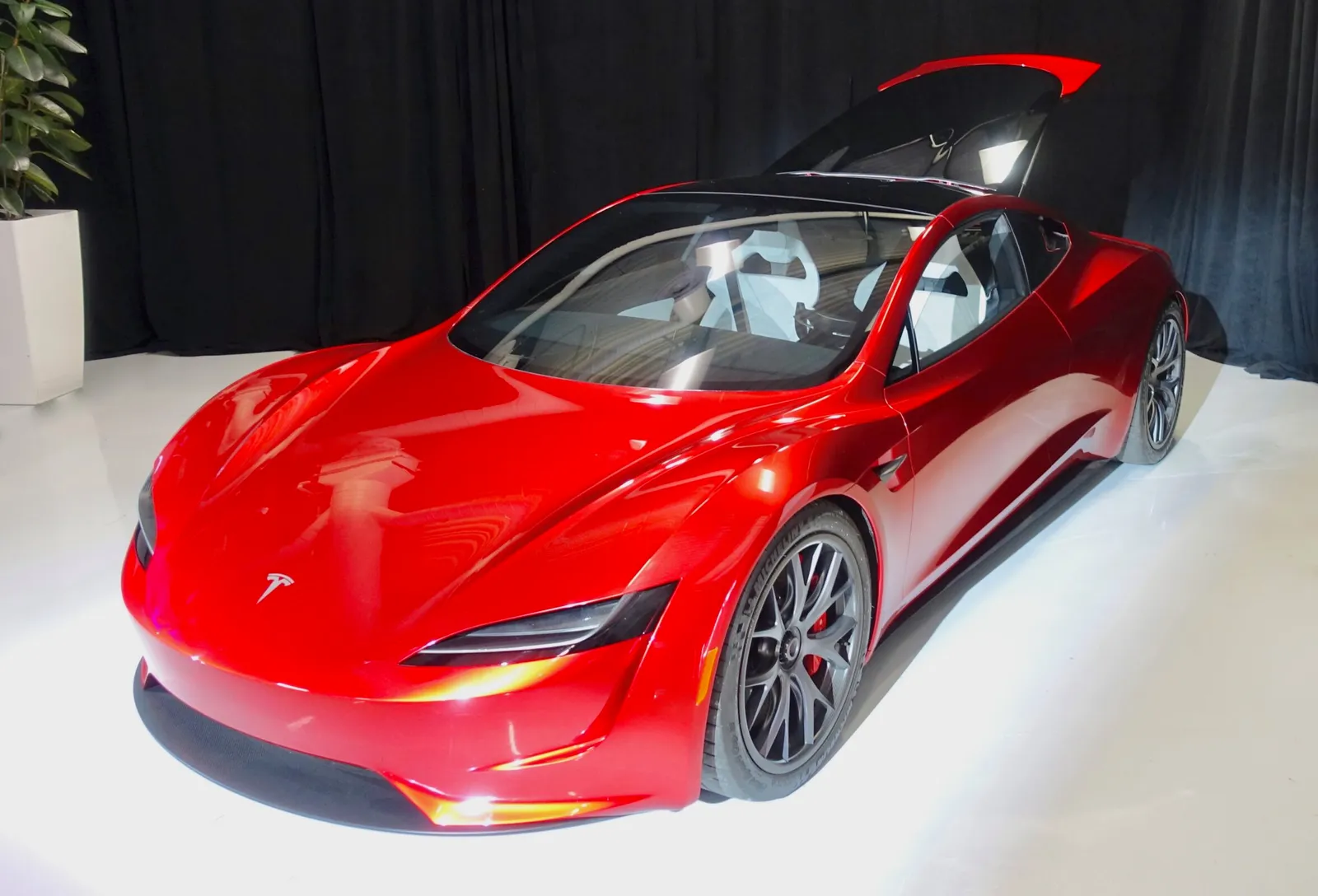
Tesla has finally put a date on the long-awaited return of the Roadster, with the electric car maker teasing an event on 1 October 2026 under the distinctly appropriate slogan “Go for launch”.
The announcement appears to confirm that Tesla will unveil the latest version of its second-generation Roadster next month, almost nine years after the electric supercar was originally revealed. However, anyone hoping to take delivery shortly afterwards may still have a considerable wait ahead of them, with Tesla CEO Elon Musk previously indicating that production could begin 12 to 18 months after the final vehicle is demonstrated.
Tesla announced the October date with a cryptic image posted to social media showing what appear to be four jets or thrusters firing, accompanied by “10.01” and the words “Go for launch”. The company has also directed attention towards the Roadster section of its website, making the identity of the forthcoming vehicle considerably less mysterious.
The imagery is particularly significant because Musk has repeatedly claimed that an optional “SpaceX package” could use rocket technology to give the Roadster extraordinary performance. The system has previously been described as using cold-gas thrusters positioned around the vehicle to improve acceleration, braking and cornering.
More extravagant claims from Musk have suggested the technology could even allow the car to fly – or at least leave the ground temporarily.
Exactly what Tesla will demonstrate on 1 October remains unknown. The company has yet to publish a conventional specification for the new production-intent car or provide a firm manufacturing date. So although some reports are describing 1 October as the Roadster’s “launch”, it would be more accurate for now to regard it as a reveal or demonstration rather than the start of sales or customer deliveries.
It will nevertheless be an important moment for a vehicle that has become almost legendary for the length of time it has spent waiting in Tesla’s wings.
The second-generation Roadster first appeared in November 2017, emerging dramatically from the back of a Tesla Semi during the truck’s unveiling event. At the time, Musk promised specifications that sounded almost implausible by the standards of contemporary electric cars.
Tesla claimed the Roadster would accelerate from 0-60mph in 1.9 seconds and reach 100mph in 4.2 seconds, with a quarter-mile time of 8.8 seconds and a top speed exceeding 250mph. A huge 200kWh battery was supposed to provide around 620 miles of range.
The car was also designed as a 2+2 rather than a conventional two-seat supercar, while a removable glass roof panel could be stored in the boot.
Remarkably, nearly nine years later, Tesla's current Roadster website still lists the headline figures of 1.9 seconds to 60mph, more than 250mph and 620 miles of range.
Back in 2017, Tesla said the Roadster would enter production in 2020. The proposed base price was $200,000, with buyers able to reserve one for $50,000. Tesla also announced a run of 1,000 Founders Series cars costing $250,000 each, for which customers were initially asked to pay the entire amount up front.
Needless to say, 2020 came and went without a production Roadster.
The project has subsequently been delayed repeatedly as Tesla concentrated on other vehicles and technologies, including the Model Y, Cybertruck, Semi and, increasingly, autonomous driving, Robotaxi and artificial intelligence.
Yet Musk has continued to insist that the Roadster remains under development. The scope of the project also appears to have expanded considerably beyond that of the already extremely rapid car shown in 2017.
At Tesla's November 2025 shareholder meeting, Musk said a production version would be demonstrated on 1 April 2026, with manufacturing expected approximately 12 to 18 months later. That April date subsequently slipped as Tesla continued development and testing.
The new 1 October announcement is therefore significant because it comes directly from Tesla rather than being another approximate date mentioned by Musk during an interview or earnings call. Tesla's teaser explicitly gives the date and the “Go for launch” message, strongly suggesting the company is finally ready to show what the Roadster has become.
There is also good reason to expect something rather more dramatic than another static supercar unveiling.
Musk has spent years increasing expectations surrounding the Roadster's performance. In 2018 he first discussed a SpaceX option incorporating around 10 small rocket thrusters, using highly compressed air rather than combustion. He subsequently suggested this could dramatically improve acceleration, top speed, braking and cornering.
More recently, Musk has made even more ambitious claims about what the finished vehicle could do, including repeatedly discussing some ability to fly.
The imagery used for the October announcement certainly appears designed to encourage that interpretation. The teaser seemingly depicts four thruster plumes firing behind the vehicle, while the phrase “Go for launch” borrows terminology more commonly associated with spacecraft than sports cars.
Whether the resulting technology will be remotely practical for a road-going production car is another matter. A demonstration vehicle can incorporate systems that would be considerably harder to homologate for use on public roads, particularly where high-pressure gas propulsion and the possibility of the vehicle leaving the ground are involved.
Tesla also faces a very different performance-car market from the one into which the original prototype was unveiled.
In 2017, a sub-two-second 0-60mph time sounded revolutionary. Today, extremely rapid electric cars from manufacturers including Rimac, Lucid and Porsche have substantially moved the goalposts, while Tesla's own Model S Plaid has demonstrated how brutally fast a relatively conventional electric saloon can be.
That means the Roadster needs to do considerably more than simply deliver the performance Tesla promised nine years ago if it is to have the same shock value.
Tesla clearly appears to understand this. The Roadster has gradually evolved from a very fast electric supercar into something Musk has described in terms closer to a technology showcase. The apparent involvement of SpaceX-derived concepts would provide precisely the kind of headline-grabbing capability needed to differentiate it from the growing ranks of electric hypercars.

But there remains an important distinction between what Tesla demonstrates on 1 October and what customers will eventually be able to buy.
If Musk's previous estimate of 12 to 18 months between demonstration and production remains valid, manufacturing might not begin until late 2027 or potentially 2028. Considering the Roadster's history of delays, even that timeframe should probably be treated cautiously.
There are also major unanswered questions surrounding the battery, range, charging system, price and availability of the production car. The original $200,000 starting price is no longer displayed on Tesla's current Roadster page, even though the old performance figures remain.
But after almost nine years, the Roadster finally has another firm date with the public.
On 1 October, we should discover whether Tesla has simply updated one of the most famous electric car prototypes of the last decade – or whether Musk really is preparing to blur the boundary between electric supercar and rocket ship.