
Tesla wants FSD across the entire European Union. Is a key vote on October 6?
In short:
Tesla is pushing harder for broader rollout of FSD in Europe
The system is available in five EU countries, used by 70,000 drivers
The American company is releasing data to convince European regulators
Goal? To expand approval across the entire Union, including Poland
Cars with FSD are involved in collisions 4.1 times less often than manually driven Teslas, claims the manufacturer
October 6 of this year could prove to be a significant day for Elon Musk’s company
Tesla wants more
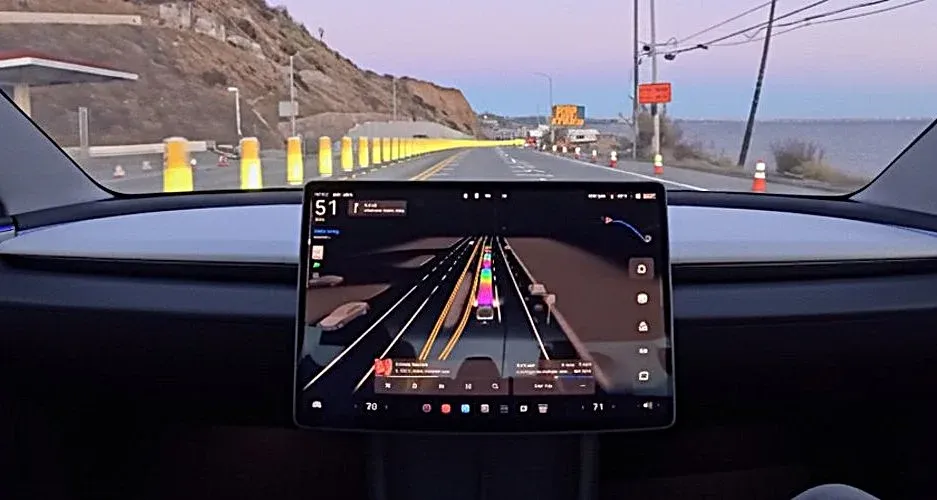
Tesla has released a new dataset related to the safety of FSD (Supervised). The system’s name alone can be misleading. Full Self-Driving could be translated as “full autonomous driving,” but the “Supervised” qualifier is what matters most here: the driver must continuously monitor the road, remain ready to react immediately, and still bear responsibility for driving.
FSD can take over many tasks that are normally performed by a human. The car is capable of maintaining its lane and speed, changing lanes, reacting to other vehicles, navigating intersections and roundabouts, or selecting appropriate exits. However, it remains a level 2 driver assistance system rather than an autonomous one.
Five EU Countries with FSD
A breakthrough came in April 2026 when the RDW approved FSD (Supervised) for use in the Netherlands. The RDW tested the system for over 18 months, both on test tracks and public roads. It also analyzed Tesla’s data and independently verified the statistical methodology used.
The approval in the Netherlands currently has a limited scope, but it has also been accepted by Denmark, Belgium, Estonia, and Lithuania. Tesla claims that over 70,000 European customers are already using FSD, covering more than 1 million kilometers per day in total. Poland is not on this list.
Tesla: 4.1 times lower collision risk
According to Tesla, over 100 million kilometers driven on EU roads, vehicles using FSD (Supervised) were involved in collisions 4.1 times less frequently than Tesla vehicles driven manually.
This is data from the manufacturer itself and compares FSD to manual driving of Tesla vehicles, not to overall European traffic.
Tesla also released a broader set of data it had previously provided to EU countries. According to an analysis from 2025, FSD was supposed to reduce the number of serious collisions by 45% on highways compared to driving Tesla manually, 69% on main roads, 50% in cities, and 40% on local roads.
In the same comparison, the number of automatic emergency braking activations was 74-84% lower, while sudden braking incidents occurred 81% less frequently.
Lane changing was to be one of the system’s strengths
A separate analysis covered over 377 million lane changes. Tesla claimed FSD reduced the number of minor collisions during lane changes on highways by 99%, and outside highways by around 93-95%, depending on the data set.
The manufacturer also analyzed driver fatigue. On highways with FSD activated, there were 67% fewer incidents indicating fatigue compared to driving manually.
This specific measurement comes from North America, so not all of the data used by Tesla as an argument in Europe is European.
1.6 million km of European testing
Tesla also conducted tests directly in Europe. The vehicles traveled approximately 1.6 million km in countries such as Germany, the Netherlands, Spain, France, Italy, Switzerland, and Finland. According to the manufacturer, not a single serious or minor collision caused by the system was recorded over this distance.
Separate scenario tests were carried out in cities including Amsterdam, Barcelona, Rome, Paris, Munich, and Copenhagen. In total, over 230,000 tests were conducted involving intersections, roundabouts, pedestrian crossings, traffic lights, and bike lanes. Tesla claims that the system’s effectiveness remained around 98% even in rain, fog, day, and night.
The issue is regulations, not just technology
Tesla cannot simply enable FSD for all European customers through a software update. The legal basis is UN Regulation No. 171 regarding DCAS systems. Tesla has adapted the European FSD to comply with these regulations, but some of the system’s behaviors still exceed the standard framework.
The company therefore uses the procedure outlined in Article 39 of the EU Regulation 2018/858. This allows new technologies to be approved if the manufacturer demonstrates that they provide at least the same level of safety as the requirements from which an exemption is sought.
It is on this basis that the Netherlands temporarily allowed FSD in its territory, and four additional countries voluntarily recognized this decision.
October 6 could be crucial
Tesla states that a vote on permitting the solution across the entire EU could take place on October 6, 2026. As a result, the company has decided to make publicly available some of the materials that were previously submitted to European regulators.
For now, however, this date should be viewed as information provided by Tesla. There is no public agenda from the European Commission confirming a vote on that exact day. If the process ends with approval, it will be the most significant step toward ending the current situation where FSD is only available in a few countries.
FSD is still not autonomous driving
Regardless of regulators’ decisions, FSD (Supervised) will remain a Level 2 system. The car can take over much of the driving tasks, but the driver must constantly monitor the road and be ready to take control.
Tesla uses European safety statistics as an additional argument. In 2025, around 19,400 people died on EU roads, which is an average of over 53 per day.
Whether FSD can truly reduce this number significantly will only be evident with broader adoption. However, the next concrete step lies with regulators’ decisions. If approval is extended, the system may be made available on a larger scale for the first time in countries where it is currently unavailable — including Poland.
Piotr Sobczyk