
Testimonial – This is why Fabrice will keep his Toyota Yaris hybrid for a few more years instead of switching to an electric car
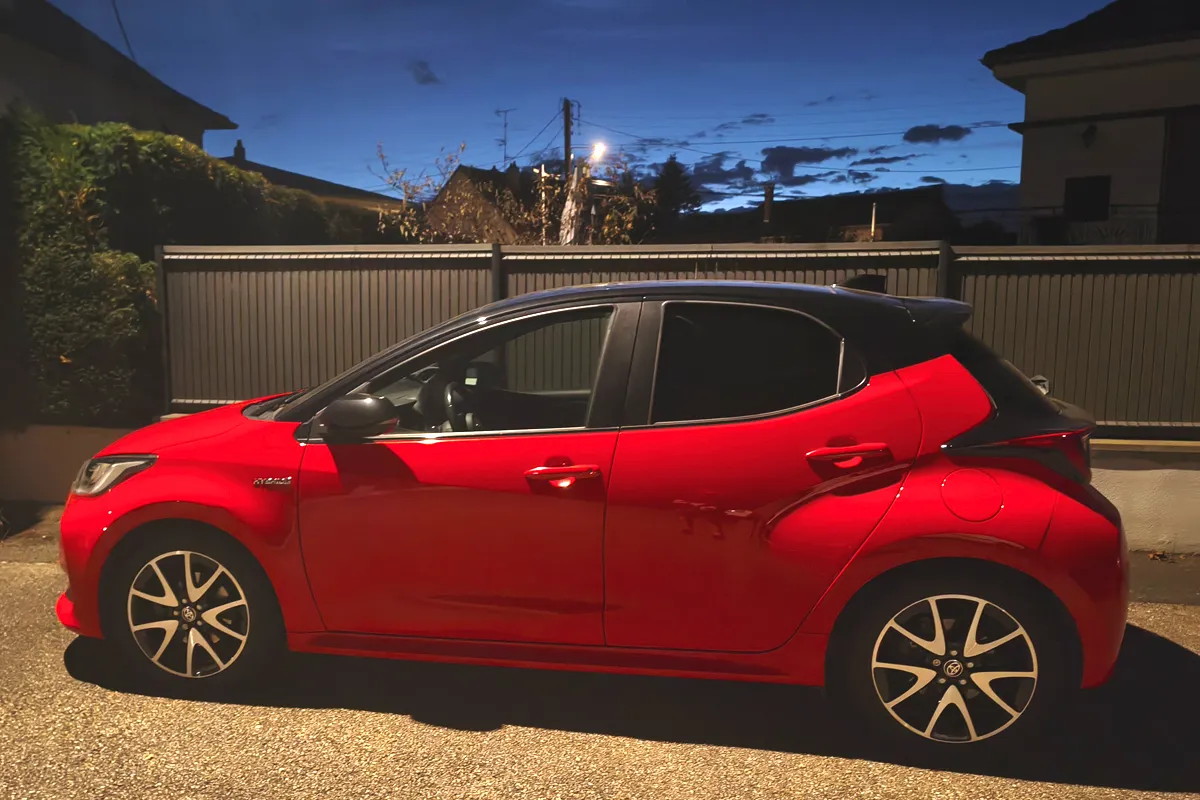
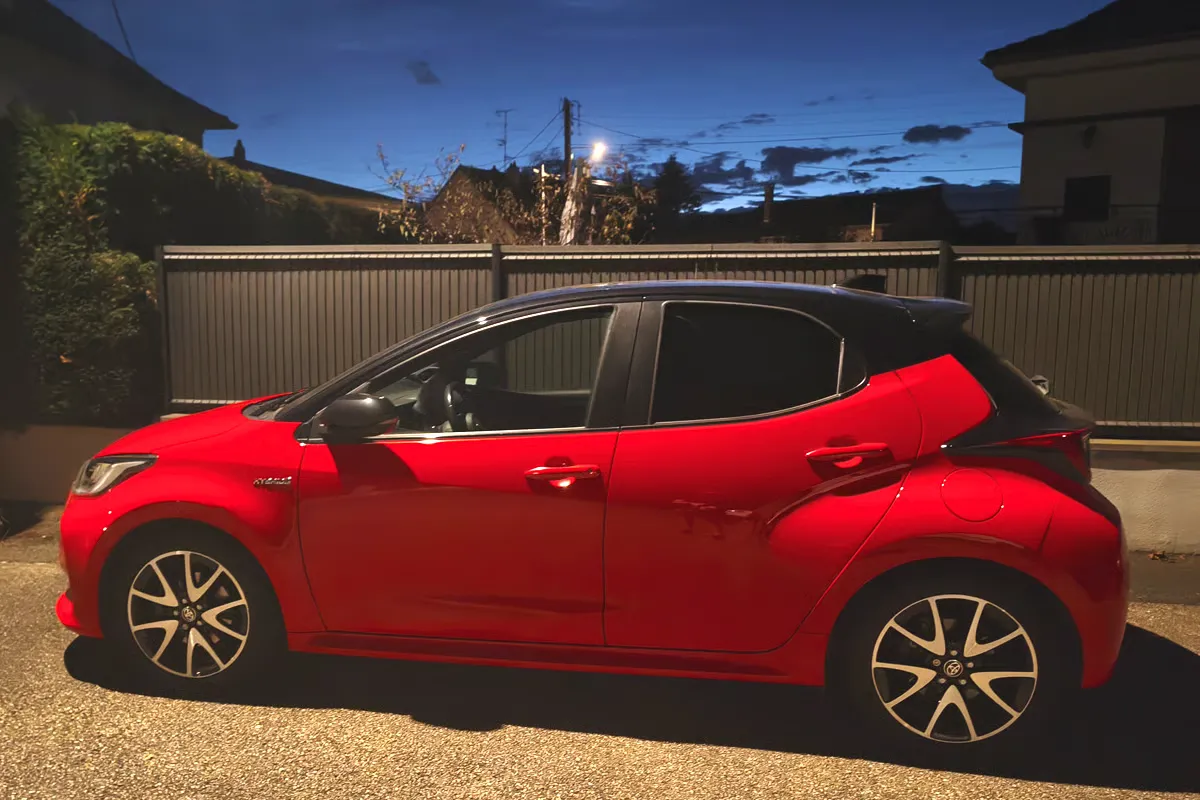
Purchased new in 2020 without being able to test drive it due to Covid lockdowns, Fabrice’s Toyota Yaris hybrid is identical to the one tested by Hugo Lara that same year. It comes in the fully equipped Première version. Satisfied after already covering 90,000 kilometers, this 38-year-old reader from Lorraine plans to keep it for another two to four years.
A lot of new features in the 4th generation
The drive is transmitted to the front wheels via a continuously variable transmission (CVT). In addition to introducing the GA-B platform derived from TNGA, this Yaris features a new lithium-ion battery that is 12 kg lighter than the previously used NiMH battery pack [NDLR: Nickel-Metal Hydride]. All of these improvements were highlighted to show that, despite potentially more dynamic driving, there are some downsides: 3.7 liters of gasoline per 100 km, with 87 grams of CO2 emitted in the WLTP mixed cycle.
Also read
Testimonial – After 15 years with a diesel vehicle, Christian regrets switching to a hybrid before going electric
What attracted many car owners to this city car (3.94 x 1.75 m, with a height of 1.47 m) was its production at the factory in Valenciennes (59). It’s about 220 km by air from Fabrice’s home: “French manufacturing is valuable to me; it’s an advantage, but I chose this hybrid Yaris mainly because I liked it and knew it was more performant than the third-generation model. It’s my first new car, bought for 23,000 euros, just before the price increases caused by a shortage of electronic components.”
No charging option in 2020
Before switching to a hybrid vehicle, Fabrice drove diesel cars: “My father bought his first Toyota Prius before 2010. It was with him that I discovered hybrid vehicles. I myself purchased a used Toyota Auris 1 hybrid in 2014. Developed from a conventional model, this car had its trunk space reduced due to the battery [NDLR: 40 liters less, from 350 to 310 liters]. Hybrids are even more attractive to me since I live near Luxembourg, where SP95 is about 0.20 euros cheaper.”
Switching to a smaller model: “Without children, I wanted a more compact car that was easier to park. I wouldn’t have chosen a Renault Clio hybrid, which is somewhat a competitor to the Yaris, because it was already a bit larger [NDLR: 11 cm longer and 4 cm wider]. Living in an apartment in 2020, I couldn’t have gotten an electric car since I didn’t have access to a charging outlet at home. Since then, we’ve moved into a house, and my partner already drives an electric Fiat 500. However, because its range isn’t sufficient, we still use the Yaris for longer trips.”
With its hybrid system, our driver already experiences a driving feel different from traditional gasoline models: “With its smooth CVT transmission, it’s a car that’s pleasant to drive, offering fluid acceleration similar to that of an electric vehicle. During high-power demands, the engine makes quite a bit of noise. However, it’s less noisy than my Auris, and at steady speeds, you can barely hear anything. It’s very different from what you experience in a gasoline car, where you can feel and hear the gear shifts.”
In Practice
The fuel consumption figures recorded by Fabrice differ from those reported by Toyota: “The low fuel usage of 4.3–4.5 liters in summer for my 14 km daily commute is a big advantage for the Yaris. In winter, it’s between 5 and 5.2 liters. On the highway, however, it quickly exceeds 6 liters. I stop every two to three hours of driving for about 15 minutes to use the restroom or around 45 minutes to eat. Our little Shiba Inu travels with us, comfortably seated in the back seat.”
What is the range of this 2020 Yaris hybrid? “If you wait until the last moment to refuel, it’s 700 km in summer and 600 km in winter. Driving at 130 km/h reduces the range by about 100 km. But I have all-season tires that aren’t very favorable. I find that the fuel reserve is reached a bit early. Only 28 liters are used out of the tank’s 36-liter capacity. So there’s still enough to travel over 100 km more. This is likely Toyota’s way of avoiding dry battery failures that could potentially cause some kind of clogging.”
Our reader isn’t shy about driving across France in his Yaris: “From the area around Thionville, we’ve already gone to Brittany with this car, as well as to Belgium and Germany. For farther destinations, we take the train or plane. We’ve never had back pain in the Yaris. Even with a bit stiff suspension, comfort is maintained thanks to the quality of the seats. Although sound insulation has improved with the fourth generation, the Yaris is still quite noisy on the highway compared to driving on country roads.”
Driving Assistance Features
On the highway, Fabrice uses the lane-keeping feature: “At Toyota, driving aids feel natural. You don’t necessarily feel any jolts in the steering wheel. The system in my 2020 Yaris isn’t very good in sharp turns or on country roads. It needs clear lane markings. I also use the adaptive cruise control. It works excellently in traffic jams. The system slows down and restarts smoothly, so you don’t necessarily feel the speed changes. It’s very relaxing.”
He says, “The system anticipates situations very well without overreacting. If someone does a fish tail behind me after overtaking but drives faster, the Yaris keeps going without slowing down. It’s very different with my partner’s Fiat 500e. In the same situation, the vehicle would beep and react. Her car is more abrupt and quickly emits audible alarms. By contrast, mine is more lenient. The assist systems still work in fog, while the 500e can become unreliable in sunlight due to a camera that’s positioned too high and gets blinded.”
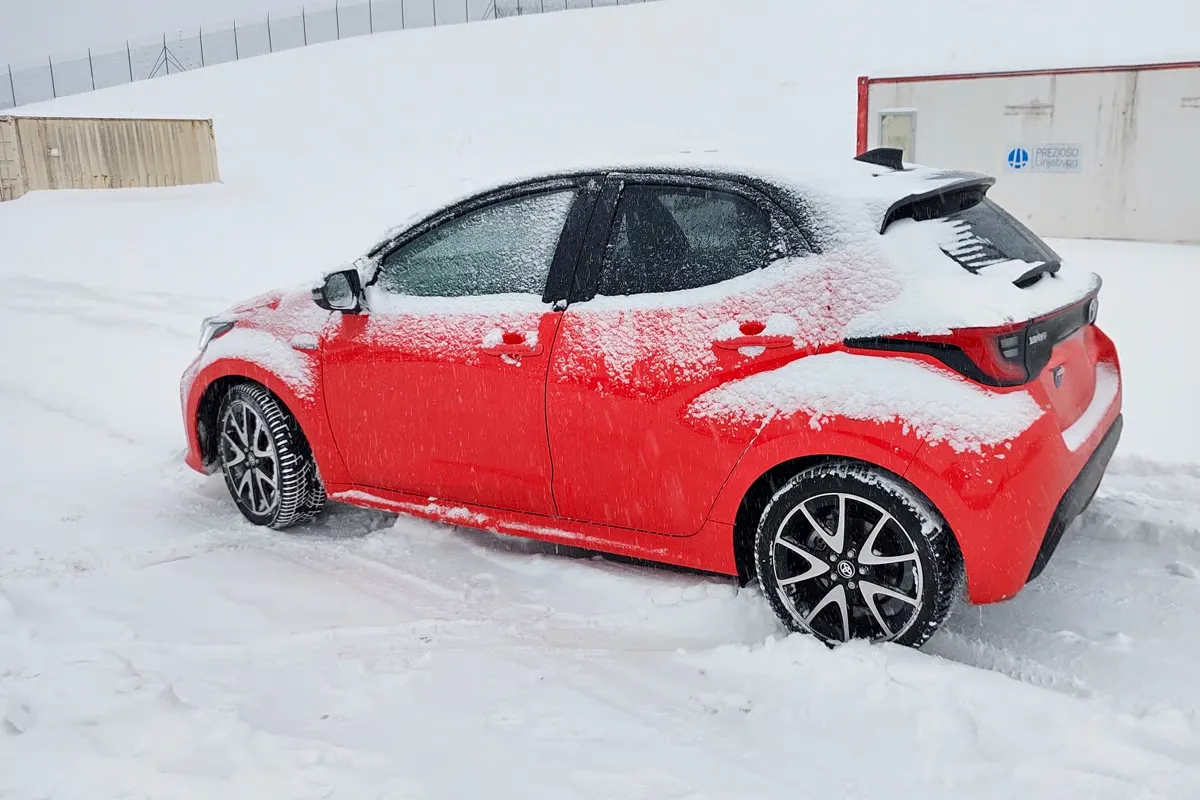
Our reader’s partner drives the Yaris from time to time: “She likes driving it too, but she still prefers her electric car. The two models have similar power, but the 500e is more responsive. With the Yaris in winter conditions, I find that regenerative braking, Drive Mode B, and predictive features are more effective than brake pads at preventing skidding and wheel lockup. Once the car is moving, the lack of gear shifts thanks to the CVT also helps avoid skidding during acceleration.”
Marketing and After-Sales Service
Fabrice does not have a good memory of his purchase: “I think the sales team at the dealership near my home wasn’t very good in 2020. The person I signed with later went on maternity leave, and no one took over my file. Fortunately, since things weren’t always working properly, I was able to track the arrival of my car through an app. When I went there in person, nothing had been done regarding the paperwork. I have a much better opinion of customer service.”
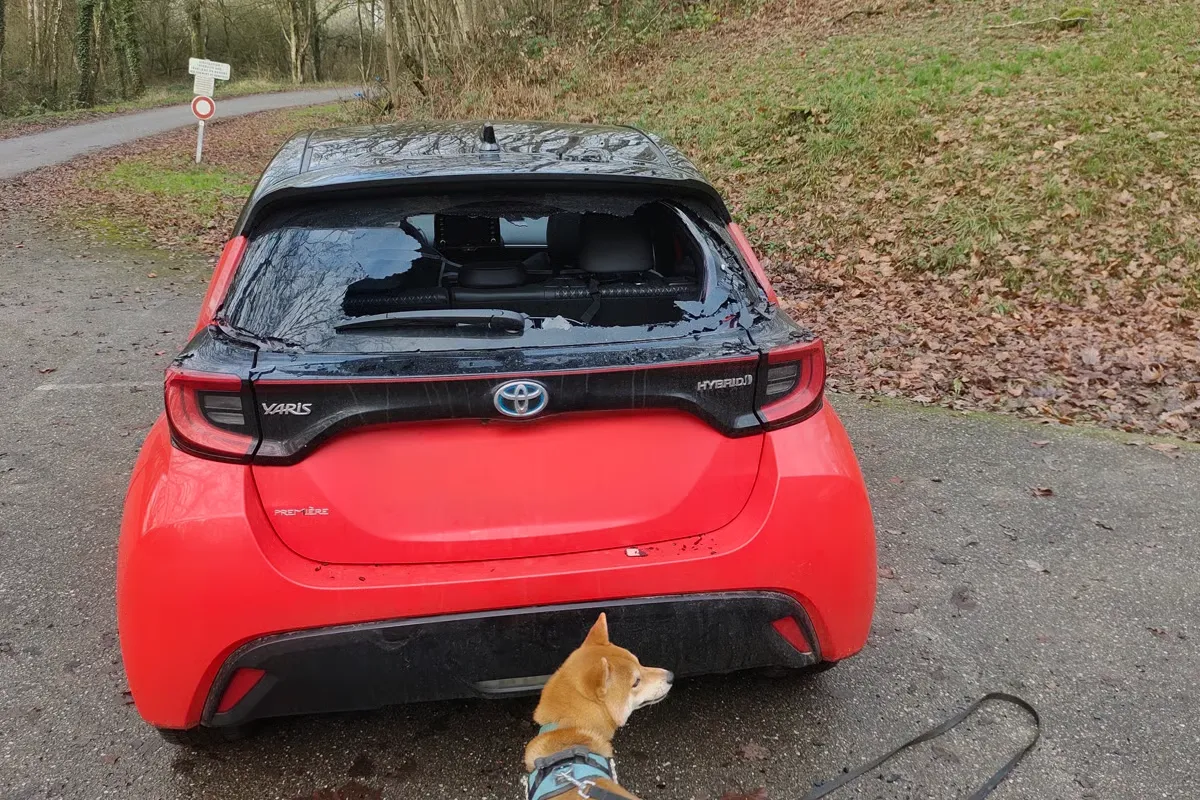
Our reader was able to quickly assess the quality of this service: “I received my new Toyota Yaris in November 2020. On January 1, 2021, someone broke the trunk window while I was walking my dog. There was nothing to steal, but the glass shards scratched the rear lights. The workshop responded very quickly and replaced everything right away. Recently, my 90,000 km service cost 709 euros, which is the highest price. It takes an hour or less; for the others, done annually or every 15,000 km to maintain warranty coverage, the cost is between 300 and 350 euros.”
The driver from Lorraine noticed that the costs were rising: “I used to easily save a hundred euros with the Auris. I didn’t have any problems with my Toyota Yaris hybrid, except once when the 12 V battery needed to be replaced by the service center. That happened after three or four years. It’s well known that this component wears out quickly. Since then, I bought a booster that I’ve only used once so far, as I haven’t encountered the problem again. The 12 V battery is under the rear seat, but the device can be connected through terminals under the hood.”
Another few years
In general, Fabrice doesn’t regret buying his 2020 Toyota Yaris hybrid: “At first, I followed a group of users on Facebook. Now, I feel it’s missing a rear radar that I should have opted for from the start. So I have to settle for the camera, which is already very good. Additionally, the vehicle’s compact size is great, except when you need to transport something bulky. On trips for vacation, it can quickly feel cramped.”
Also read
Testimonial – Between the Renault Megane and the Volvo EX30, the dealership experience tipped Andrea’s choice
Now that he lives in a detached house, our reader says, “Today, I could drive an electric vehicle like my partner, but it would need to have a larger battery to allow for long trips. For now, I plan to keep my Toyota Yaris for another two to four years. I value it because it’s my first new car, purchased on credit. With a good interest rate, it’s much more advantageous than a lease. Once the loan is paid off, I’m done paying. I don’t want to bear monthly payments for the rest of my life.”
For this nuclear power plant maintenance worker, a car like the Toyota Yaris hybrid “remains attractive for young singles or couples without children. A family would quickly feel cramped inside it, especially on long trips like vacations. It’s a car that’s pleasant to drive even when traveling long distances. Thanks to its CVT transmission, it’s much more comfortable than many conventional models. Personally, I still don’t know what I’ll choose next.”
Automobile Propre and I would like to express our sincere thanks to Fabrice for his excellent hospitality, responsiveness, and the insights he shared after we asked our readers for their experiences.
For your reference, any offensive comments directed at our interviewees, their lives, choices, and/or ideas will be removed. Thank you for your understanding.
Author’s Note
This time we give the floor to a hybrid car user so that we can hear his story, one that many drivers and readers of Automobile Propre will recognize. Switching to electric vehicles in 2020 without access to home charging was difficult for many. Today, with the development of charging networks, it’s easier, though exceptions still exist. Additionally, the cost per kilowatt-hour remains prohibitive, and urgent action is needed to address this issue.
The CVT transmission has often been criticized for the noise generated by its motorization during sharp accelerations. Fabrice, on the other hand, has accepted it due to the improved driving comfort it provides otherwise. Since everyone has their own perspective, a driver interested in the Toyota Yaris hybrid should test drive it before purchasing to form their own opinion.
As for Toyota’s driving assistance features, I personally experienced them well while driving a Mirai. It was so natural and smooth that I thought the lane-keeping function was inactive, even though the dashboard indicator showed it was active. I usually turn off these features systematically, but with such performance, I’m quite convinced, as it offers both comfort and safety.
Philippe SCHWOERER