
Testimonial – For slightly higher rent, Anthony preferred the Audi A6 Avant e-tron over the Renault Scenic E-Tech
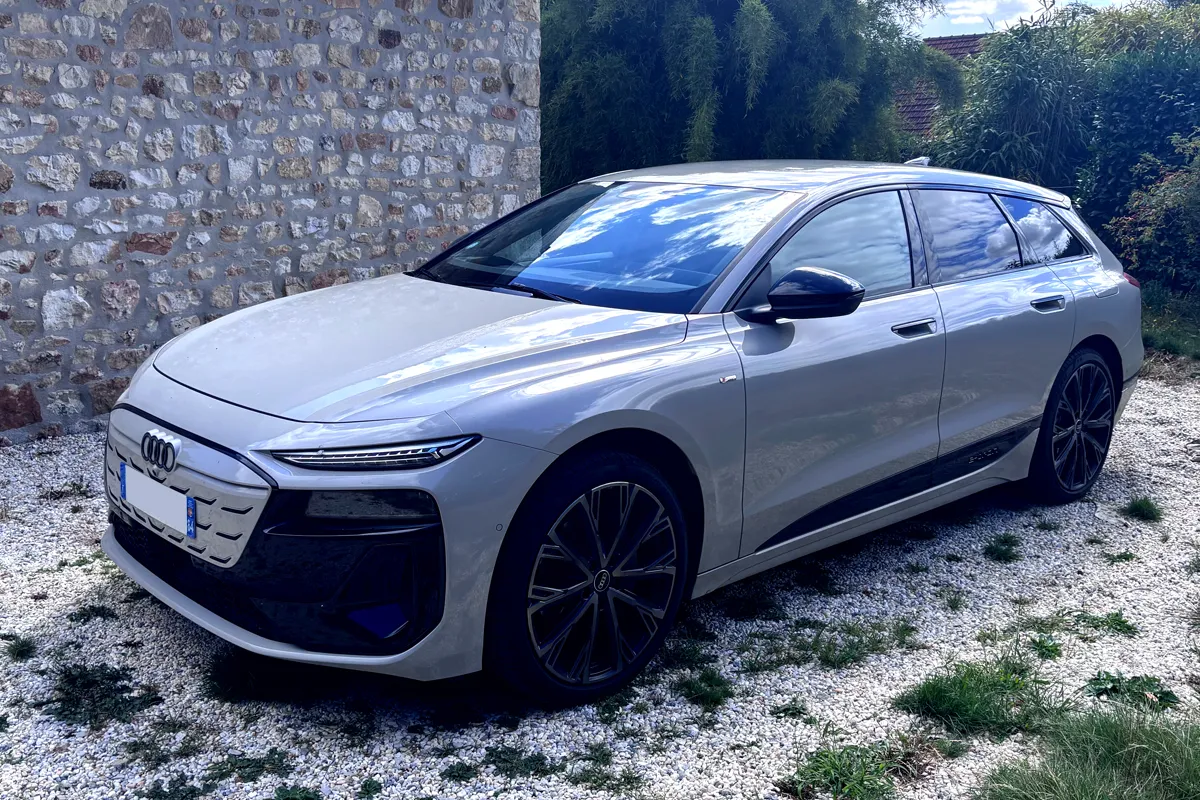
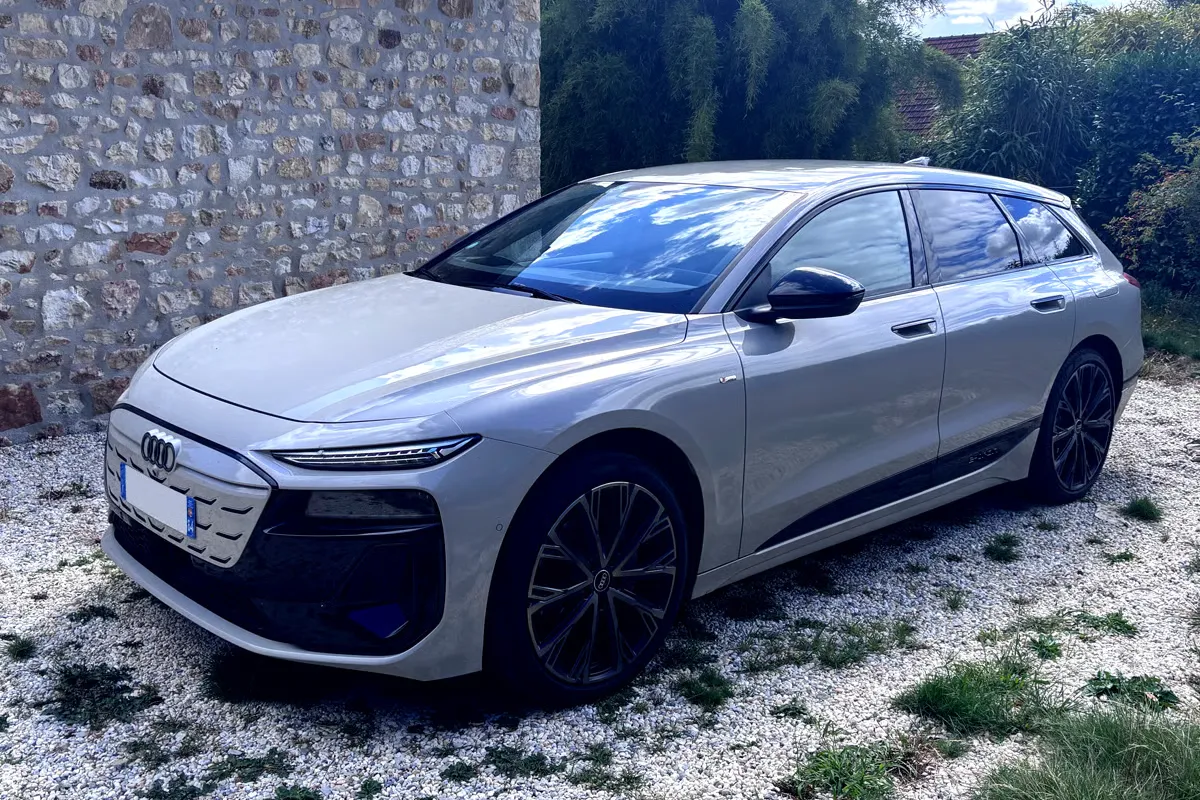
For his work in real estate, Anthony needs a business car with reliable range. After four years with a rechargeable Volvo XC40 hybrid, he switched to an electric vehicle. With its 800 V platform, the Audi A6 Avant e-tron also offers fast charging, allowing him to travel from the PACA region to Normandy in just over nine hours via highway, including stops. His longest single-day drive was 1,100 km for a vacation from Marseille to Cherbourg.
An uncommon model
The Audi A6 Avant e-tron is not an electric car that one sees on every corner. The model shown by Anthony is in Siam beige, just like the one Andy tested at the end of 2024, but it is in the Performance version as tested more recently by Soufyane. It is a station wagon that retains the dimensions of a sedan: 4.93 x 1.92 meters in length, with a wheelbase of 2.95 meters and a height of 1.52 meters.
With a maximum torque of 565 Nm, this powertrain delivers 270 kW (367 hp) of power, and even 280 kW (381 hp) with Overboost. It is equipped with a lithium-ion NMC battery (nickel, manganese, cobalt; CATL 811 cells) with a total energy capacity of 100 kWh, of which 95 kWh is usable. Thus, this electric car assembled in Ingolstadt, Germany, has an estimated range of up to 721 kilometers in mixed conditions during summer, and 573 kilometers on the highway.
Thanks to the 800 V system, the charging curve can approach 270 kW at a sufficiently powerful fast charger. With a standard weight of 2.26 tons when in operation, the Audi A6 Avant e-tron offers a trunk volume of 502 liters. This can increase to 1,422 liters by folding down the rear seatbacks. Add to this a 21-liter frunk area, and the ability to tow a braked trailer up to 2.1 tons.
From PHEV to BEV
Anthony drives 30,000 to 35,000 kilometers per year: “After using diesel cars, I switched to a rechargeable hybrid with a Volvo XC40, which satisfied me. I knew it would be a transitional model for me. I charged it every day, which allowed me to use electric power for local trips. However, 80% of the 145,000 kilometers I drove in it over four years were on highways. There, my gasoline engine consumed 8-9 liters per 100 kilometers, compared to 5-6 liters with my previous diesel cars.”
Also read
Testimonial – After 15 years with diesel, Christian regrets switching to a rechargeable hybrid before going electric
Then the time came to switch to an electric vehicle: “Having worked extensively on financing projects for photovoltaic and solar energy, I have a certain sensitivity to ecology. That’s why I wanted to switch to electric for a long time. I was waiting for a model designed for long trips. Technically, with its 800 V system, the Audi A6 Avant e-tron is well-suited for this. On the company side, there’s no debate about it—it’s economically advantageous, with a lower total cost of ownership compared to conventional or plug-in hybrid vehicles.”
Often, official vehicles have to be chosen from a catalog that limits the models available: “That wasn’t my case. I had considerable freedom in selecting my electric car. However, I had to prove that it wouldn’t incur any extra costs for the company. I only considered two models with a range of over 600 km: the Renault Scenic E-Tech and the Audi A6 Avant e-tron. Very disappointed with the treatment at Renault, I chose the Audi, becoming the first person in my department to order one.”
The Best Choice of Car
It wasn’t just the reception that disappointed Anthony, but also the lease payments: “I took out a no-downpayment lease from Audi for 37 months, with 30,000 kilometers per year. For my Audi A6 Avant e-tron Performance in a highly equipped S Line version, my monthly lease payments, including taxes, are 1,063 euros. This car costs 95,000 euros in total. On the other hand, I had a high-end Scenic E-Tech with all options for only 100 euros less per month, even though its price is only 55,000 euros. It’s clear that Renault isn’t willing to make an effort.”
Our reader signed the contract with Audi without having the chance to test a Audi A6 Avant e-tron first: “I placed my order in October 2024, even though this model didn’t arrive at the dealership until January 2025. My vehicle was delivered to me in March of that year. Its odometer already shows 48,000 km. As for the experience at Audi, well, I happened to work with a good salesperson. This car is fantastic; I’m absolutely obsessed with it. It’s incomparable to a conventional vehicle.”
Among the positive points mentioned: “Its sound insulation is exceptional. Not only is it quiet, but there’s no longer any vibration from a combustion engine. Thanks to the adaptive suspension that adjusts to road conditions, such as detecting potholes, the comfort is excellent. At least once a month, I have to drive nine hours to Normandy, including 45 minutes of stops. This is the first car that allows me to do this without back pain upon arrival. I’ve never had a vehicle this large: it can sometimes be difficult to park. I don’t use it for shopping in the city.”
In Use
Given its usage, the average consumption since purchase appears moderate for an electric car of its weight and size: “It’s 19.3 kWh/100 km when driving at top speed, nothing more. I’m quite strict about sticking to speed limits. On the highway, at 132 km/h, the consumption is around 20-21 kWh/100 km. So I can expect a range of 320-330 km. But if I drive until the battery is completely drained from full charge, it would be around 430-440 km.”
This doesn’t stop our reader from enjoying the performance of his electric car: “It has insane acceleration; it’s incomparable. Before, manufacturers competed to show off impressive figures, especially in terms of 0 to 100 km/h times. Now, all electric cars have a lot of power. Yet mine is a station wagon with an enormous trunk that’s very easy to access, where my Chow-chow feels very comfortable when I take it with me.”
The A6 Avant e-tron is equipped with level 2 driving assistance: “At first, I thought it was just a gimmick. But actually, it’s really very addictive. On the highway, I use this system constantly to stay in lane with adaptive cruise control. To use it properly, you just need to lightly touch the steering wheel to show you’re paying attention. Never go against its movements, otherwise it operates in a jumpy way that’s particularly unpleasant.”
On-the-road charging
Regarding charging networks, Anthony has some preferences: “I try to avoid Eni’s Plenitude chargers because the prices are too high. However, I signed up for their service since there are stations of this network in convenient locations along my route. I prefer Allego, where the prices are more favorable and I’ve also subscribed to one of their plans. Occasionally, I stop at Ionity as well. Last week for the first time, I encountered a charger with broken cables. It was in Toulouse.”
The charging times are quite short with the A6 Avant e-tron: “Twenty minutes is usually sufficient. To see the charging rate reach 270 kW, the battery level needs to be very low. At up to 50% charge, it’s above 200 kW. At 80%, it drops to only 80-85 kW. It’s better to unplug at that point to prioritize higher charging speeds, which helps save time on long trips. With this setup, I barely spend any more time charging than with a conventional car.”
The 80% limit is also in place to facilitate vehicle rotation at charging stations: “For electric vehicle owners who travel long distances, the main problem is a lack of civility. Some—and there are more and more of them—are still charging at high rates of 90%, 97%, or even 100%. Among them are people who were probably forced to switch to electric vehicles. I’ve even seen them next to their cars, unhesitating to stay for an hour just to fully charge up. This selfishness shocks me. I’ve already reported this to the service providers, but they seem uninterested in addressing this issue.”
The Only Electric Vehicle at His Company
Anthony did everything he could to ensure his long trips went smoothly: “First of all, I avoid recharging on Saturdays or Sundays. I try to do without a planner as much as possible, because I find the suggested stops not very sensible—sometimes too many or too short. I only use the car’s planner when I have no choice, when I’m not familiar with the route. Otherwise, aside from my regular trips, I plan my stops myself the day before.”
A model as uncommon as the Audi A6 Avant e-tron should attract curiosity during charging: “No, it’s never happened to me, but people do turn around when it passes by. At work, I’m the only one with an electric car, and no one has shown interest in my A6. There are still about a dozen plug-in hybrids in the fleet—maybe that will change things. The only ones who show interest in my car, wanting to know if it’s truly all-electric, are my clients, partners, and suppliers who often have German cars. Anyway, I’m not going back to a gasoline car.”
Also read
Audi A2 e-tron: We got behind the wheel of the new compact electric car that focuses entirely on efficiency
Our reader noted some electronic issues: “The rear camera was out of order at times. Additionally, I’ve gotten false alerts saying the turn signals wouldn’t work. It happens randomly. I also find that the pseudo-tactile buttons on the steering wheel are neither comfortable nor precise. Many owners of this car say the same. And having to use the screen to adjust the climate control is really not great.”
Other EVs in the community
Anthony’s home is now fully electric: “My spouse has a Renault Megane E-Tech as his service vehicle. His company paid for the 22 kW electricity box we have at home. We use three-phase power. Before, we had an EDF Tempo contract for household electricity. Thanks to an article in Automobile Propre, we took advantage of a bundled offer through supplier Ohm for cheaper energy. It costs us about 0.13 euros per kilowatt-hour during off-peak hours when our electric vehicles are charging.”
There are now three electric cars to consider: “For our second car at home, we chose a Volkswagen ID. Polo. It’s truly a pleasure to drive this car. We hesitated over other models. Basically, we ruled out Chinese brands and Tesla—I’ve never liked Elon Musk’s personality. We thought about the Renault 4 E-Tech through another dealership. But again, the service was unpleasant, not to mention any discounts. For me, Renault is off the table for years.”
The preferred model wasn’t purchased after all: “It was the Skoda Epiq, but I was worried about resale value due to its lack of recognition as a new electric vehicle. I like to change cars every 18 to 24 months. After the Audi, in about 18 months, it will be a BMW i3. I already saw it in advance at a dealership after receiving an invitation via text message. For me, electric cars have become a real passion. I enjoy staying informed about all the models available. And I truly act as an advocate for electric vehicles among my friends and family.”
Automobile Propre and I would like to express our sincere gratitude to Anthony for his excellent hospitality, responsiveness, and insightful testimony shared in response to our request for reader experiences.
For your reference, any offensive comments targeting our interviewees, their lives, choices, and/or ideas will be removed. Thank you for your understanding.
Author’s Note
While there are still critics trying to prove that electric cars aren’t suitable for long distances, our readers continue to show the opposite is true. Sure, it’s not a city car, but professionals who travel long distances regularly rarely use small gasoline or diesel models for these trips.
Once again, an electric vehicle enthusiast tempted by a Renault electric car left the dealership disappointed with his experience. And this happened at two different dealerships. For clarity, I hadn’t asked any questions about this matter. This shows just how challenging things still are for Anthony. Renault shouldn’t complain later that drivers prefer other brands, European or Asian.
What we see once more in this testimony is a transition through a rechargeable hybrid car. It at least gave our reader the desire to switch to an electric vehicle, a plan he had been considering for years as well. We’re receiving more and more similar feedback, indicating that electric vehicles and charging options are now increasingly suitable for drivers.
Philippe SCHWOERER