
Testimonial – Nicolas loves his Mercedes EQS, but here’s why he’s leaving the brand


After more than two years of using it, Nicolas feels that driving the Mercedes EQS 580 4Matic electric sedan is like driving the best car available today. With the lease set to end next year, a replacement has already been identified. His monthly payments will be cut in half.
“I had a real crush on it.”
We can truly say that our 50-year-old reader, based in Soissons in the Aisne department, is interested in automobiles: “I haven’t missed a single World Motor Show since 1986. Before getting the Mercedes EQS, I was rather against electric cars and drove a G 500 AMG Line. Since I’ve always been quite a tech enthusiast, it was the EQS’s design that convinced me after six to eight weeks of consideration. It all started with an invitation from my dealer to a local Relais & Châteaux venue for a presentation of various models.”
It was early 2024: “As I recall, there was a Mercedes Classe S, the roadsters SL 43 and 63, maybe a Classe A, and an EQS 450+. I was quite interested in the latter and discussed it with the dealer. After some time, I told them I was willing to go with that model but wanted to know how it would perform on long trips. I got to use this car to visit family in La Rochelle, about 600 km from my home. I then subscribed to Ionity for 5.99 euros per month for charging.”
Also read
Testimonial – Highly disappointed with a European vehicle, Delphine reconciled herself to electric cars thanks to a Chinese model
The test was successful: “With my passenger, we realized this electric car was suitable for such trips. I really fell in love with it. I found it impressive, comfortable, quiet, and powerful. But I didn’t want the one that was borrowed—it wasn’t attractive in gray, with its black interior which I found too plain. In Reims, I found a model that I much preferred, in dark blue with a light gray interior. But it was a 580 4Matic, and at first I was worried it might not have enough range.”
122 km less range
On paper, under the mixed WLTP cycle, there is indeed a significant difference in range between the 2024 Mercedes EQS 450+ Propulsion and 580 4Matic. The ranges are 814 km and 692 km respectively, a difference of -122 km or -15%, despite both having the same battery with a gross energy capacity of 120 kWh, of which about 108 kWh is usable. “In the best case, with average usage, one can expect a range of 650 km in summer, with a 20% drop in winter when our EQS 580 4Matic is parked outside.”
With a starting price of over 30,000 euros, the figures for the all-wheel-drive version are even more impressive: 385 kW or 523 horsepower (compared to 245 kW / 333 horsepower), 855 Nm of torque (568 Nm), 0 to 100 km/h in 4.3 seconds (6.2 seconds), with a top speed of 210 km/h. These two large electric sedans (5.22 x 1.93 meters) are equipped with an 11 kW AC charger and offer a DC charging curve that can reach up to 200 kW. For comparison, with the adoption of 800 V in 2026, speeds of 350 kW will now be achievable.
Up to 220 km/h on German highways
At Nicolas’s place, there is no other car besides this Mercedes EQS 580 4Matic: “It’s the all-around car. In the first two years, while we lived in a village outside Soissons, it was used several times a day for running errands, going to the business we owned, and various work trips. Since November 2025, we’ve been in the city center. Now, the EQS is mainly used for medium-distance trips. For example, to go to Paris or Reims.”
This doesn’t rule out longer trips either: “With this car, our longest journey was to a trade show in Dortmund, Germany. It’s about 500 km from our home. Everything went wonderfully well again thanks to the high charging power. We stopped for that on the way there on the highway near Aachen. In Germany, I noticed that this Mercedes EQS 580 4Matic can reach speeds of 220 km/h. On the way back, I found that the average fuel consumption was only 22 kWh/100 km.”
Our correspondent describes the route: “Between Dortmund and Aachen, I drove at speeds of 170 to 190 km/h whenever possible. There are very steep sections limited to 100 km/h, where regenerative braking helps recover a lot of energy. In Belgium, I set the speed regulator to 125 km/h. Arriving in France via the area around Valenciennes and up to Saint-Quentin, I was traveling at 135 km/h on the speedometer. After that, it was secondary roads at around 80 km/h.”
Usage
The average consumption since March 2024 is slightly higher: “It’s around 23 kWh/100 km. I often drive at speeds of 130-140 km/h. To overtake, I use short bursts of speed. I don’t know how to drive efficiently, even regarding the vehicle’s features like the air conditioning or seat massage function. On the other hand, I like to set the regenerative power to its maximum. I really appreciate being able to drive mainly using just the accelerator, but if I take my foot off completely, it doesn’t stop the car.”
Nicolas says he is “pretty satisfied” with his first electric car: “It’s spacious, extremely practical with its trunk, quiet even at 135 km/h, safe, and powerful with an amazing chassis. I feel like I’m driving the best car. Its rear steering wheels help when parking in tight spaces. It’s also great for parallel parking, but be careful not to get too close to the sidewalk, as it could damage the wheels. This system makes the car more agile by reducing the turning radius. We have a large sedan that drives like a Classe A.”
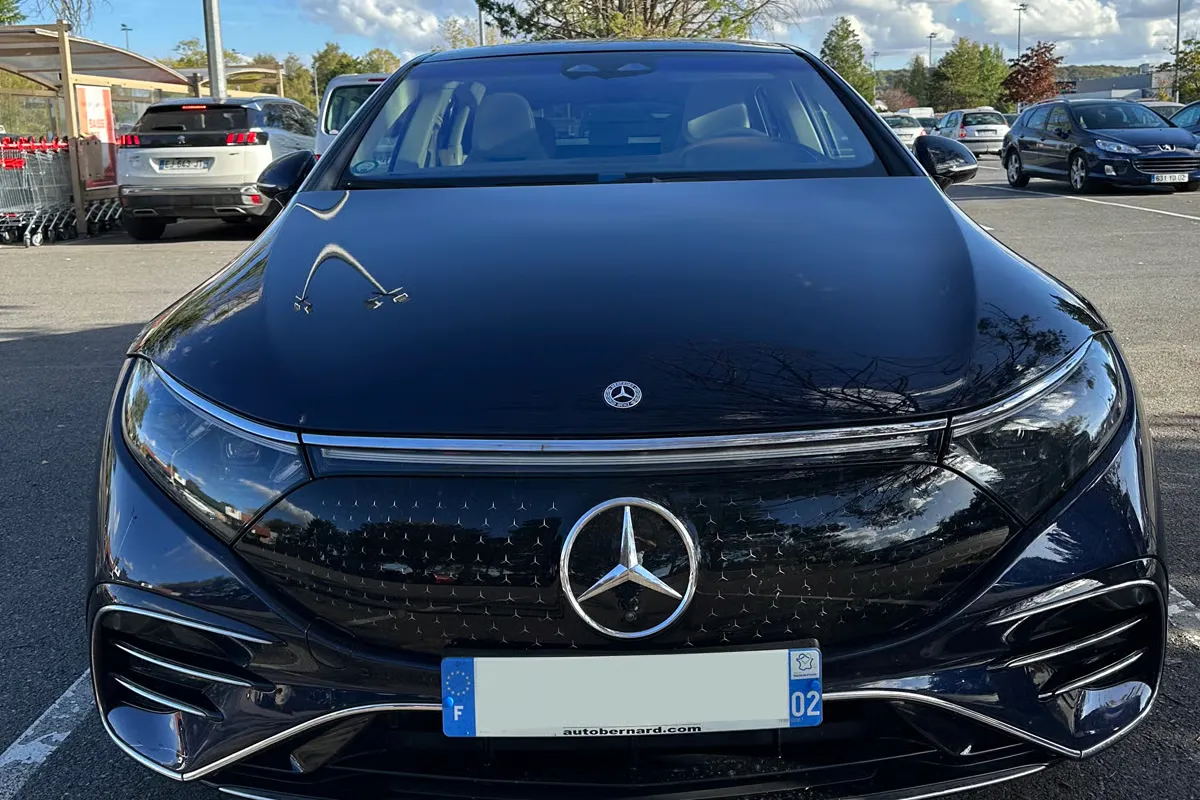
Our reviewer notes several drawbacks, however: “It already has ergonomic issues. The central screen is positioned a bit low and very wide, which makes it difficult to use Apple CarPlay functions. As for alerts from Waze, the buttons are too small and scattered across the screen. It’s also problematic with YouTube Music. OTA updates reset the favorite settings. Perhaps Mercedes should turn to Google for its software interface.”
This rental that changed everything
There are a few areas that could be improved elsewhere: “It’s also the case with the dashboard. For example, to turn on the fog lights, one has to fumble around because the control is placed way too low. The smartphone app doesn’t always work very well either. And then there’s this stupid business policy that limits certain services over time. We’re still talking about a car that costs 170,000 euros. For me, it’s clearly no longer the brand one would want to be a customer of in the long term.”
This stinginess applies to other, less expensive models as well: “With a Mercedes CLA priced at 75,000 euros, you find somewhat deteriorated plastics everywhere. In any case, they don’t add to the vehicle’s value. It’s still nice to have an interior that looks decent. This quality is increasingly rare, except in more expensive models. At 81,000 euros, the Polestar 4 offers a much nicer interior. It’s also worth noting that for the four power windows, you have to settle for two buttons and a front/back switch. It’s really not very user-friendly while driving.”
"Polestar 4," Nicolas just revealed the name of the car he plans to buy after his Mercedes: "We discovered the brand in Miami. There, we rented a Polestar 2. Unlike my EQS, it has the One-Pedal system, and that’s really great. Our rental car had 80,000 miles on the odometer, yet the interior was still flawless. This car has a very dynamic chassis, almost BMW-like, with excellent suspension comfort. I loved this super responsive car."
Polestar as a Alternative to Lexus
Florida was like a great testing ground for Nicolas: “There, you often have torrential rains. We found ourselves in a situation where the water level rose above the threshold at which the doors could open. But everything remained completely waterproof. The Polestar 2 performed very well, even on Florida’s highways, which are no ordinary roads. I even have the impression that they’re like concrete sections. On the way back, since it wasn’t yet possible to access official information on French websites, I followed the brand’s updates through a Belgian website.”
Our reader also thought of another car: “It’s the Lexus RZ. But its range didn’t meet our needs [NDLR: 478 km according to the WLTP mixed cycle]. Sometimes we have business trips of 350 km that we drive straight through on the highway. We can’t afford to stop en route. I checked Automobile Propre and YouTube; this car with a 71 kWh battery consumes 25 kWh/100 km at high speeds.”
Also read
Testimonial – After 5 electric cars, Olivier found one he considers almost perfect
It might just be a matter of time: “For comparison, I found on Facebook user accounts that the Polestar 4 offers a range of 600 to 650 km. On the highway, it still has a range of 350-400 km thanks to a 102 kWh battery and an energy consumption of around 22 kWh/100 km. The Lexus RZ might arrive after 2031, once it gets a by-wire steering system and its special steering wheel. It sounds futuristic and very geeky for a car.”
Much Lower Rents
With the move to the city, the Mercedes EQS has been driven much less: “The lease agreement called for 15,000 kilometers per year, and we’ve only covered 32,000 so far even though we’re returning it in March next year. This first experience also showed me that insurance costs soar with electric vehicles. I used to pay 1,500 euros per year for the Mercedes G 500, but 2,200 for the EQS. It should be similar with the Polestar 4.”
The rental costs, on the other hand, will be much lower: “With a down payment of 20,000 euros, the cost for the Mercedes EQS is around 1,700 euros. With a 20% discount, the Polestar 4 will cost only 796 euros. I gave up on the Polestar 2 because it didn’t appeal to my passenger. However, the Polestar 4 suits him well. It will be in the Dual Motor Long Range version. In addition to its comfortable interior, it also has excellent sound system.”
Automobile Propre and I would like to thank Nicolas greatly for his excellent hospitality, responsiveness, and valuable insights shared after our request for feedback from our readers.
For your reference, any offensive comments directed at our interviewees, their lives, choices, and/or opinions will be removed. Thank you for your understanding.
Author’s Note
Although it is only a point briefly mentioned in this testimony, it is true that paid services that tend to develop for cars indeed seem highly inappropriate, whether on a vehicle costing over 170,000 euros or on a more popular model. The same goes for the idea of displaying advertisements on the central screen. It is not through such measures, even though they are not specific to electric vehicles, that we will encourage drivers to switch to electromobility. On the contrary, a movement that needs to be amplified requires incentives rather than new obstacles.
Through these attempts, it is clear that manufacturers are striving both to keep drivers more trapped and to maximize profits. Isn’t it outrageous when the push toward electric vehicles is primarily aimed at mitigating climate change? The automobile as a symbol of freedom seems to be fading away in this context.
On the other hand, what is reassuring is that some drivers turn to electric vehicles for other reasons, such as the desire to explore new technologies, the appeal of certain body styles and interior designs, the pleasure of driving, cost savings over time, etc.
Philippe SCHWOERER
