
Testimonial – Between the Renault Megane and the Volvo EX30, the treatment at the dealership swayed Andrea’s decision
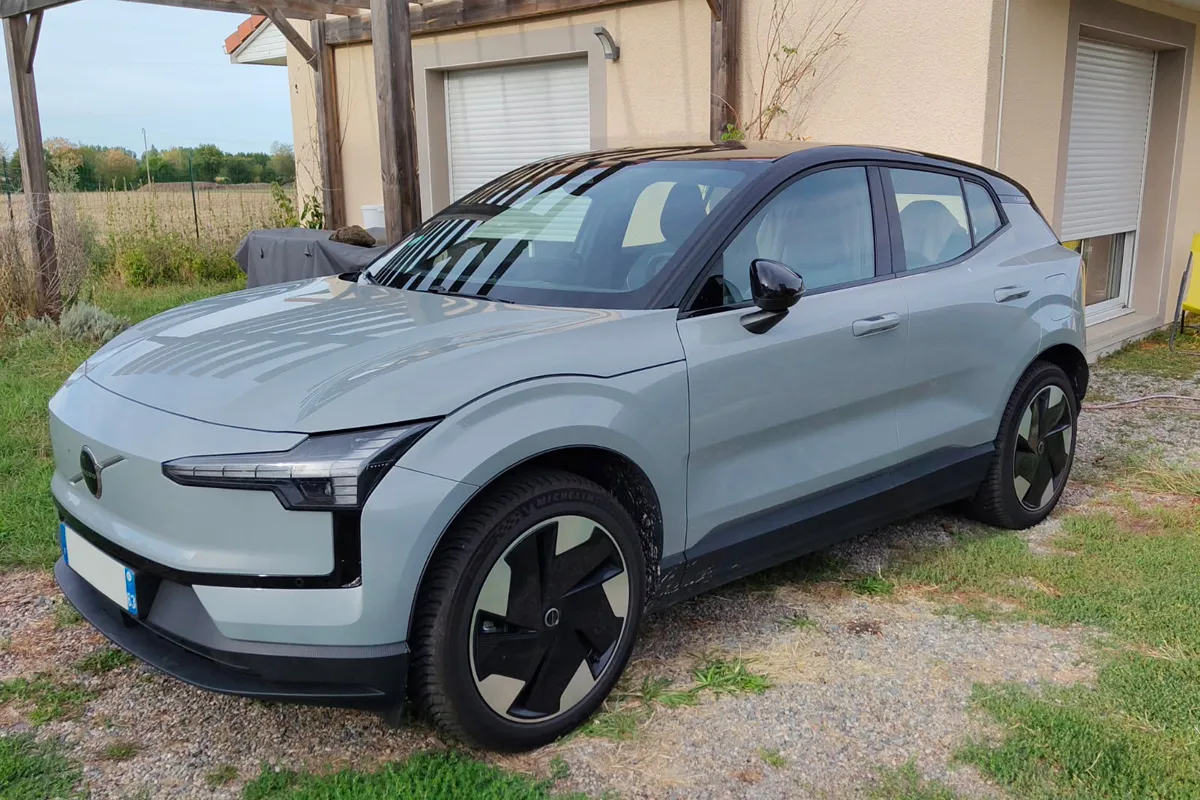
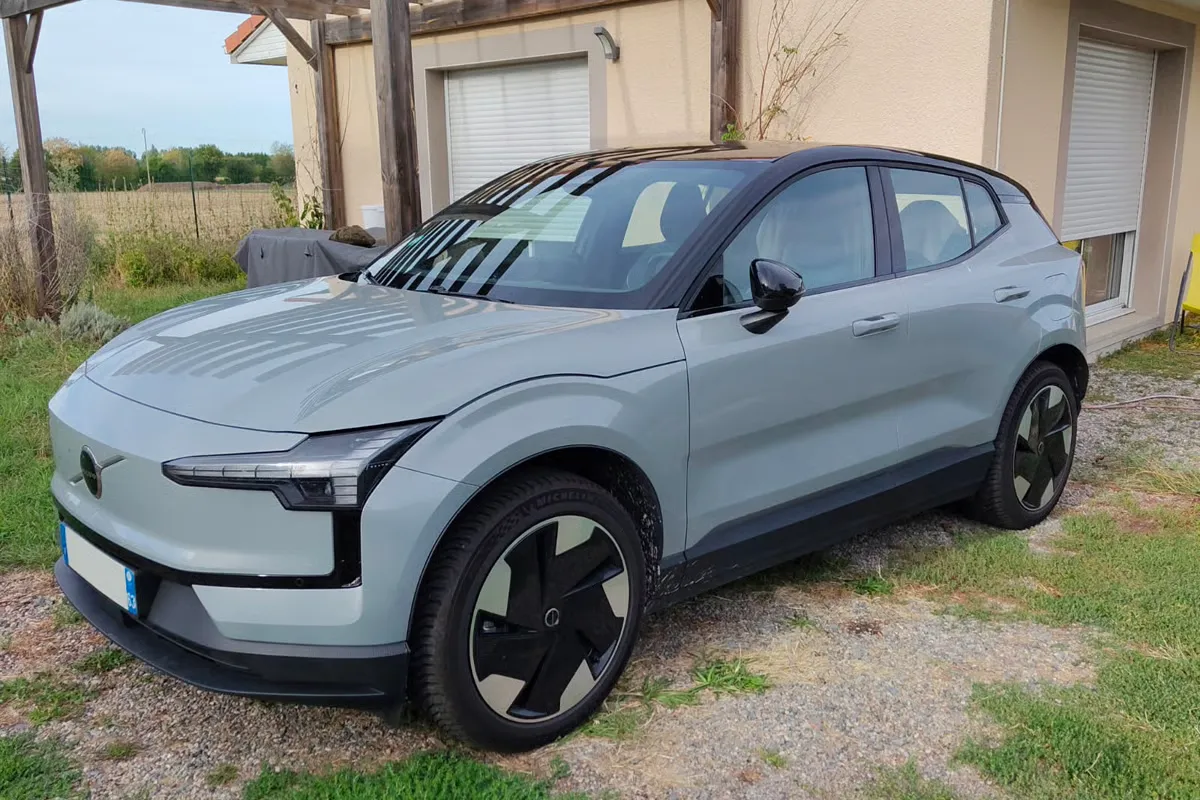
Andrea’s dog weighs 45 kilograms of cuteness and requires a particularly spacious trunk. Our reader had initially chosen three electric cars, but a fourth model that appeared quite late in the consideration process outshone them all. That model is the Volvo EX30 crossover.
Three models competing initially…
Before switching to electric, Andrea already owned a compact SUV: “It was a Renault Kadjar bought in 2019 that ended up being driven less than usual due to the Covid crisis. In almost five years, I covered less than 55,000 km with it. As I noticed the variety of models available, I’ve been interested in electric cars for a few years now. Initially, Tesla stood out, as did Renault with its Zoé. For my work, I had the opportunity to drive electric vans.”
We can even say that his company was quite innovative in this field: “Until very recently, we used Renault Kangoo Electri’Cité models from the early 2000s with nickel-cadmium batteries for our inter-site trips. We also had older electric Citroën Berlingo models. So I already had some experience and knowledge about electric vehicles, enough to motivate me to switch to them personally. At first, I selected three compact models.”
The first two electric vehicles were quickly ruled out: “Without even trying them, I dismissed the Cupra Born because it didn’t appeal to me and its brand held no interest for me. With a solid size and a fairly large trunk that could fit my dog, the MG4 was suitable for my needs, allowing me to make long trips as well. The pricing was very attractive, and this compact electric vehicle seemed excellent during a test drive. However, in 2023, I had doubts about the brand’s charging network. That left me only with the Renault Megane E-Tech.”
… Then a fourth option that was also excellent
The Renault Megane was not entirely unfamiliar to this 36-year-old engineer in R&D specializing in materials: “I had gotten to try a colleague’s car, and I really liked it. The model was immediately available at the dealership due to a large inventory ready to be sold. That’s when the Volvo EX30 came into consideration through advertisements I saw on my social media. I discovered a new electric crossover that could suit me well thanks to its range and excellent charging capabilities.”
The Swedish original brand quickly had an advantage: “The EX30 already featured a cleaner interior that suited me better than that of the Megane. With the French car, I found its abundance of screens to be too encroaching and oppressive. Another factor that made a difference was the pricing offer: Renault would buy back my Kadjar for just over 12,000 euros, while Volvo guaranteed a fixed purchase price of 14,000 euros, even though the new EX30 wouldn’t be delivered until ten months later.”
Also read
Testimonial – At 70, Gilles switches from diesel to electric and charges his Mazda 6e using sunlight
The Losange dealership was too rigid in Clermont-Ferrand: “It’s a huge concession, almost like an automobile hypermarket that also sells Nissan and Alpine brands. Even though the salesperson was very good, I could only be considered an ordinary customer there, so there were no special offers on the purchase and an excessive focus on lease options. A lease? With a Bernese mountain dog—can you imagine if my dog started chewing on the seats! At the Volvo dealership, the salesperson was much more attentive to what I wanted.”
“The human element is very important.”
Andrea isn’t shy about saying, “For me, customer service and the human touch are extremely important. That’s exactly why I won’t get a Tesla. At Volvo, when I picked up the EX30, I was treated like a premium customer, and the salesperson spent over an hour thoroughly explaining the vehicle’s software system and many other important details. At Tesla, I would have had to go to a reception area, maybe in some prefabricated building, where they would hand me the paperwork, wish me luck, and perhaps tell me to come back if I had any problems.”
Volvo also addressed our reader regarding the amount of the bonus: “At the time of signing in July 2023, it was 5,000 euros. The dealership assured me I would receive it, even if they had to cover the difference out of their own funds. The law later changed the amount, but Volvo kept its promise by offering me a charging cable at delivery in April 2024 as well as a discount of 1,000 euros. The offer was unbeatable, so I signed on credit since I hadn’t had the chance to test an EX30 before—only a Volvo XC40.”
Trust was already there: “My grandfather previously owned several Volvos. Today, my EX30’s mileage has exceeded 41,000 km. It’s mainly the person driving the car who matters, I’d say 70% of the time. My wife drives it when I’m working from home. She found the Renault Kadjar too big, but she’s excited about getting an EX30. Since she still has a Ford Fiesta diesel that’s over 310,000 km, we’re considering replacing it, with several options, some of which would involve giving up the Volvo.”
Charging
At Andrea’s home, the Volvo EX30 is used every day: “About 90% of my trips are to get to work, with round trips of 40 km. Our electric car is charged at home using a Green’Up outlet. That’s more than enough these days, as I usually get through the week on just one charge. This car is also used for vacations. Our longest trip in a day was about 700 km to Brittany, in the Guingamp area.”
It wasn’t right after receiving the EX30, though: “I had a year to thoroughly research chargers and recharge cards, for example by watching videos on YouTube. That’s why I felt very little anxiety before setting off. In the end, the trip went smoothly without any surprises. We used the Chargemap badge and its associated app. These days, we drive on highways less and less often.”
Our reader shares his preferred networks: “I avoid Ionity because the stations are too small, and Engie because it’s too expensive. I prefer Izivia Fast, Electra, Powerdot, Allego, and also Tesla for its pricing and the number of chargers at its stations. I’ve never encountered chargers with stolen cables. With my 64 kWh net battery-powered model, I can achieve peak power of up to 165 kW, allowing me to charge from 20% to 80% in 22 minutes, which is close to what the manufacturer claims. It’s really the car that waits for me during breaks.”
“They expected an older driver.”
This propulsion-based architecture sometimes requires caution: “With a power output of up to 272 horsepower and a fairly stiff chassis, it accelerates quite well and is extremely pleasant to drive. But on muddy or icy roads, one needs to be vigilant. I would have preferred 100 fewer horsepower along with better efficiency. On long trips, due to the stiffness of the suspensions and seat cushions, taking a break every two hours isn’t excessive.”
Even for daily commutes, the fuel consumption seems relatively high: “For my trips back and forth between home and work, I travel 60% on departmental roads at 90 km/h and 40% on highways at 110 km/h. When the temperature is around 18-20 °C, my fuel consumption is between 17 and 18 kWh per 100 km. It even rises to 21 in winter. The WLTP combined cycle range is 475 km. In the best case, I can expect around 380-400 km. On the highway, it varies greatly. At 110 km/h, I can drive for about 2 hours and 30 minutes, covering roughly 250 km.”
In retrospect, our reader says: “I have no regrets about buying this electric car. It clearly shows the signature style of the Swedish brand, which still carries a sense of status in people’s eyes. At first, I encountered people who looked at my car and said they expected an older driver. Similar comments came from those around me. Yet, the excellent Harman Kardon sound system allows me to enjoy my favorite music genres like Metal and punk hardcore. What I also appreciate about the EX30 is Volvo’s effort to use recycled materials.”
What next?
Andrea’s Volvo EX30 delivery could have been delayed: “It was due to a connectivity issue. Since I was able to fix it with my smartphone, I preferred to take the electric car as is. After three or four months, an update resolved the problem. Similarly, the few minor bugs in the vehicle’s software were quickly fixed. As for the downsides, I still have the frunk, which I find too small even to fit my cables.”
Also read
Test drive – After a rechargeable hybrid, this family of three drives a Volkswagen ID.Buzz
Our reader is already thinking about replacing his first electric car: “Generally, I replace it after four or five years. I’m not sure about staying with this model or even Volvo. The pricing has changed, and in terms of quality/price/performance, there are now better options elsewhere with more advanced models thanks to newer technologies. Additionally, my dog is seven years old now, and I’m specifically looking for an electric vehicle with a low ground clearance. For example, I’m thinking of the new Opel Astra Sports Tourer Electric.”
It’s not easy to find a suitable option, as there are sometimes conflicting requirements in the specifications: “I want to stick with a compact and versatile design that provides enough interior space without exceeding parking space limits. Cars are getting bigger and bigger these days. I’m also looking at Chinese models, such as those from Xpeng. Although they may not be very efficient, these cars are quite impressive in terms of comfort and road handling.”
And they are now readily available for electric vehicle owners in the Puy-de-Dôme region: “There’s an Xpeng dealership in Clermont-Ferrand. We see many G6 models here, and now P7+ as well. It’s impressive how Chinese manufacturers have caught up to and surpassed Europeans. Impressive and concerning, I can understand that. With MG, we now have high-end electric models. With a Polestar, I’d remain connected to Sweden in a way.”
Automobile Propre and I would like to thank Andrea greatly for her excellent hospitality, responsiveness, and the insights she shared after we asked our readers to contribute their experiences.
For reminder, any offensive comments targeting our interviewees, their lives, choices, and/or ideas will be removed. Thank you for your understanding.
Author’s Note
It’s really unfortunate that I have to say this, because it’s a French brand and I would rather say only good things about it. But too often our readers complain about poor service at Renault dealerships, something I’ve also observed several times myself, including just a few days ago. It’s almost as if the brand doesn’t need to make an effort to sell its electric cars. This inevitably leads to lost sales, as well as those of friends who might have appreciated an electric vehicle purchased elsewhere.
What comes up in this testimony as well is the appeal of Chinese brands today, which are able to offer attractive models. Given that several of their models will be assembled in Europe and even in France, French automakers do have reason to worry. But at least a Chinese car produced in a factory in France will employ local workers. This is already the case in sales and after-sales service outlets.
Philippe SCHWOERER