
Testimony – From the Jaguar Type E to the Electric Skoda Elroq, a car-loving family transitions through eras
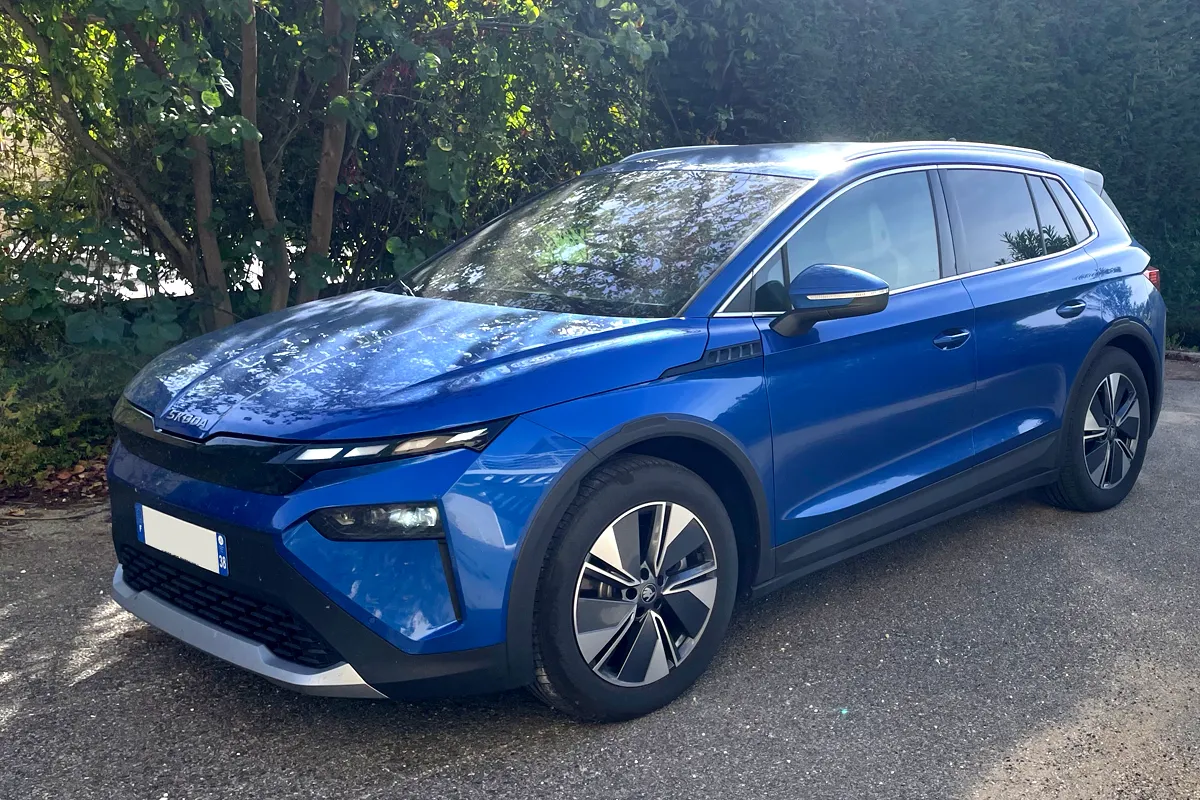
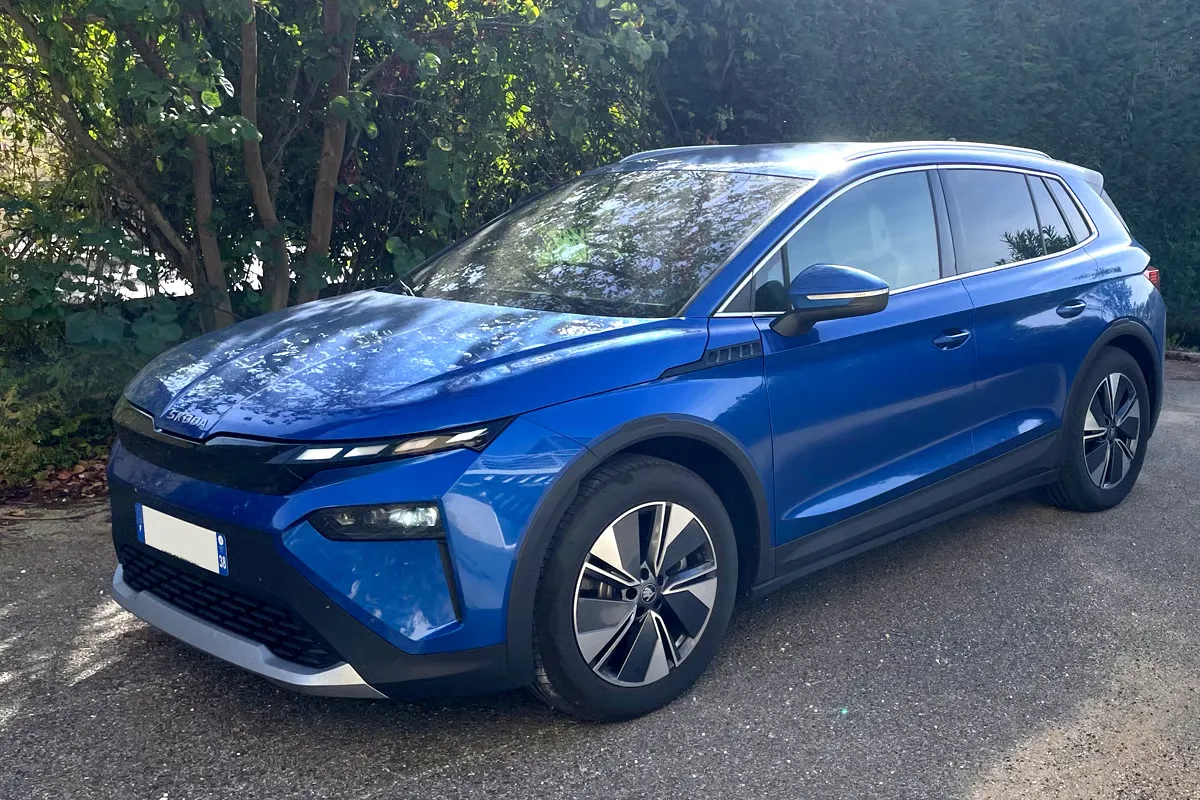
In a corner of the garage belonging to this family based in Drôme, there is the father’s 1963 Jaguar Type E Roadster and the son’s Honda CR-Z. An electric car arrived in April 2026. It is a Skoda Elroq whose mileage has already reached 19,000 km in just 5 months. It may be a short experience, but it has already been fruitful.
For an environmental reason
There are fewer and fewer pre-defined paths to get into the world of electric vehicles. Twenty or thirty years ago, enthusiasts of sports cars or classic models could already quite naturally transition to electric vehicles. For those who enjoy new technologies and/or uncommon vehicles, plug-in cars remain a source of discovery. Being interested in automotive history to the point of keeping one or more iconic models does not mean that one is unconcerned about climate and ecology.
Professional activities can offer new opportunities. This is the case for Jérôme: “As an industrialization consultant, I design factories using bioresources. My wife is even more environmentally focused in her work related to CSR. She uses our electric vehicle two-thirds of the time instead of our Kia XCeed with a turbo-diesel engine. We had been considering getting an electric vehicle for two or three years. Including our son’s Honda CR-Z and my two old cars, we have five vehicles in the house.”
It’s no coincidence that the Skoda Elroq’s mileage has already reached such a high figure: “My wife commutes to three locations at her company. The nearest one is 25 km away. When she’s there, a single charge per week would be sufficient. But she also has to travel regularly to the area of Bourg-en-Bresse, which is 220 km from our home, as well as to Auvergne. The site there is 310 km away. It’s possible to get there without needing an intermediate charge using the Skoda Elroq. This was a key requirement in the specifications. With this model, we get 360-370 km of range on the highway.”
Significant differences in rental costs
Several models were considered and tested: “In theory, it would have been the Xpeng G6 that we could have chosen. I came out of its test with a real fondness for it. Its interior is truly magnificent, and its LFP battery charges very quickly, which is a huge advantage for long trips. However, it was too expensive, and more importantly, we wanted a model with a high eco-score. It was important to us to support European manufacturing, not only for the car itself but also, if possible, for the battery as well.”
Also read
Testimonial – Bruno drove 76,000 km in a Tesla Model 3 at only 3.33 € per 100 km
Jérôme’s wife was attracted to another electric car: “For her, it was the Volkswagen ID.3. But we eventually settled on the Skoda Elroq in the 85 Plus version, built on the same platform but much more affordable to rent with better equipment. Among the options are a heat pump and a tow hitch equipped with a holder for carrying up to four bicycles. The vehicle can also pull a trailer that I use regularly to go to the landfill.”
Our reader preferred to go with long-term leasing: “As battery technology is likely to advance rapidly, I don’t want to take the risk of buying something that loses too much value when resold. With no down payment, over three years and 45,000 kilometers per year—so 135,000 kilometers in total—the lease cost for our Skoda Elroq is 720 euros. For models with similar specifications, the Volkswagen ID.3 cost 890 euros, the Tesla Model Y 900 euros, and the Xpeng G6 1,005 euros. These other models were truly more expensive.”
“We’ve regained the real pleasure of driving.”
Jérôme really wanted the high-end Sportline version: “If we didn’t get it, it’s because of its larger 20-inch wheels instead of 19-inch ones, which reduce the range by 45 km. That wouldn’t have met our needs, with an even greater actual loss in range. We use it one-third of the time on highways, just as much on mountain roads with tight turns, and the rest of the time on national roads in flat areas and cities like Grenoble and Lyon. Additionally, we’re in a region where snow tires are required in winter. The whole thing would have cost us an extra 450 euros.”
It is through these options that our driver was able to obtain a more pleasing setup: “Already with the Racing blue color scheme, and the Lounge interior theme at 850 euros, which is close to what you get with the Sportline. Thanks to the light gray materials, we enjoy plenty of brightness inside the cabin. Part of the seat cushions is black, and the safety belts are bright orange. Our Skoda Elroq, ordered in October 2025, arrived at the end of March, and we took delivery on exactly April 8, 2026.”
This model is powered by the APP550 engine with 286 horsepower [NDLR: 210 kW] and 545 Nm of torque, which completely redefines driving experiences, especially on mountain roads. With the Kia XCeed, it was often impossible to overtake on straight sections 200 meters long. With the electric version, we’ve regained the true driving pleasure we hadn’t had in a long time. The vehicle is quiet and its chassis is highly precise. The Skoda Elroq offers sufficient comfort, especially at high speeds, though less so in urban areas.
1,600 km per day
This is also for long distances that Jérôme regularly uses this electric car for: “For example, to visit my children or clients in Lyon, mostly on the highway. On a single day, my longest distance exceeded 1,600 km for a move with a deadline for returning the keys. Starting from Drôme, I passed through Paris and Compiègne to reach Nancy, then returned right away. Five charge stops were needed along the way, and everything went smoothly.”
The Skoda Elroq features a 77 kWh usable battery, providing up to 577 km of WLTP mixed-cycle range: “At home, it’s charged using a 22 kW three-phase charger. Thanks to Octopus Energy, I pay 0.139 euros per kilowatt-hour. This means charging for about 350 km on the highway at 130 km/h costs me 8 euros. That’s five times less than with my wife’s Kia XCeed and the Volvo C70 diesel I still use today, which consume 6.6 and 6.1 liters of diesel at 2.25 euros each.”
The average fuel consumption appears to be measured mainly on highways and mountain roads: “It’s 17.7 kWh/100 km, with high air conditioning use due to the heatwaves. Thankfully, we have a heat pump. But be aware, we haven’t driven this car in winter yet. At 134 km/h on Waze and an average of 118 km/h, my consumption is 18.7. With rain, it increases by 20%. It’s almost impossible to achieve very low fuel consumption with this car in our area. At best, on 50 km of county roads, I once saw 13.7 kWh/100 km.”
Charging and Heatwaves
The heatwaves also changed the landscape of charging for Jérôme: “We experienced temperatures over 40 °C during our major July trip in the Skoda Elroq. Some charging stations weren’t working due to the extreme heat. Before, I liked using Ionity quite a bit. But even under normal conditions, there are always stations that break down, which made us unsure in such circumstances. On the other hand, two networks seemed particularly stable to me: Tesla and TotalEnergies.”
It wasn’t just availability that mattered to our reader: “Even during the hottest periods, the only four times the charging curve reached and even slightly exceeded its maximum power of 135 kW was at their stations. They are a bit expensive, but Fastned and Atlante also seem reliable to me. On the other hand, I ruled out Engie due to its prices. To get reasonable rates, I had six subscriptions available for use with my smartphone. Additionally, some regional networks didn’t accept DKV, Chargemap, or Octopus. I won’t go to their stations anymore.”
The Skoda Elroq has performed well overall at charging stations: “Our electric car only needs 26-27 minutes to charge from 10% to 80%. Even when the peak power of 135 kW isn’t reached, this time doesn’t change much. I find Volkswagen Group’s platform quite reliable in this regard. Now, when it comes to charging, it’s no longer the peak power value that interests me, but rather the duration of the high-power phase and the total time required to reach 80%.”
To Review
Another point emphasized by Jérôme: “On highways or national roads, we consistently use level 2 autonomous driving with adaptation, combined with automatic regeneration. However, it’s important to pay close attention to the vehicle’s behavior when approaching roundabouts. Coming from a road at 80 km/h into a city, the vehicle does slow down to 50. But if there are country roads on both sides, the car would want to enter the roundabout at 80.”
The “Matrix LED headlights” are also highly praised. They are truly stunning and provide excellent lighting. When switching to high beams, one can see the beam widen. However, this poses a problem on highways, as the system does not respond when vehicles approach from the opposite side of the median. This results in glare from oncoming headlights. We are forced to turn off the system and manually control the switch between high beams and low beams.
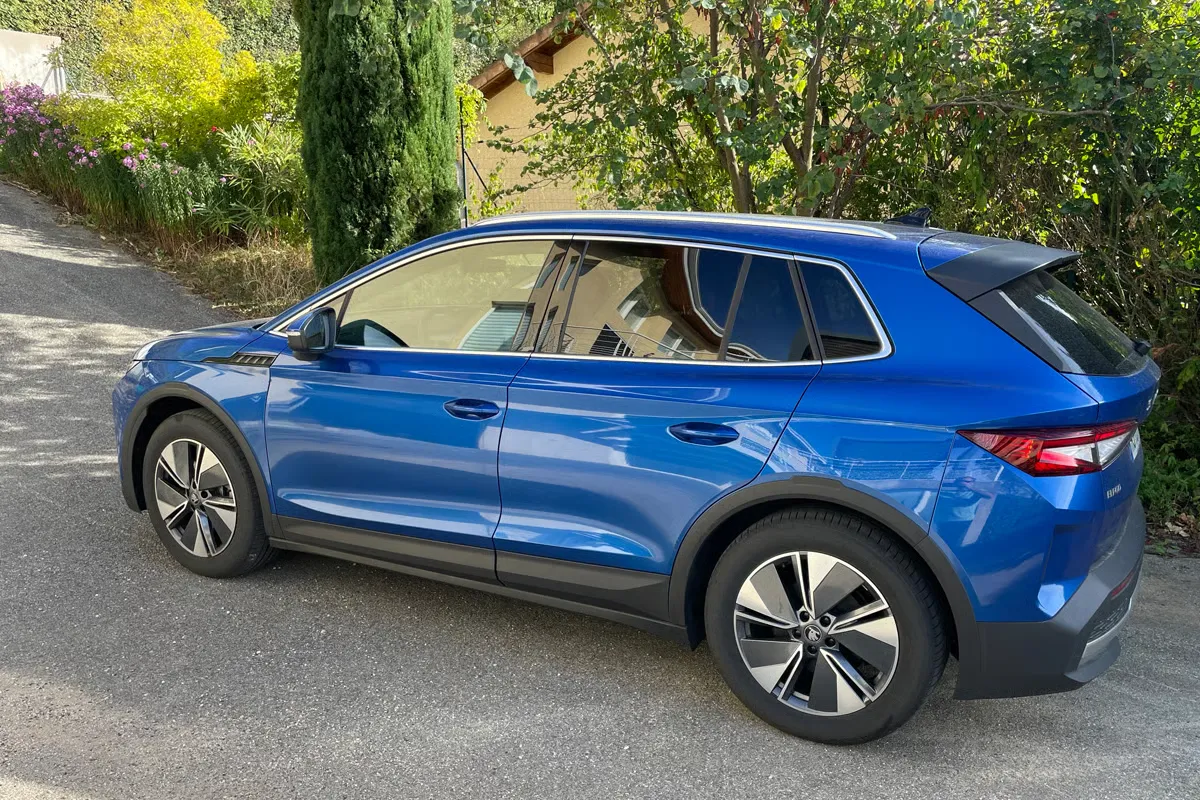
What else should be reconsidered: “The route planner itself is already really terrible. I opted for ABRP Premium instead. As for the infotainment system, it’s like Claude François’s song: ‘It goes away and then comes back…’. It keeps failing due to the loss of wireless connection from the smartphone. You have to stop and restart the vehicle for it to work again. I, on the other hand, have never had any issues with the air conditioning, unlike other Skoda Elroq users.”
Towards Tesla and Xpeng
All of this doesn’t stop Jérôme from appreciating his electric car: “With the same pricing, we would make the same choice. But Skoda has very likely revised its offers. We’ve asked our children to drive the Elroq occasionally to get used to electric cars, as I’ll also replace my Volvo C70 diesel in a while—its odometer reads 367,000 km. Our daughter would really like the Skoda, but our 20-year-old son still wants to stay with his Honda CR-Z.”
Also read
Testimonial – For slightly higher rents, Anthony preferred the Audi A6 Avant e-tron over the Renault Scenic E-Tech
For now, our reader plans to keep using his everyday gasoline car until the end: “I’m waiting for a convincing electric convertible or a high-tech version of the Porsche Cayman. In the meantime, we invite our friends and colleagues to experience electric vehicles with our Elroq, which they can test drive. They clearly leave convinced that they need to switch to electric vehicles, but not sure exactly which model. This often leads to lively discussions on the topic.”
Already four acquaintances have been referred to electric vehicles that might suit them better than the Skoda Elroq: “Not everyone has a geeky mindset that allows them to fiddle with a dongle to plan routes. That’s why I referred two families with children to the Tesla Model Y, whose ecosystem is simpler. For another two acquaintances, I recommended the Xpeng brand.”
Automobile Propre and I would like to express our sincere gratitude to Jérôme for his excellent hospitality, responsiveness, and valuable insights shared after we asked our readers for their experiences.
For your reference, any offensive comments directed at our interviewees, their lives, choices, and/or ideas will be removed. Thank you for your understanding.
Author’s Note
It’s not always the most environmentally conscious drivers who succeed in convincing those around them to switch to electric vehicles. It’s often a matter of recognition within a particular community. Once you’re labeled as too unconventional or rigid, it can become a hindrance. That was certainly the case in 2007 when I got my first electric vehicle. My friends from the Lorraine vintage car club were shocked, and no one else in the group followed my lead in getting an electric vehicle. But back then I made new friends. Jérôme faced fewer difficulties in getting people interested in electric vehicles, as development was already underway.
Sometimes the testimonials align. For example, when our readers mention preferring the Electra charging network. Other times, it’s the opposite. Here, TotalEnergies’ chargers are highlighted alongside Tesla’s superchargers. This is useful to know. On the other hand, Ionity gains another negative point. Returning on Tuesday from a long trip, I once again observed that out of 6 chargers in this network which I still visit regularly, at least one was marked red as unavailable.
Another point raised in this testimony: just because a car has flaws or shortcomings does not mean it cannot be appreciated. Similar to internal combustion engines, one can work around these issues with some tricks or accessories. For example, by installing a frunk that is not available originally. This is exactly what Jérôme did (it’s not mentioned in the article), in addition to using ABRP Premium to overcome a subpar original planner.
Philippe SCHWOERER