
Testimonial – Bruno drove 76,000 km in a Tesla Model 3 for only 3.33 € per 100 km
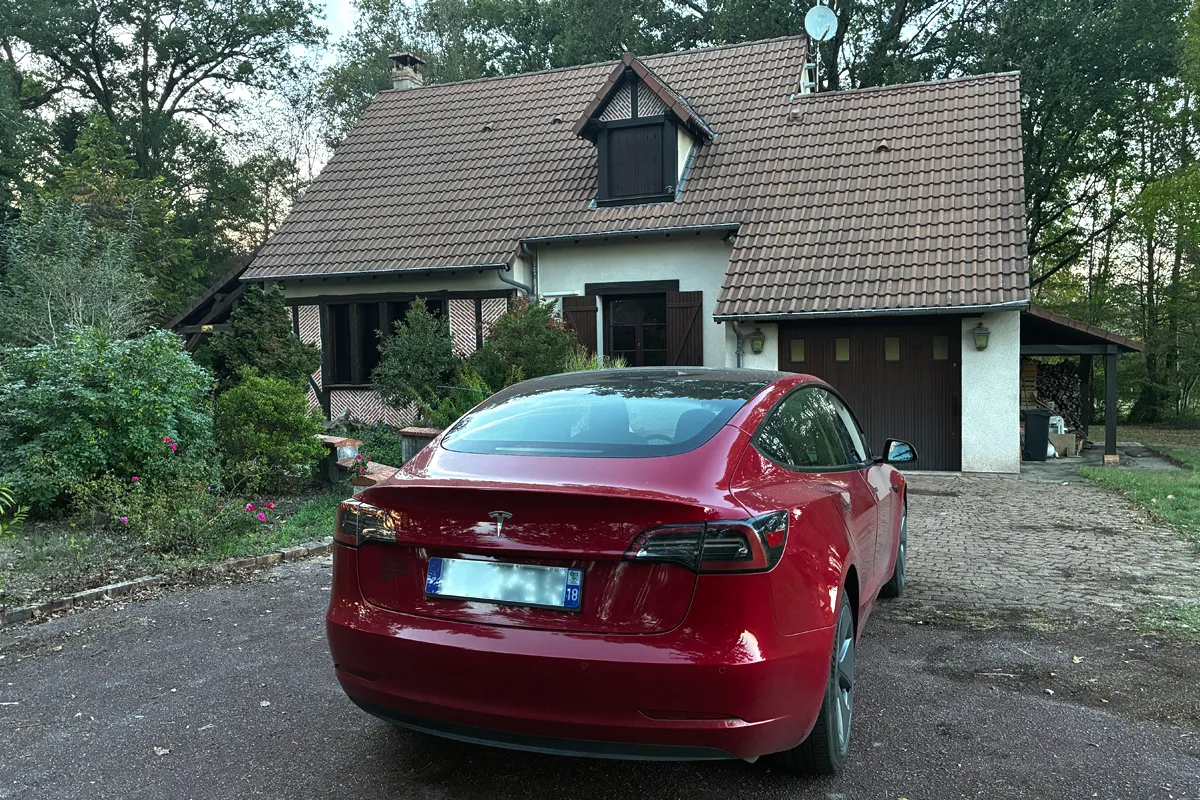
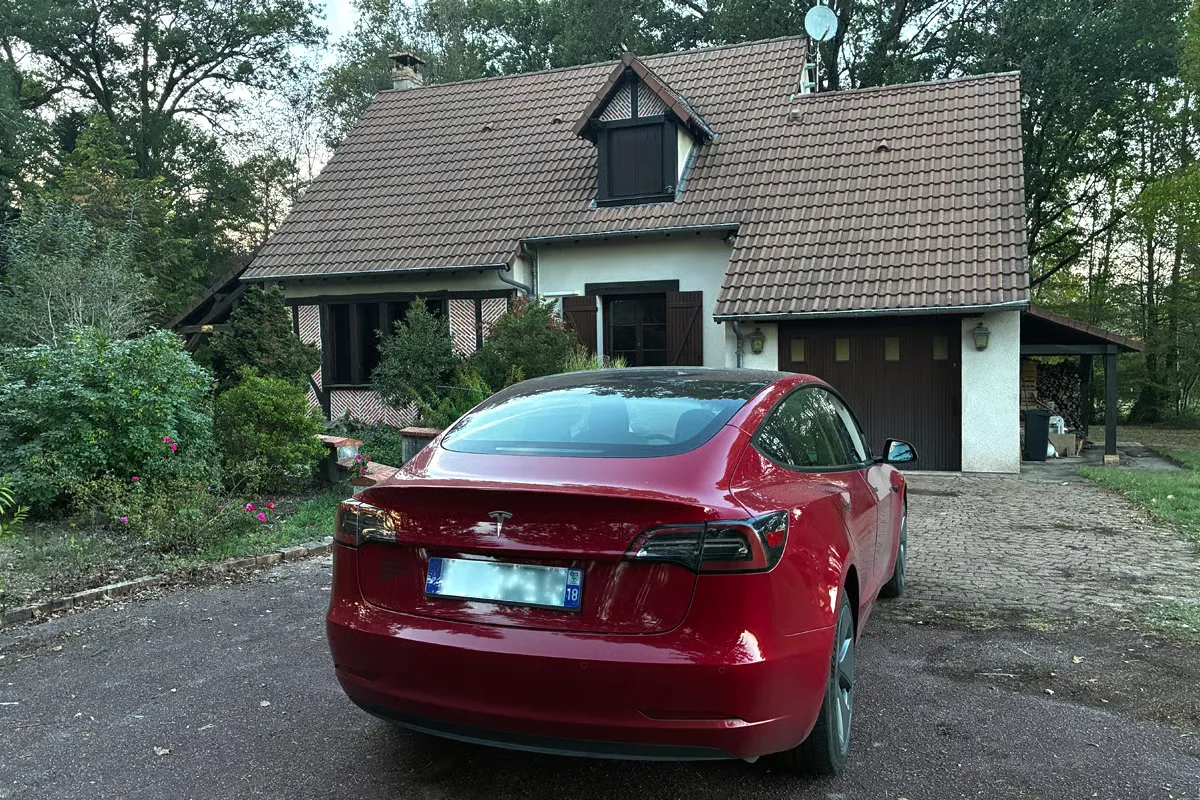
Before retiring, Bruno owned two Toyota cars. His wife’s gasoline-powered Yaris is still around, but the hybrid Auris was replaced by a Tesla Model 3 electric sedan that he drives frequently for long distances as well. In his testimony, he explains why he switched to electric vehicles and why he chose this model, as well as how he manages things to keep his average cost per kilowatt-hour relatively low.
First time using an electric car
When he was still working as a manager for an order preparation team, Bruno, now 66 years old, drove both gasoline and diesel cars: “It was out of a sense of environmental awareness that I wanted to drive more cleanly, first by switching to a hybrid Toyota Auris which I sold when I retired. From the Parisian region that we are about to leave to live in Cher, I needed to be able to quickly visit my mother in Haute-Marne if necessary.”
This journey, about 250 km long, he initially thought of completing it using TEC services in a multimodal manner: “I would have had to take the RER first to reach Gare de l’Est, then a train to Chaumont, and finish with a taxi to get to my mother’s house, 30 km away. With transportation that wasn’t well organized or reliable enough, it made no sense to rely on such a complicated route for quick trips. I preferred to rent a car, and an electric one at that, when my mother needed home repairs for a week.”
Also read
Testimonial – After 15 years with diesel, Christian regrets switching from a rechargeable hybrid to an electric vehicle
Our reader thought he made a good choice of model: “I also needed to be independent once I got there. I ruled out electric city cars so that I could have enough range to reach Haute-Marne without needing a recharge along the way. So I chose a second-generation Nissan Leaf, which was promised to have a range of over 350 km. But it was November, and this compact electric car was far from capable of covering such a distance, even with the battery fully charged.”
The Tesla choice
Many drivers would have given up on electric vehicles after such a trip: “I was already disappointed by the range, and I would have been even more so due to my poor charging experience. It was 2021. I looked for a charging station, but this car required a CHAdeMO connector. I realized how complicated it was to charge such an electric vehicle, with so few compatible stations available, not to mention all those 22 kW AC chargers that weren’t accessible in public areas. Other times, I rented a gasoline car.”
Our reader then decided to buy an electric car: “I needed at least 400 kilometers of real-world range, a connector that met European standards, and reliable charging infrastructure. That ruled out quite a few models. In 2021, there weren’t many options. I naturally turned to Tesla, which has established its own highly efficient charging network. Since I received my Model 3 in 2022, I’ve only experienced five minutes of waiting once, during a busy period in July and August. Diesel drivers sometimes wait even longer.”
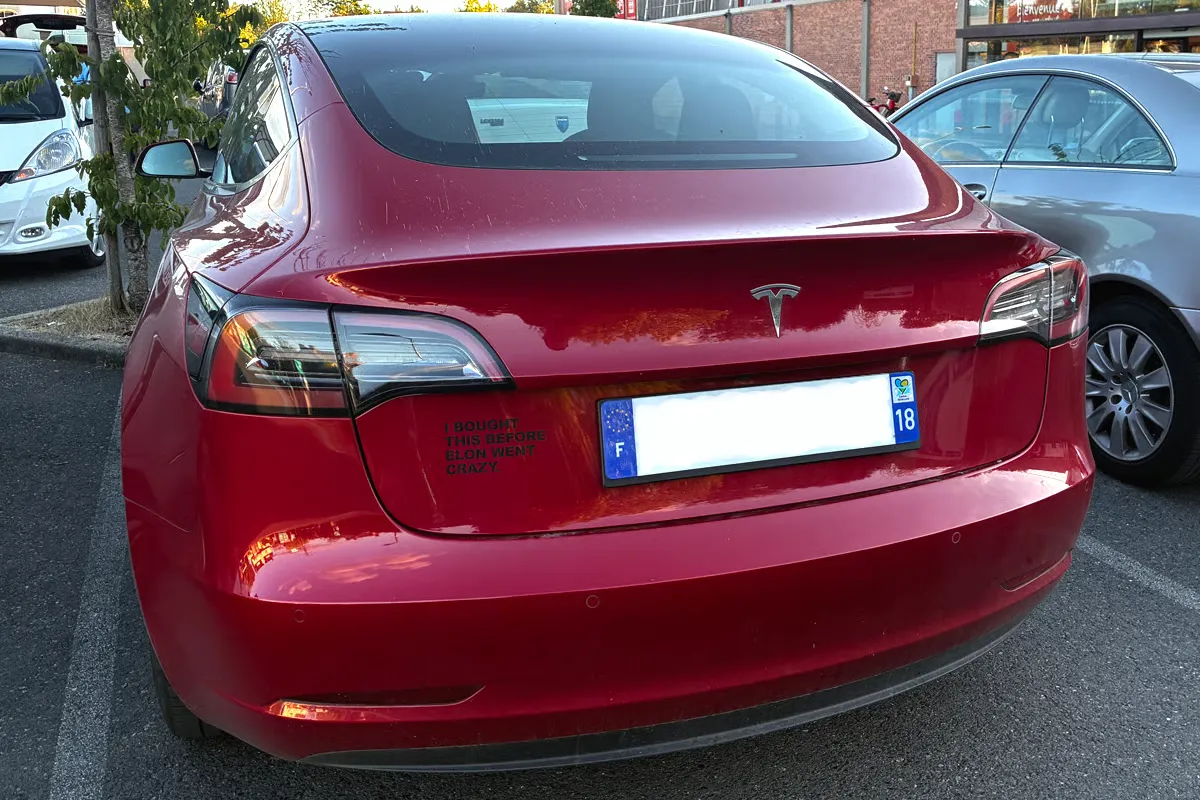
Today, one can read this message on the back of a car: “I bought this before Elon went crazy.” It expresses what electric vehicle owners feel: “For me, when I placed an order for the Tesla Model 3, Elon Musk was seen as an innovative and visionary business leader like Steve Jobs at Apple. He hadn’t yet committed the misdeeds we know of today. Without trying it out, I ordered a Model 3 in February 2022, at the start of the Ukraine crisis which added to the problems with electronic components.”
15.2 kWh/100 km consumption over 76,000 km
The purchase context explains the delay in delivery: “The timeline was supposed to be three months. It ended up being six, as I received my Tesla Model 3 in August 2022. By reading articles from Automobile Propre and watching videos from various YouTube channels, I realized that everything I discovered matched what I wanted. After placing the order, I still reserved a test drive to make sure I hadn’t made a mistake by choosing this car. In the standard range version, I bought it for 38,900 euros.”
With a battery capacity of around 60 kWh, this model was rated at 491 km of range in mixed WLTP conditions, and 390 km on the highway in summer (300 km in winter): “I was still scared a week after receiving my Model 3, during my first trip to my mother’s house. I had been able to make the round trip without stopping. On the way back, I planned to charge at Chaumont. I hadn’t paid attention to the battery level. A message appeared on the center screen: I arrived at the superchargers with 2% of energy left.”
No more worries: “Arriving at the charging station with less than 10% battery left doesn’t scare me. Over the 76,000 kilometers driven since delivery, my average energy consumption is 15.2 kWh per 100 kilometers, while driving at 130 km/h on the highway. The estimated remaining range becomes more optimistic when I restart the vehicle while driving. I can then limit my speed to 125 km/h until it stabilizes. To avoid stress, I drive with the speed limiter on — which irritates many drivers behind me, some of whom overtake me in their Renault Twingos.”
Almost no home charging needed
Tesla electric vehicle owners generally aren’t afraid to travel long distances: “For a wedding near Bayonne, I once drove 1,600 kilometers in four days, arriving on Friday afternoon and returning on Monday. We’ve also been to the Pyrenees several times, as well as to see the Verdon Gorges, and to explore the Alpes-de-Haute-Provence. We set off with a fully charged battery, recharge along the way at Tesla stations, and then depending on what’s available where we go.”
In foreign countries as well: “For example, in Belgium. But our longest trips are to Ireland, which includes a ferry crossing. Since my wife’s daughter moved to Dublin, we’ve been there several times already. The first time was to help her settle into the house she had just bought. After that, we explored more of the country, going as far as Belfast and other places. I didn’t subscribe to any special plan for charging; I just used Tesla’s regular rate and appreciated the Plug & Charge feature.”
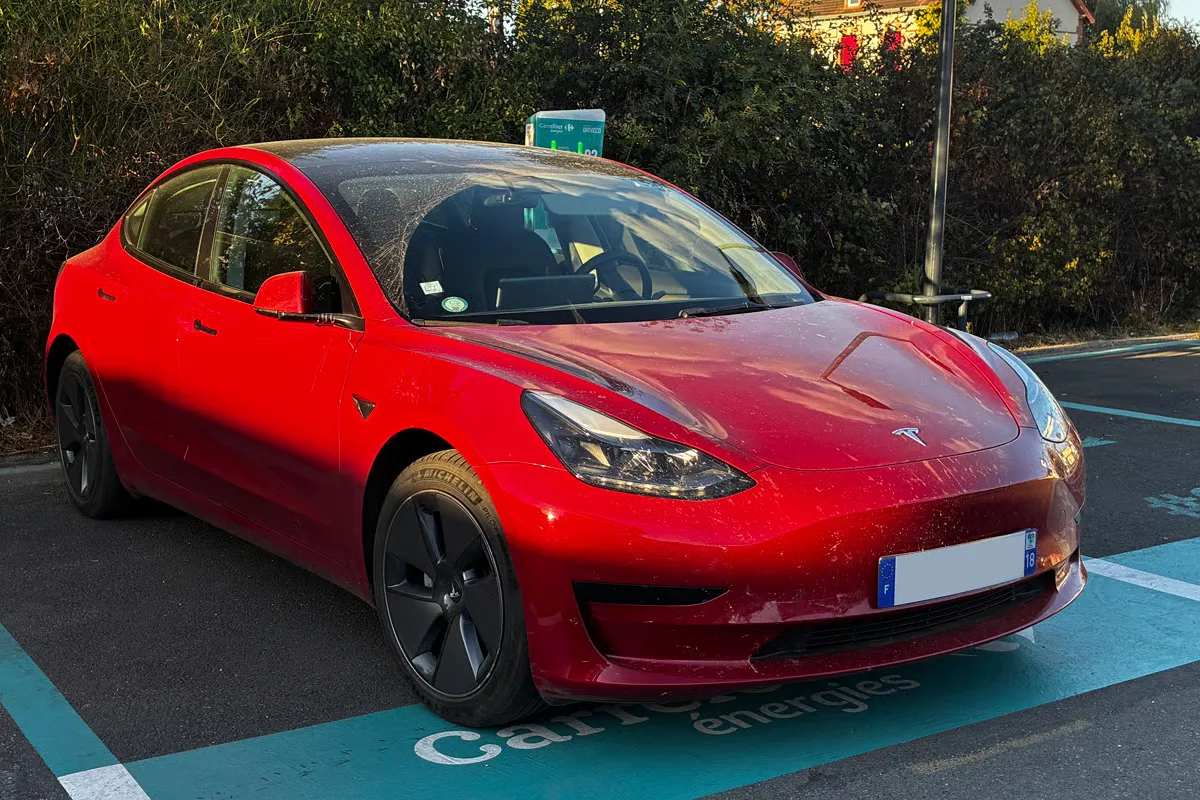
Bruno only charged his Tesla Model 3 partially at home from 2022 to 2024: “I wasn’t too comfortable plugging it into a household outlet. Installing a Green’Up upgraded model was an option, but not a Tesla Wall Connector, as we already had plans to move, though we didn’t know when yet. So I took advantage of the free charging at Carrefour.” Our reader’s account was actually gathered while he used a charging station at the store, with the photo above taken on that occasion.
Free Charging at Carrefour
The use of free charging at Carrefour has a significant impact on the cost per 100 kilometers: “When I still charged at home, up until 2024, the cost was 4.00 euros. But in 2025, even though we had traveled less and I made good use of the free charging at Carrefour, the cost dropped to 1.99 euros. Since the beginning of 2026, it has risen back to 2.99 euros because we’ve traveled a lot again. All in all, the average cost since we received our Tesla Model 3 is 3.33 euros.”
The terms of use for charging at Carrefour have changed, but Bruno still finds it convenient: “Previously, you could get an hour of free charging by using the loyalty card. There were always lots of people there. I would go there early in the morning before others, around 7 a.m., for example. They’ve all disappeared since free charging became dependent on the paid Carrefour credit card and requires a pooling system. You really need to be a customer of the store for it to work. Which is my case, as I do some shopping while the car is plugged in.”
Our reader really doesn’t understand why everyone has left: “The charging stations are still there after all. I might have to pay 30 euros per year for my Carrefour Pass Card, but if it allows me to top up free up to 300 euros during the same period, that’s still a 270-euro saving. It’s amazing that other former users didn’t do the math! Many new electric vehicle owners use their EVs in the same way they used their previous vehicles, without any intellectual curiosity. They’re not the enthusiasts and geeks of the past.”
Other EVs around Bruno
Bruno finds only one downside to his Model 3: “It’s the lack of a trunk lid. If Tesla had offered a choice like Opel did with its Vectra, available either with a trunk cover or a hatch, I would have chosen that version. When I decided to buy an electric vehicle, the Tesla Model Y hadn’t been released yet. Additionally, I don’t like SUVs; I prefer sedans. But with this model, I can’t fit my bike in the trunk. Recently, I sponsored a friend who happened to buy a Model Y after seeing how easy it is to drive an electric car during a trip with us.”
Our reader has also convinced others around him: “These are my two children. The three of us cover all possible vehicle ownership scenarios: my daughter has an MG ZS EV through a lease, my son just bought a used Model 3, and I purchased my own new Tesla outright. I think even their mother—my ex-wife—drives an electric vehicle as well. My current partner and her own children still drive gasoline cars.”
An understandable difference: “My current wife doesn’t share my sensitivity toward eco-friendly things like electric cars and solar panels. Her Toyota Yaris, bought new in 2018, has only 27,000 kilometers on it now. It served her before retirement for her 10-kilometer daily commutes between home and work. As soon as we leave the Essonne region, we use the Model 3. All of this means she has no desire to change cars, even for a Renault 5 E-Tech, Volkswagen ID. Polo, or another car of similar size.”
Her last car?
Our reader sees many advantages to driving an electric vehicle: “It’s comfortable, with no diesel smell or vibrations. And the silence! When people ask me about it, I say, ‘Have you ever been on a TGV? Well, it’s just as quiet!’ On trains, you can hear the clacking of wheels on the tracks, which is similar to what happens on highways when the road surface changes. An electric car is just as comfortable as a TGV, with an adaptive cruise control that works very well.”
Also read
Testimonial – Between the Renault Megane and the Volvo EX30, the dealership experience shaped Andrea’s choice
He says, “Many drivers are worried and say they don’t want to switch to electric vehicles. Just the elimination of maintenance is a huge improvement. I compare what we’re experiencing to the development of cell phones. Many said they would never switch to them. And now, despite those who resist, smartphones have become ordinary everyday items. Tomorrow, electric cars will be just as common.”
In retrospect, Bruno still appreciates his Tesla Model 3: “There’s an amazing amount of space in the trunk, with room underneath for charging cables. I use the frunk mostly to store a cooler. Since I got this car, aside from electricity costs, it’s only cost me two wiper blades at 30 euros each. I plan to keep it for a long time. I had never bought a new car before. I think this Tesla Model 3 will be my last car. I got to test FSD as a passenger. It might come in handy when we get older.”
Automobile Propre and I would like to thank Bruno greatly for his excellent hospitality, responsiveness, and interesting testimony shared after our request for feedback from our readers.
For your reference, any offensive comments targeting our interviewees, their lives, choices, and/or ideas will be removed. Thank you for your understanding.
Author’s Note
While Toyota continues to insist on putting its hybrids first, many of its customers have switched to electric vehicles elsewhere. Bruno once again illustrates this on our site. The Japanese automaker seems unaware that for many people, the hybrid is merely a transitional option while they gain more confidence, especially regarding charging.
Let’s not forget that Tesla has done tremendous groundwork worldwide with its reliable and highly popular superchargers. It’s still puzzling why so many other operators fail to match its standards, especially since their pricing seems quite affordable as well. Fortunately, traveling in electric cars and vans has never been easier in France, thanks to significant improvements in charging speeds.
Another takeaway from this account is that Bruno’s choice proved fruitful—there are at least three or four people around him who, thanks to him, have also adopted electric vehicles, likely inspiring others to do the same. This is precisely how cleaner transportation methods gain traction.
Philippe SCHWOERER