
Testimonial – Bertrand saves 2,500 € per year by driving an electric vehicle
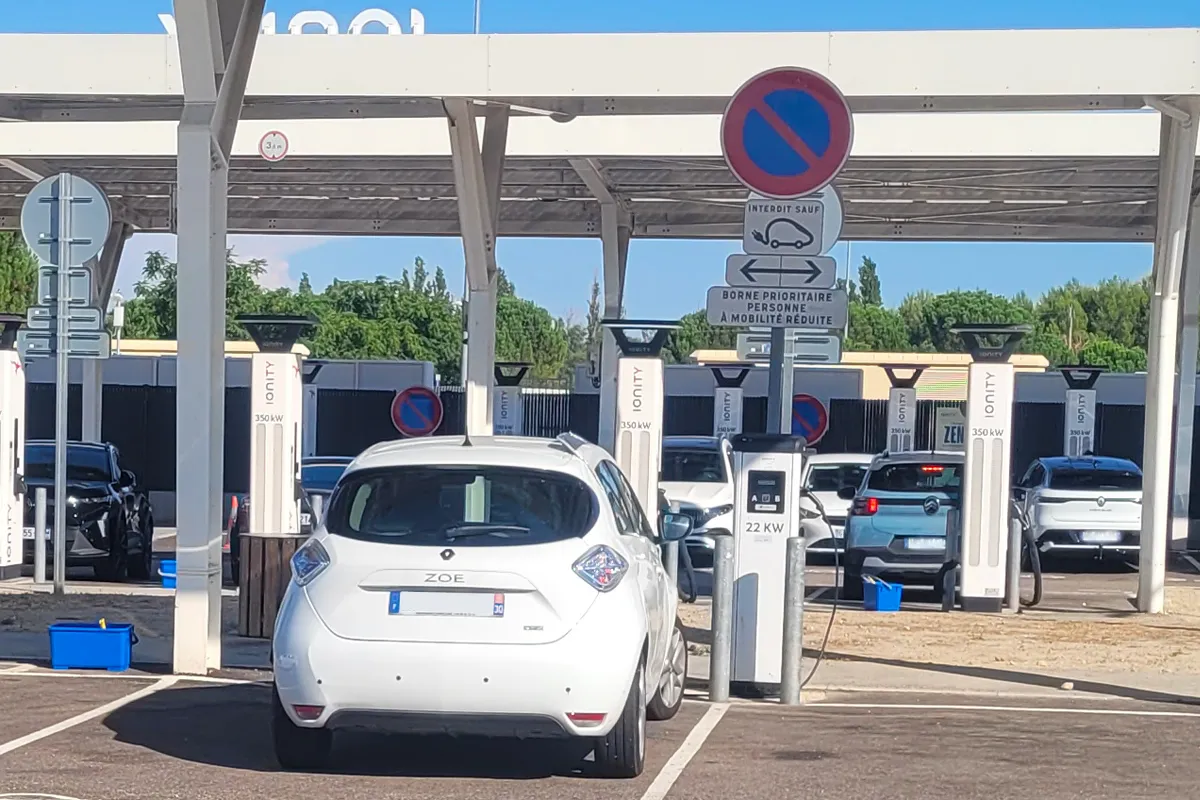
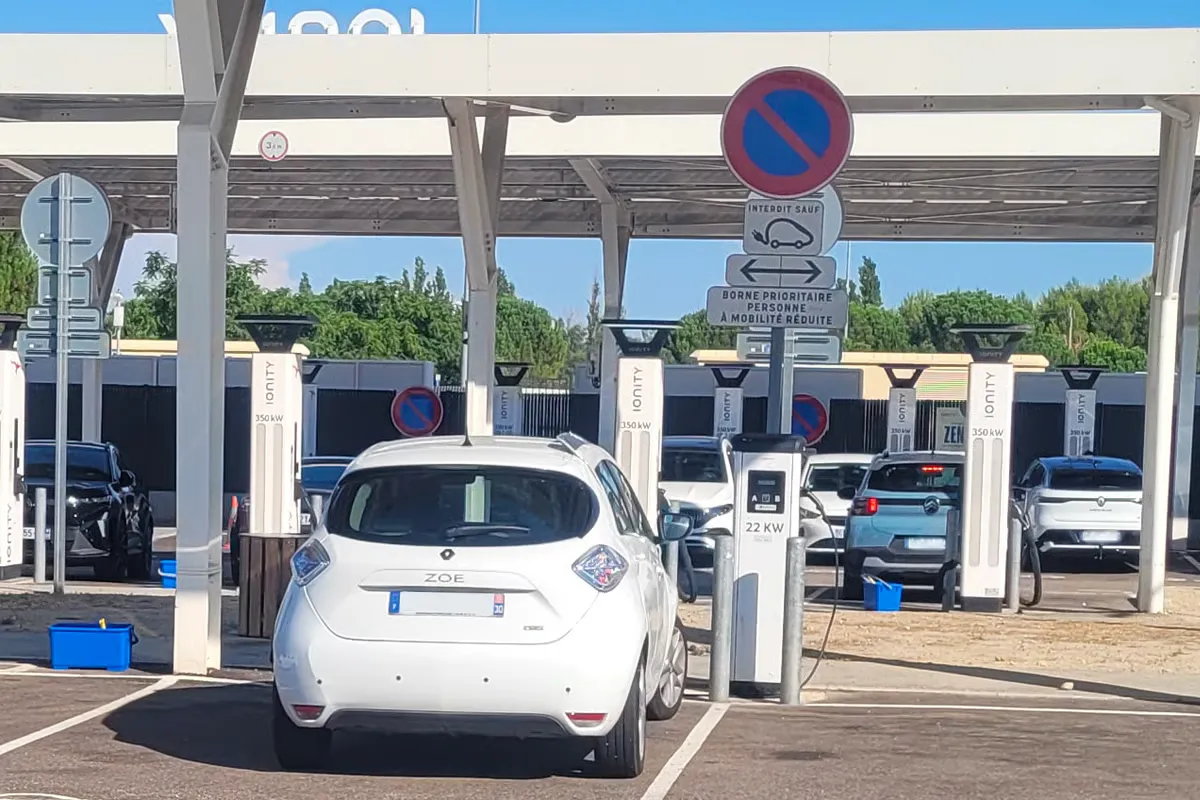
It was officially at the beginning of 2020 that Bertrand’s family switched to electric vehicles. They don’t have any large models, but a Citroën C-Zero and two Renault Zoés that have transformed the life of the couple and their daughter. A few years earlier, they were still driving on Canada’s wide roads in Jeep Cherokee V8s.
A sudden shift in carbon footprint
Sometimes, it only takes a little to trigger a change in one’s own commuting habits: “I decided to try the personal carbon footprint assessment tool with MyCO2 without knowing exactly what would be the most impactful finding. For me, it was my travel that stood out. We drive 25,000 to 35,000 kilometers per year, and even up to 45,000 kilometers in some years. My commute between home and office is 70 kilometers round trip, and my wife’s is 20 kilometers. Our family lives no more than 200 kilometers away.”
With that established, the next step was figuring out how to rebuild the household’s fleet: “At first, I wanted to try a small electric car to see if it could handle daily commutes. I chose a Citroën C-Zero to replace another city car, a gasoline Kia Rio, which I kept for a month or two as a precaution. In the end, we sold it for 7,000 euros—almost exactly what the used 2016 Citroën C-Zero cost us, without any discounts at the time. It wasn’t even a very sought-after model back then.”
Also read
Testimonial – Highly disappointed with a European vehicle, Delphine reconciled herself to electric cars thanks to a Chinese model
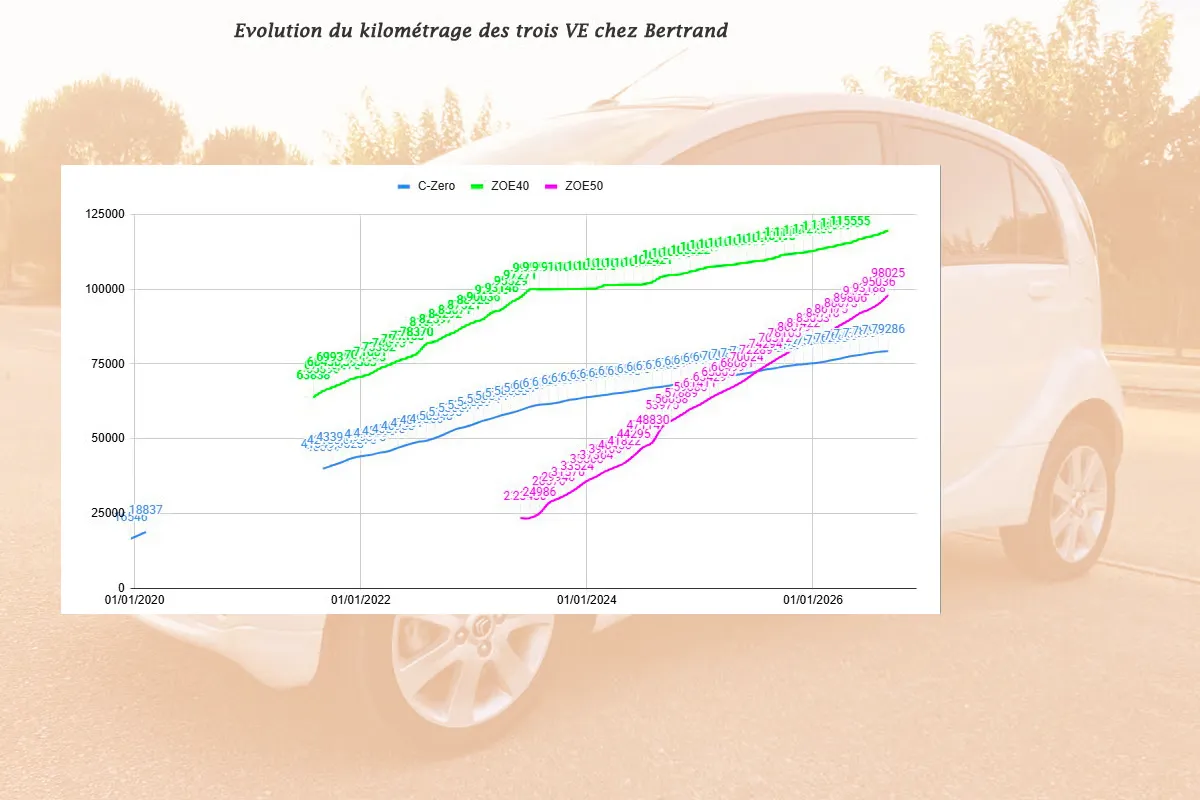
When we bought it, this first electric car for our family in the suburbs of Montpellier had only 16,000 km on it: “We still have it, and its odometer now shows 80,000 km. I had calculated the required range in advance. The seller assured us it had a range of 110 to 120 km. Around 100 km was more than sufficient for me. It was in Provence. It was to pick it up that I began researching roadside charging options. And then I needed CHAdeMO connectors.”
4-Passenger Carpooling in the C-Zero
Our 51-year-old driver has noticed a certain decline in range: “In the summer, I can still expect 80 to 90 km of range. Over the past 5 to 10 years, as I’ve gotten older, my driving style has become more cautious. I follow the advice to keep the power gauge on the dashboard between ‘C’ and ‘Eco’. For roundabouts, I plan ahead so I don’t have to brake when approaching them. This gives me a fuel consumption of 10-12 kWh per 100 km. But be aware that due to its shape, the C-Zero experiences significant wind resistance when going downhill.”
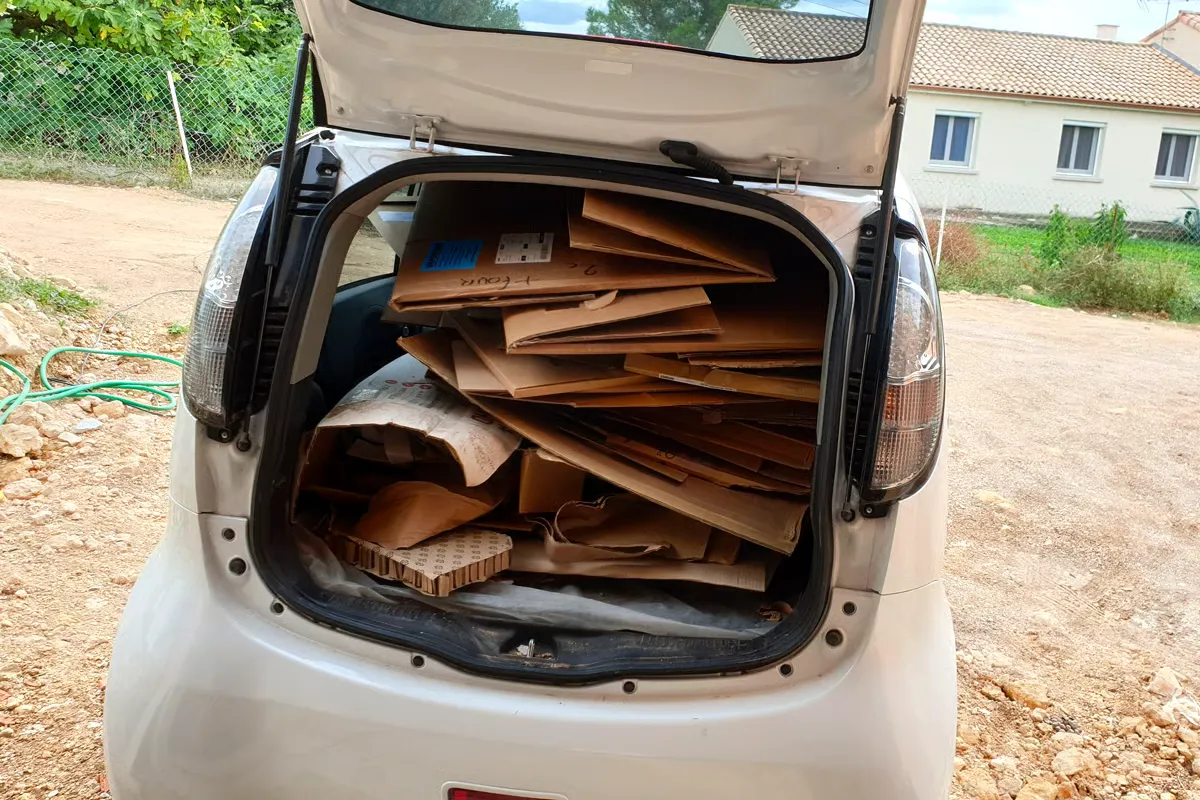
Bertrand’s electric city car is still in high demand: “I thought about what could be done within the company to reduce carbon emissions in transportation. We now use carpooling through the BlaBlaCar Daily platform. I set up a shared Excel file to track who drives and who wants to be a passenger. There have been times when four people were in the C-Zero, including a colleague who is 1.90 meters tall. No one complained about lack of space. On the contrary, everyone was surprised by how spacious it is.”
In addition to the company’s internal subsidies, there are also those from the Occitanie region: “For a one-way trip of up to 30 km, I receive two euros. Since July 2026, each passenger has to pay fifty cents; it’s much cheaper for them than using a private gasoline car. We take turns driving. One of us drives a Tesla Model S he acquired because he has three young children. Since the beginning of the year, I have driven for 90 trips, covering a total of 2,000 km, which earned me 166.50 euros. As a passenger, I have traveled 900 km for 41 trips.”
Zoé cars as primary vehicles
In use, the Citroën C-Zero quickly revealed one of its weaknesses, which Bertrand tried to address: “Its resistance heating is very energy-intensive. I thought about covering the hoses exposed to the air under the car with insulation, a design flaw inherited from the previous thermal version. Eventually, I bought a heating cover at a low price through Lidl’s website. In Hérault where we are, negative temperatures don’t occur very often.”
Our reader is satisfied with his first experience driving an electric vehicle in his Citroën C-Zero: “My hope is to be able to make an upgrade, as Revolte pushes for its legalization in France. By changing the battery technology, it would be possible to achieve a range of 250 km with such a city car. Currently, such an upgrade isn’t possible because it affects the vehicle’s basic specifications. Thanks to our positive experience with electric vehicles, we’ve also considered switching to an EV for our main car.”
To achieve this, the IT project manager turned to Renault: “We started with a 2017 Zoé 40 that now has an SoH of 83% after 120,000 km. It already allowed us to drive 200 km to our parents’ house without needing a mid-stop charge. Since she moved out with us last May, our daughter took over this car instead of her diesel Hyundai. Later, we acquired a 2020 Zoé 50 whose odometer now reads around 100,000 km. For that one, the battery health is at 92%.”
Free charging on highways
Despite relying solely on a 22 kW AC charger, Renault Zoé vehicles are still used for travel: “In the summer of 2024, we went to Croatia with the Zoe 50, covering 3,800 km in 13 days. For our stops, we used the Chargemap planner and then ABRP. With two friends, we were four people in the car when we recently went to Genoa, Italy. Starting from Aix-en-Provence where we were staying, we stopped in Monaco. During the two hours of free charging at a very clean parking lot, we were able to visit the city.”
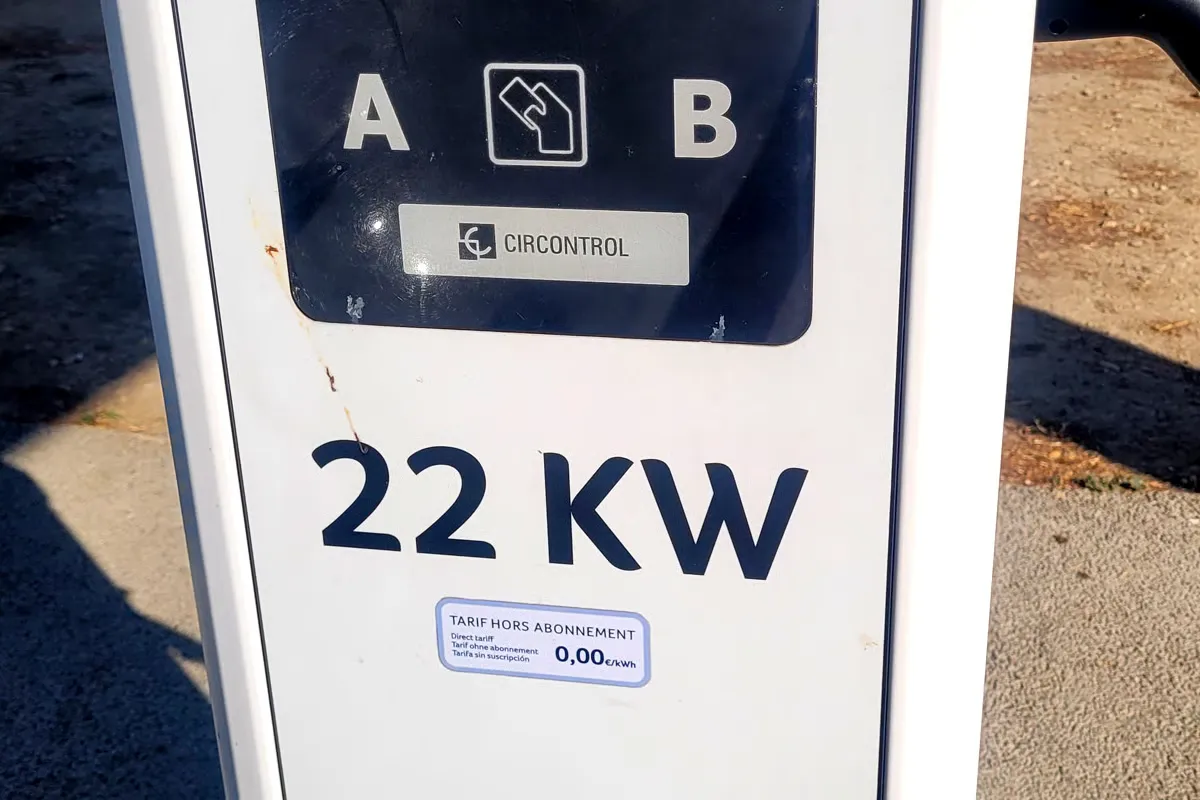
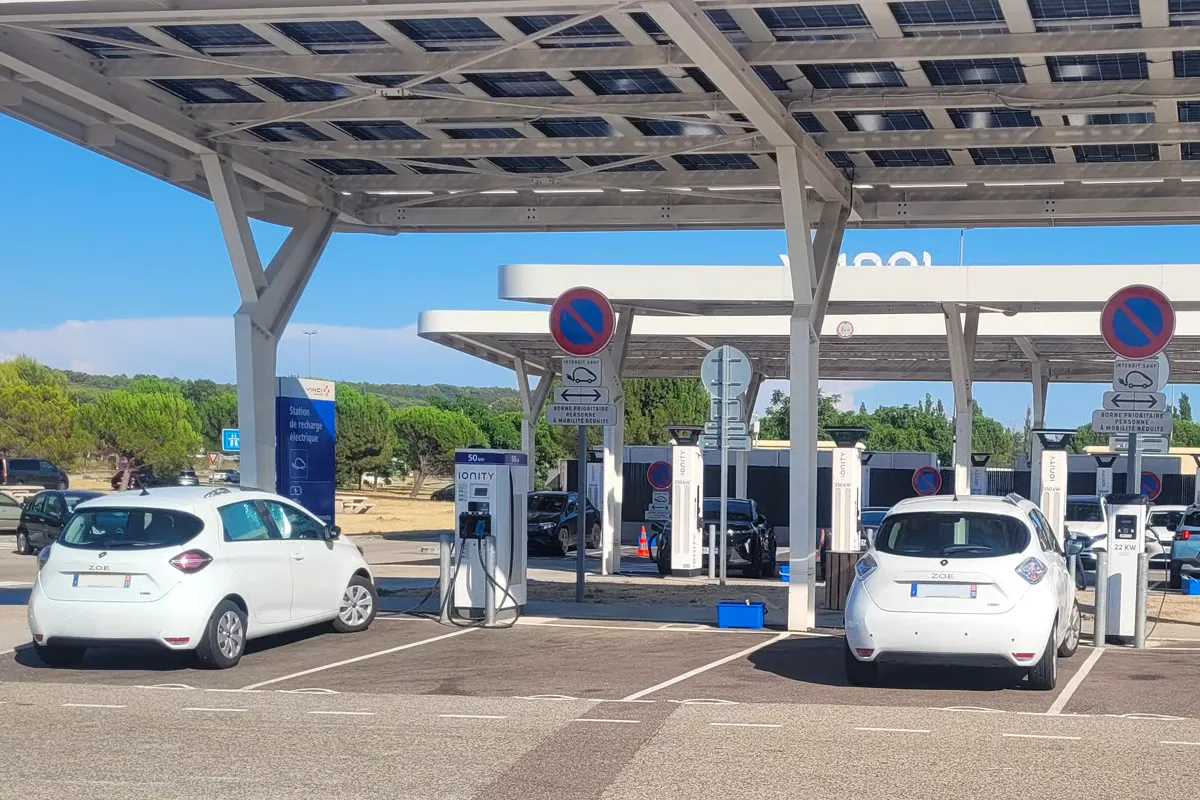
Between the Zoé 40 and the Zoé 50, Bertrand changed his habits when traveling long distances: “With the first model, the best strategy was to avoid highways. It’s the opposite with the Zoé 50, which allows us to save time even when driving at just 110 km/h. The fuel consumption is around 17-18 kWh per 100 kilometers. We can drive for two and a half hours, then charge for two hours, and so on. As we get older, we want to reach our destination faster. As long as there are no constraints, it’s hard for us to change our habits.”
Regarding charging on the highway, our reader has his own tips for frequent trips: “I definitely target triple-standard chargers where I can plug my car into the Type 2 AC connector. It’s even better when there are free 22 kW AC stations. Like at the Ionity station in the Mornas Village service area, where I stop on my way back from my daughter who now lives in Lyon. Being able to drive 600 km round trip for free these days, especially when colleagues are talking about rising fuel prices, is really thought-provoking.”
Savings
Even with three cars in the house, charging works very well: “We had our house built in 2020, the year we got the Citroën C-Zero. Before that, we lived in an apartment on the first floor of a large house. With a long extension cord, we connected the car by running the cable through a window. The C-Zero can be fully charged in eight hours at night when plugged into a regular household outlet. The Green’Up is meant for Zoé cars. Meanwhile, we can charge half of our car’s battery. When our daughter was still here, we took turns: her Zoé one night, ours the next.”
Bertrand played around with some calculations: “About half of the household’s electricity consumption is for our electric cars. That amounts to a little over 5,000 kWh per year, with a charging cost of less than 3 euros per hundred kilometers. For context, our house is fully electric and well insulated. In 2024, including the C-Zero and the two Zoé models, we saved approximately 2,700 euros in energy costs throughout the year, and 2,400 euros last year. I compared this to a fuel consumption of 6 liters per hundred kilometers using gasoline at 1.70 euros per liter.”
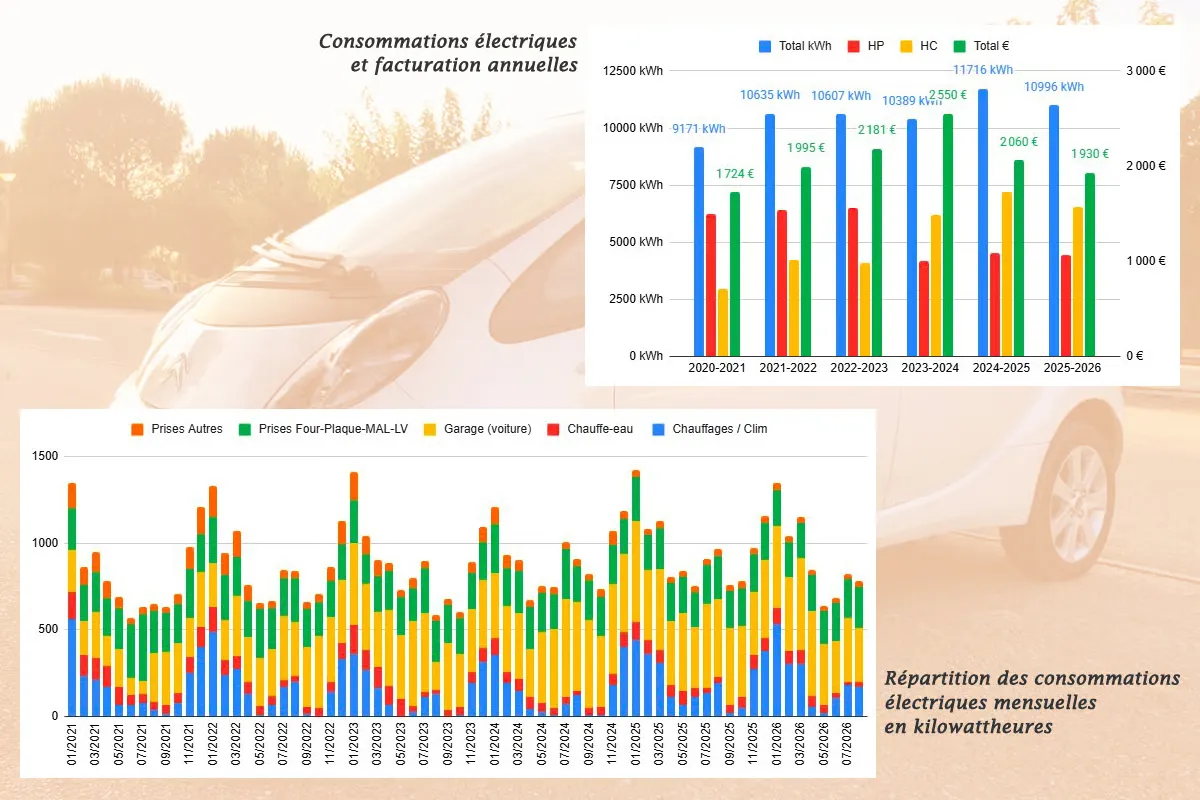
A recent savings was also achieved by switching from the off-peak/on-peak rate to Tempo: “During the 22 peak days, I turn off the reversible air conditioning at 6 a.m. and turn it back on at 10 p.m. This reduced our annual electricity bill from 2,500 euros under the previous contract to 2,000 euros with Tempo. Charging electric vehicles is what we can most easily schedule during off-peak hours. When people ask me questions with preconceptions about electric vehicles, I don’t hesitate to say that the savings we make more than cover the cost of dining out while charging during holidays.”
Repairs
For maintenance tasks, Bertrand also makes sure not to spend too much: “With our three electric cars, we haven’t encountered major problems. Aside from the well-known engine rolling issue with one of our Zoé models. At Renault, we would have been billed between 6,000 and 7,000 euros including tax for a complete engine. With about ten hours of labor just to replace the faulty parts, I only paid 1,800 euros including tax by going through Golden Services garage in Marignier, Haute-Savoie.”
Another address suggested by our reader: “Some garages refused to help with a noise issue on the wheels of one of the Zoé vehicles, claiming it was electric. I went to LWS Automobile in Baillargues, Hérault: they also repair batteries, BMS units, and electronic components. Like Revolte and its network, there are independent garages that have much better knowledge of the Renault Zoé and other electric cars than dealership staff.”
Also read
Testimonial – After 5 electric cars, Olivier found one he considers almost perfect
As for the costs of repairs, the electric vehicle enthusiast downplays them: “Sure, 1,800 euros is still a significant amount to spend on replacing the engine bearings in a Renault Zoé. But it’s still cheaper than the 3,000 euros that a colleague had to pay to replace his punctured AdBlue tank in a Peugeot 307 diesel.”
What’s next? “Now that our daughter has left home, I could consider having just one electric car for the household, even one smaller than a Renault Zoé, renting a vehicle occasionally for longer trips. We’ve also avoided flying for several years now.”
Automobile Propre and I would like to express our sincere gratitude to Bertrand for his excellent hospitality, cheerfulness, responsiveness, and his very interesting testimony provided in response to our request for feedback from our readers.
For your reference, any offensive comments directed at our interviewees, their lives, choices, and/or ideas will be removed. Thank you for your understanding.
Author’s Note
Who would have known before reading this account that it’s still possible today to charge one’s electric car for free in certain highway rest areas? Personally, I learned about this through Bertrand. However, this option isn’t suitable for my own electric vehicle or those of most other electric car owners. It’s only a benefit for those who can make the most of 22 kW AC charging and aren’t afraid to stay at the site for a long time.
If the focus is on the savings that can be achieved by driving an electric vehicle, it is also relevant to the overall approach taken after conducting a personal carbon audit. Let us not forget that the push toward electric vehicles aims primarily at reducing one’s personal carbon footprint. Even the smallest effort matters and is not limited to transportation alone.
A point that should not be overlooked, as Bertrand notes, are independent garages that know how to work on electric cars and have the capability to do so. When a dealership offers an exorbitant quote, do not hesitate to look for better options.
Philippe SCHWOERER
