
Testimonial – With its fleet of electric cars, this SME saves up to 2,000 euros per month

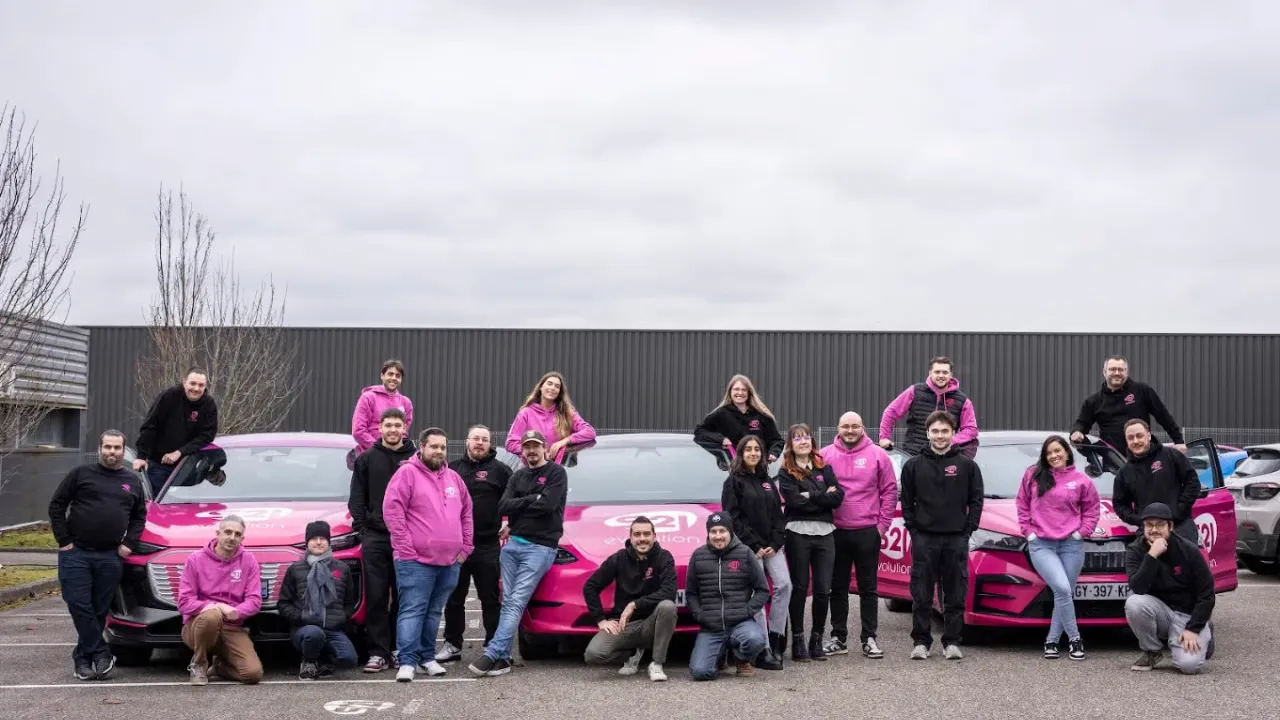
Luc Eschbach, co-manager and administrative and financial director of S2i Evolution, a web and e-commerce agency based near Mulhouse and Strasbourg, switched the company’s service vehicles to electric models starting in 2021. Tesla, Audi, Skoda: his fleet now runs without a single drop of fuel. This decision was initially driven by data, which he details thoroughly, ranging from negotiating lease terms at dealerships to the reception given by employees.
From a rechargeable hybrid to a 100% electric fleet
S2i Evolution employs 26 people across its offices in Brunstatt-Didenheim and Strasbourg, serving five departments: Haut-Rhin, Bas-Rhin, Territoire de Belfort, Doubs, and Vosges. The company’s eight electric vehicles are reserved for management use and operational needs. Each one averages 20,000 kilometers per year, whether for client appointments or personal use by the drivers.
How did the company achieve this transition? The first step came in 2020, during the peak of the health crisis. Luc acquired a rechargeable Skoda Superb hybrid, the only PHEV in the company’s history. The experience was short-lived: “I drove over 30,000 kilometers per year. With its limited electric range, I still had to stop at the gas station every week.”
In response to this reliance on fuels, the company switched to electric vehicles the following year with a Skoda Enyaq, the first electric vehicle in its fleet. This was followed by a Peugeot e-208, Teslas, other Skodas, and more recently, Audis. Today, the agency’s parking lot houses eight vehicles: two Audi Q6 e-trons, four Tesla Model Ys, one Tesla Model 3, and one Skoda Elroq.
“The banker will remind you at the end of the month.”
This manager doesn’t give motivational speeches; the motivation is primarily financial. Electric vehicles are exempt from the penalties and taxes imposed on corporate gasoline-powered vehicles, and they enjoy a higher depreciation limit.
And at the fuel station, the savings are remarkable. Luc Eschbach estimates that his fleet saves between 1,500 and 2,000 euros per month, a figure that rises as pump prices increase. “The bank reminds you of this at the end of the month,” he summarizes. Even the possible introduction of a tax on electric cars doesn’t shake his confidence. “Compared to the savings achieved with a conventional fleet, it will remain negligible,” he assures.
The vehicles in his company are financed, depending on the case, through a bank loan or long-term lease, with contracts negotiated directly with local dealerships, except for Tesla, which operates differently. “We’ve already looked at national intermediaries. Their offers weren’t any more attractive than those from direct deals,” explains the DAF owner.
At the end of each contract, negotiations resume with nearby dealerships, and the company knows how to secure the best deals. In the premium segment, the Audi Q6 e-tron outperformed the Tesla Model S and Model X, whose production ceased this year: “For the same purchase price, the lease cost for the Q6 was lower, and it’s a significantly better-equipped vehicle,” explains Luc Eschbach. In the entry-level segment, however, Tesla holds an advantage, with the Model Y currently available for around 500 euros per month.
Range first: no batteries under 60 kWh
When choosing a model, one criterion comes before all others. “It’s the battery that makes the difference,” says Luc Eschbach. The capacity must not drop below 60, or even 70 kWh. For Audi models, the capacity goes as high as 100 kWh gross, which amounts to 94.9 kWh usable according to our test of the Audi Q6 e-tron.
The goal is simple: to allow an employee to complete a workday without needing to recharge. With clients spread across five departments, travel distances can quickly increase. “Our employees shouldn’t waste time waiting at a charging station between appointments,” insists the co-manager.
Size also matters. Since these cars are used for personal purposes on weekends as well, the company prefers SUVs with ample trunk space that can take a family on vacation. Just like the Q6 mentioned earlier, the Skoda Elroq fully meets this requirement.
The final rule, and no less important: no Chinese brands. “We want vehicles produced in Europe whenever possible — Teslas from Berlin, Skodas, Audis,” he lists.
Five charging stations in the parking lot, and an issue that is no longer one
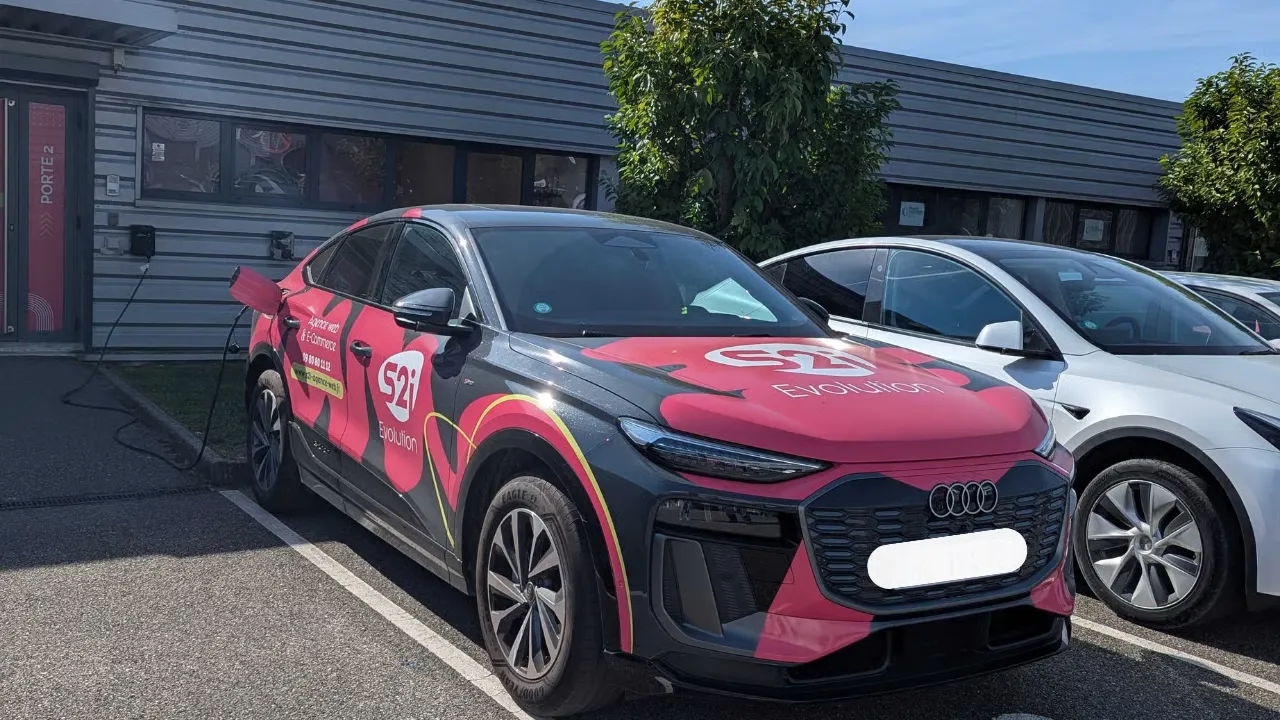
While the executive regrets that “the issue of charging is rarely addressed by sellers,” for his company “it’s no longer a concern.”
Indeed, fleet recharging is initially organized at the office. With the installation of charging stations in the agency’s parking lot, S2i Evolution provides its drivers with as many as five charging points: three 22 kW stations and two 7.4 kW stations. It should be noted that the fleet vehicles can handle up to 11 kW of alternating current, which is more than sufficient to charge the batteries throughout a workday.
The 7.4 kW stations, however, show their limitations with larger battery packs. “For a Q6 that arrives with 10% battery remaining, it’s a bit tight,” admits Luc Eschbach. With nearly 95 kWh of usable capacity, it actually takes more than ten hours to fully charge the battery at this power level.
Some employees also recharge at home. In the past, the company covered the installation of charging stations at home for employees who owned company vehicles.
Also read
Testimonial: With his BMW i4, this heavy driver covers 50,000 km per year!
Hesitations quickly forgotten among employees
The announcement of an electric company car didn’t always generate enthusiasm. “There’s certainly hesitation among those who have never driven an electric vehicle,” admits Luc Eschbach. But this initial reluctance fades quickly.
The choice of long-range, well-equipped models plays a major role here. The charging network, “unmatched from what it was just a few years ago,” did the rest. The result? “No one would want to go back.” To convince the most hesitant, the company has its method: the first electric vehicle given to a reluctant employee is a Tesla. “It guarantees an existing charging network and a top-notch navigation system,” says Luc Eschbach.
On the customer side, however, electrifying the fleet is by no means a selling point. “At first, our cars had a sticker that said ‘I drive cleanly.’ Today, so many companies are doing the same that it no longer sets anyone apart,” he notes. Moreover, a customer sees an individual vehicle, rarely the entire fleet, and thus doesn’t realize that the whole fleet runs on 100% electricity.
The choice of models has sometimes sparked conversation, especially with close clients. But the newest addition, the Audi Q6 e-tron, generates more interest due to its status than because of its powertrain.
“Do the math”: his advice to businesses
To a leader still hesitating, Luc Eschbach responds with arguments from DAF. “For an individual, a new electric car comes at a cost. For a company, the rental cost is under control, significant penalties are avoided, and substantial savings on energy are achieved,” he argues. In his view, the taxation for electric vehicle fleets remains favorable.
It also emphasizes budget transparency. “A company needs stability to plan for the future. Electricity is produced here. Its price rises, like many things, but it doesn’t experience the sharp spikes seen in fossil fuels, which are completely beyond our control,” he says. He cites a scenario that concerns him: “If the United States stopped selling diesel to Europe, the price per liter could rise to 3 or even 4 euros.” These prices remain hypothetical, but they clearly illustrate the dependence of diesel fleets on distant markets.
Also read
Electric vehicles gaining ground: this study highlights the huge impact of reforms to in-kind benefits for official vehicles
An electric fleet treated as an expense item
This testimony contrasts with the image of electrification driven solely by environmental concerns. At S2i Evolution, electric vehicles have emerged as a cost-effective option, with prices renegotiated at the end of each contract based on the best offers from local dealerships.
Its journey also reflects that of many small and medium-sized enterprises: a disappointing experience with plug-in hybrids, the first European electric SUV, Teslas to reassure the most hesitant employees, and then diversification as more options became available.
Do you manage a company fleet or drive an electric company car? Share your experience in the comments: savings, charging, colleagues’ reactions—we want to know everything!
Automobile Propre and I would like to thank Luc Eschbach greatly for his hospitality and testimony.
To avoid discouraging our readers from sharing their experiences in the future, any offensive comments directed at our interviewees, their lives, their choices, and/or their ideas will be removed. Thank you for your understanding.