
Testimonial – After two rechargeable hybrids, Pascal is still hesitant to switch to a fully electric vehicle
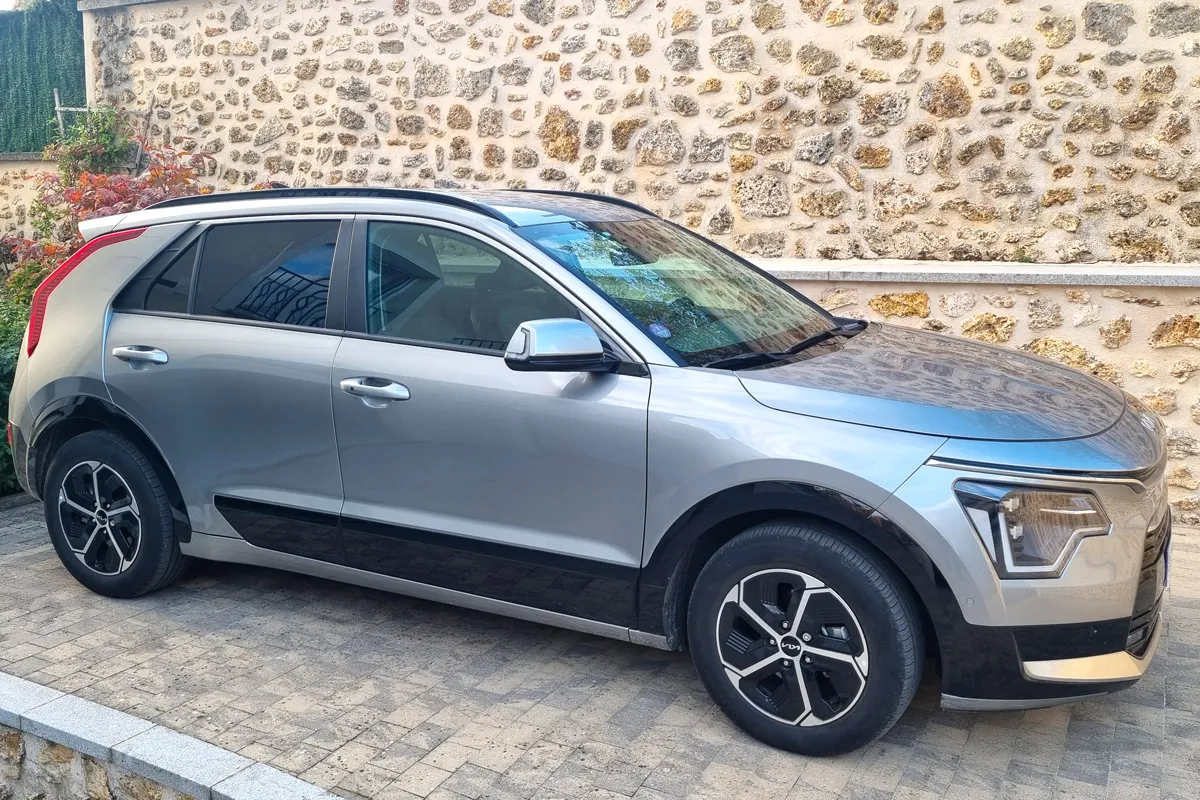
First with a first-generation model from May 2019 and then with the new one, whose lease is set to be extended in a few months, two Kia Niro plug-in hybrids have both met Pascal’s expectations fully. In his household, electric vehicles will likely become more common someday. There are still a few questions that should find answers in a few months or years.
HEV for ladies / PHEV for gentlemen
Today, Pascal and his wife are retired, with just one car for the two of them: “In 2019, I needed to replace my vehicle. At that time, I worked as an aerospace technician at Thales about fifteen kilometers from home. Even accounting for a short detour to run some errands in the evening on my way back, the advertised range of 58 km [NDLR: In mixed NEDC cycle, with an 8.9 kWh lithium-ion polymer battery] for the Kia Niro PHEV seemed sufficient for me to drive solely on electricity in my daily life.”
For her professional work, the wife had already given up on gasoline vehicles: “As a general practitioner, she switched between two Renault Zoé models and one Peugeot e-208 to try different types. However, she preferred the Zoé for its greater space and quieter operation. Now that we’re both retired, we try to have only one car. If necessary, I can use my motorcycle, a BMW K 1600 GTL. Having been satisfied with a Seat Ibiza break, I still wanted to change brands.”
A model like the Mitsubishi Outlander PHEV didn’t fit the bill: “I didn’t want a large SUV. In 2019, the Kia Niro offered heated and ventilated seats along with plenty of driving aids. It was also very pleasant to drive, comfortable, and well-insulated. So I was tempted by this Korean model, which I got in the Premium trim, and I’ve never had any problems with it. Under normal driving conditions, I could achieve 60 to 62 km of range in EV mode, which is more than what the manufacturer claimed.”
A difficult transition
Pascal was only supposed to keep his first Kia Niro PHEV for three years: “That’s what was specified in the lease agreement. Since we were fully satisfied with the first-generation Niro, it was obvious to us that we should stick with the new model. Especially with the updated design and a digital display behind the steering wheel, it really felt like we were in a very different car while still enjoying the brand’s reliability. Without this design change, we might have switched to another brand.”
Also read
Testimonial – For slightly higher lease costs, Anthony preferred the Audi A6 Avant e-tron over the Renault Scenic E-Tech
The LOA was extended by one year for two different reasons: “We were already waiting for it to become possible to order and receive the new generation of rechargeable hybrid Niro. This was achieved in June 2022 with delivery scheduled for mid-September, with the dealership handling the extension of our initial contract. But this garage in Coignières closed its doors shortly after [NDLR: in July 2022]. Approximately 150 files, including ours, were left stuck.”
The situation dragged on: “Because of this closure, we lost almost eight months, forcing me to call every fifteen days to check if anything was progressing. Some offices were assigned to take over the cases. Our case was part of a batch of 80 that went to the office in Chambourcy, far from where we live, even though an office five kilometers away but in a neighboring department would have been better. I complained a bit, but they offered us roof bars and rubber mats, including one for the trunk, worth 250 euros.”
VE Bonus
A small trick helped Pascal get a lower price for his new Kia Niro PHEV: “It’s also in the premium trim. By asking to replace the large wheels with 16-inch models, we reduced the CO2 emissions below 20 grams per kilometer, allowing us to qualify for a 6,000 euro bonus like electric cars. The rules were later tightened, eliminating this option. Still with 15,000 kilometers per year, the monthly cost is 509 euros, whereas I paid 511 for the previous Niro.”
There’s no risk of confusing the two vehicles: “I really liked the evolution in style; it’s a good change. Our old Niro was navy blue, while the new one is comet gray. Between the two, we unfortunately lost the ventilated seats. It’s likely for commercial reasons that this feature along with the sunroof are no longer available, in order to reduce the vehicle’s weight. On the positive side, I found a Harman Kardon sound system again: there are better options out there, but it’s excellent for listening to RFM, Nostalgie, NRJ, Europe 2, and the music I import.”
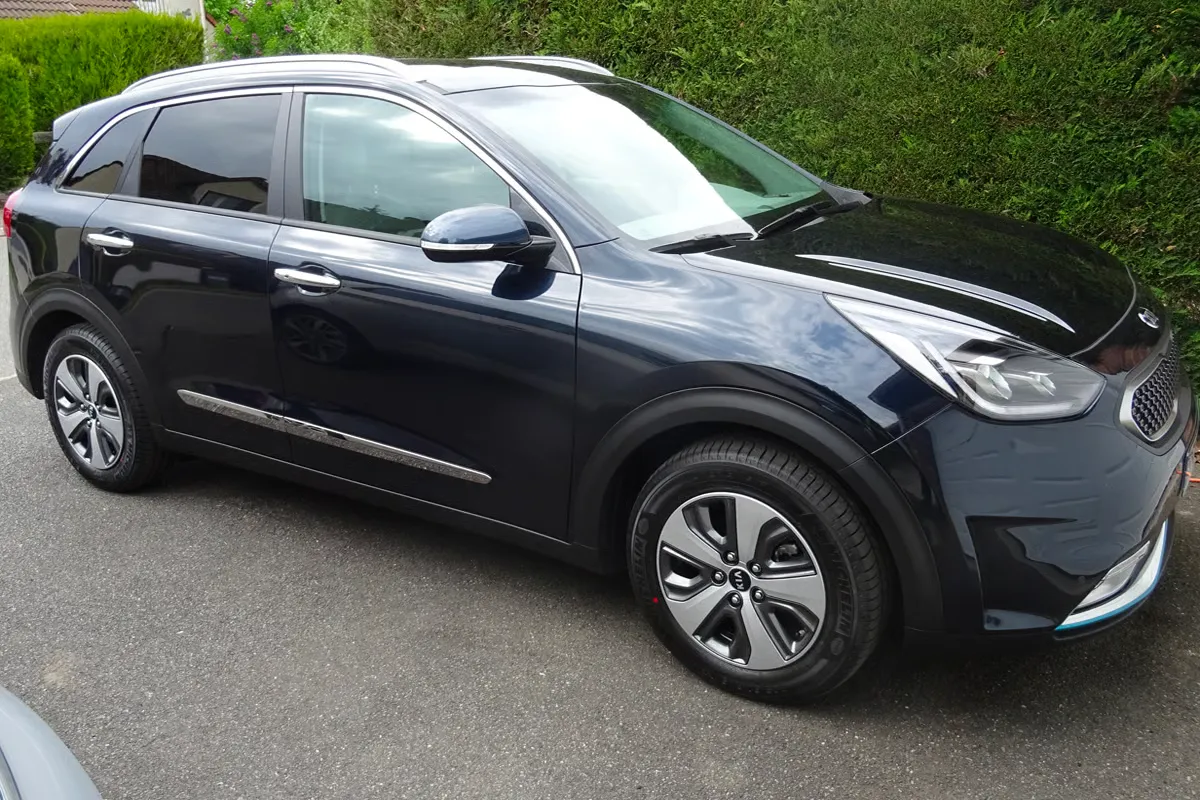
With the new model, electric range has officially increased to 65 km WLTP thanks to an elevated energy capacity of 11.1 kWh: “Once again, I exceed that figure, reaching around 70 km under normal driving conditions. The battery level never drops below 10%. Only once did it show 9%, but the internal combustion engine started up and the range became zero. It’s the same gasoline engine in both generations of Niro [NDLR: 4-cylinder 1.6 l GDi 77 kW (105 hp)].”
Well-proven range
To get to Bordeaux, there are 560 km from the area around Limours (91), where the Parisian couple lives: “It’s a trip we make regularly every five or six weeks to visit our in-laws. We first take the A10 at the toll booth in Saint-Arnoult, then switch to the A11 until Chartres, where we take the N10. In Tours, we return to the highway and then head toward Poitiers Sud again to rejoin the four-lane N10. Just before entering Bordeaux’s ring road, we turn back onto the A10.”
This maneuvering between the two routes makes perfect sense: “Firstly, we’ll cover about 30 km less by not staying on the highway all the time. But the highway allows us to avoid a section that’s difficult due to too many speed limits. With a fully charged battery, we operate in EV mode for the first 15 kilometers until we reach the A10. After that, we switch to HEV mode, and return to electric driving on the Bordeaux ring road. On sections where the speed is 80 or 90 km/h, the battery recharges. I can still gain a few more kilometers of range at 110 km/h.”
The driving routine is now well-established: “With practice, we know how to make the most of the route to optimize the use of the rechargeable hybrid engine. On the highway, we maintain a speed of 120-130 km/h with the cruise control. Depending on the weather, fuel consumption ranges from 4.5 to 5 liters, but never exceeds that. We can charge our Niro at our in-laws’ place; it’s never been charged at public charging stations. At home, using a 16 A Green’Up reinforced outlet, it takes about 2 hours and 50 minutes to fully charge.”
Downsides
Another regular route, about 120 km long, is also well handled by Pascal: “It’s to go to Nogent-sur-Seine to visit our daughter, where we can also charge the Niro. The first thirty and last thirty kilometers are covered in EV mode, with the rest in HEV mode. The vehicle behaves quite poorly when it reaches a long uphill stretch at 125-130 km/h in Eco mode. It shifts down one or two of the six gears in the transmission. To prevent this, I switch to Sport mode to force it to stay in sixth gear.”
If our reviewer really appreciated the evolution of the dashboard with the second-generation Kia Niro PHEV, he also quickly got used to it: “Visually, the two flat screens gave the impression of being in a completely different car. But we found the same controls in the same places on the steering wheel, which was ideal for easy operation. On the other hand, regarding ventilation, it’s impossible to reset it using the button on the small dedicated strip. It worked with the old Niro, but now you have to go through the screen and the climate control menu.”
The new model has proven just as reliable as the old one so far: “I only encountered a problem for which I’m not entirely sure if I’m responsible. It was with the rear seat belt—the red part was slightly out of its housing. This triggered an unnecessary alarm about an unbuckled belt. There was a scratch in that area: maybe I damaged the equipment with a child seat. It cost us 250 euros to repair it.”
What happened next?
Between the two Kia Niro PHEVs, there aren’t significant differences in maintenance costs: “I didn’t opt for that service so the expense wasn’t included in the monthly rentals. To keep the warranty, I need to take it to the shop every year. Our current Niro has already covered over 40,000 km. The most major repairs cost between 250 and 300 euros, while the intermediate ones range from 220 to 250 euros. Since Kia is discontinuing its rechargeable hybrids, it will be difficult for us to buy another one from them next September when the lease ends.”
Also read
Testimonial – Bruno drove 76,000 km in a Tesla Model 3 for only 3.33 euros per 100 km
Out of caution, Pascal has already requested an additional year from Hyundai Capital’s financing department: “We want one more year to think it over. First, to see if it’s feasible for us to stay with just one car. Then, to decide whether we’ll switch to an electric vehicle or not. We’ve indeed noticed the positive progress in charging infrastructure, but we have doubts about two things: How will cable theft from charging stations develop? Won’t charging stations become quickly saturated with the growth of electric vehicles? Fortunately, we don’t travel during peak seasons.”
Models have already been considered for the next car: “If we stay with a rechargeable hybrid, it would be a Volkswagen Tiguan, which would allow us to double our range in EV mode, around 120 km. If we switch to electric, it wouldn’t be a Tesla because my wife definitely doesn’t want one, and I’m not really into Peugeot, DS, or Citroën. We might stay with Kia. The EV5 is my favorite, but it’s really too big, and the EV3 is too small. So it would be the EV4. But there’s also Renault with its Scenic E-Tech.”
Automobile Propre and I would like to thank Pascal greatly for his excellent hospitality, responsiveness, and interesting insights shared after our request for feedback from our readers.
For your reference, any offensive comments targeting our interviewees, their lives, choices, and/or ideas will be removed. Thank you for your understanding.
Author’s Note
Here’s another issue that’s undermining electric mobility: “How will cable theft from charging stations develop?” I’ve been asking myself this question too, as I can’t charge my electric vehicle at home. A few days ago, I was in the regions of Eure and Oise. The IECharge station in Trie-la-Ville looked terrible, with cut cables, damaged chargers, and trash bags surrounding them. And for the first time, I saw tags on 22 kW AC charging stations: it was in Gisors, and it certainly didn’t encourage people to use them.
On the other hand, for drivers who avoid traveling on red or black days and can usually charge at home, the concern over stations potentially becoming overwhelmed should be less of an issue. Development is progressing quite rapidly, and it’s evident that many networks, especially the newer ones, are reliable and well-maintained. There’s also always the Tesla superchargers as a backup option.
The dealership closing its doors just one month after taking an order without notifying customers is absolutely unprofessional on the distributor’s part. Especially since this results in six to eight months of waiting time without any warning. The consequences should have been anticipated, and affected customers should have received thorough support.
Philippe SCHWOERER