
Testimonial – After 5 electric cars, Olivier found one he considers almost perfect
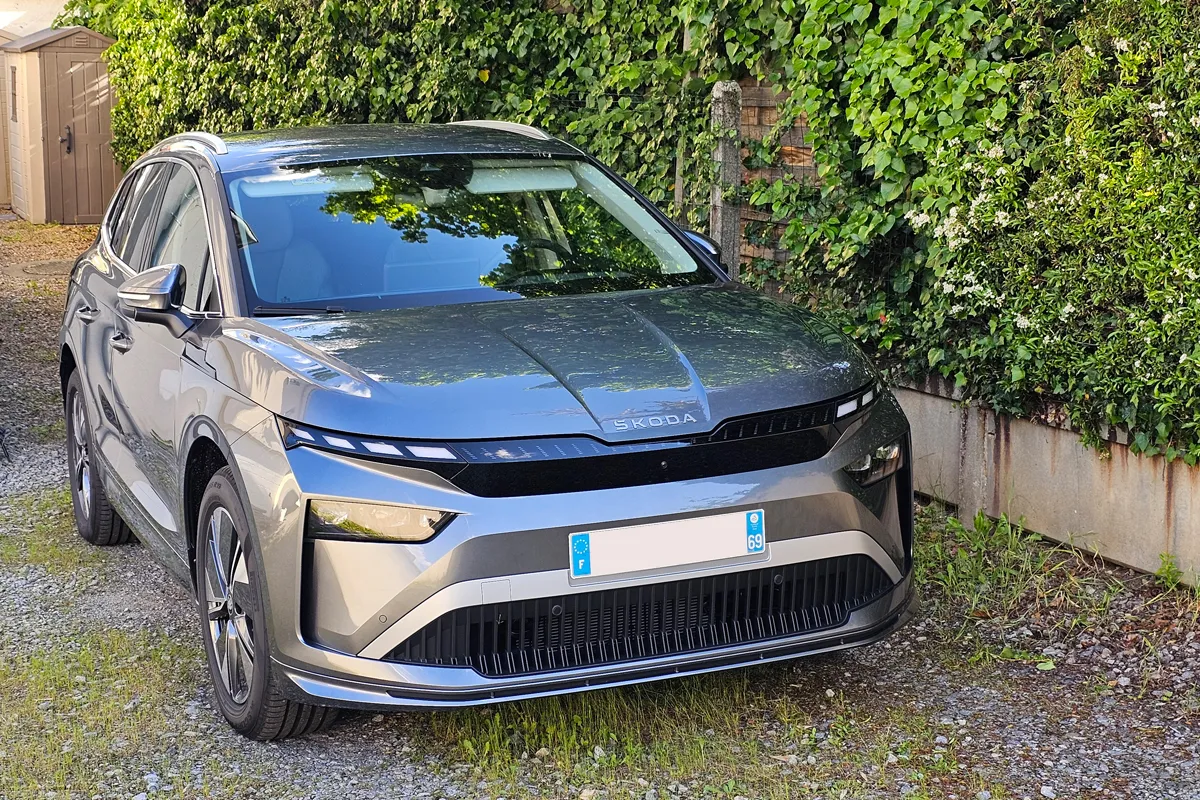
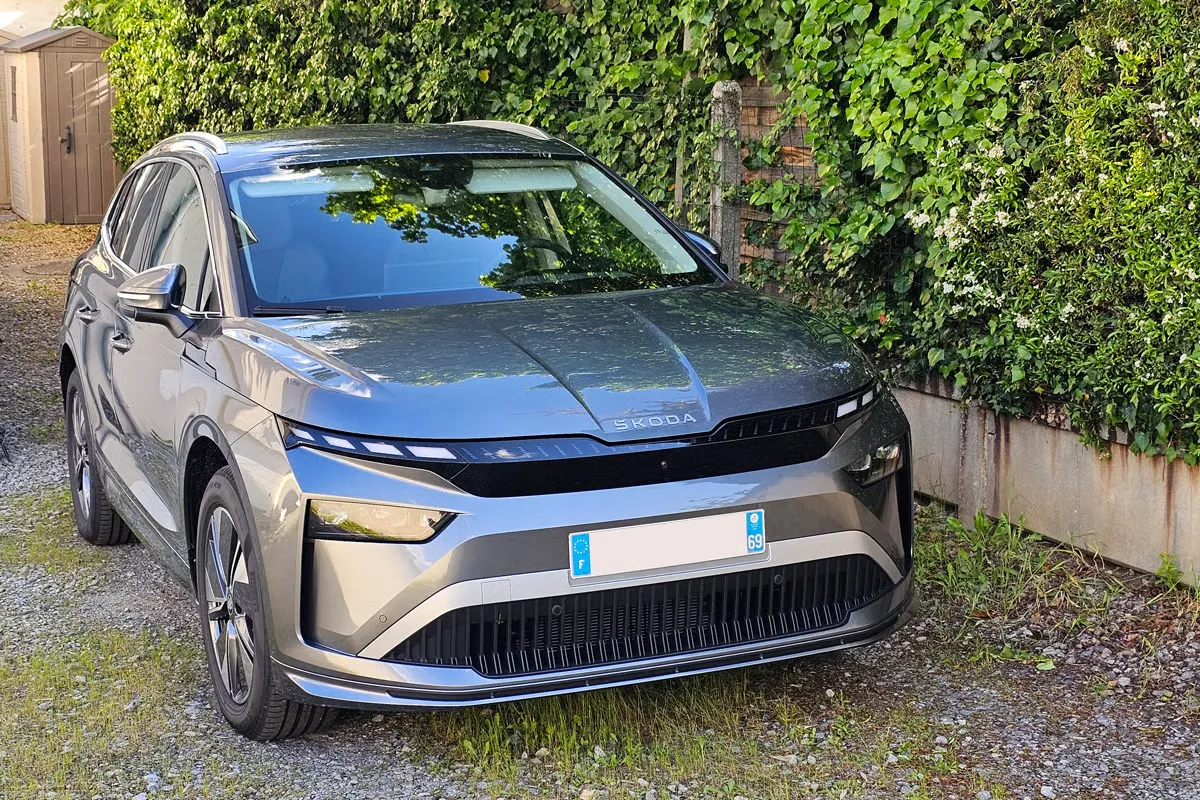
A few days ago, we published the testimony of an electric vehicle owner who was very disappointed with her first electric car. It was one of the earliest Skoda Enyaqs to be sold. Yet this model satisfies many of its users today. That’s the case with Olivier, who purchased his own this year after owning four previous electric vehicles. Already convinced as a teenager of the need to move away from oil, this car enthusiast would never return to internal combustion engines.
The aftermath of a class presentation on oil
After an initial career at a manufacturer specializing in car bumpers, this 53-year-old man from Lyon moved into a management role in the medical industry. In 2019, he was still driving a diesel Citroën Picasso: “I would travel about a hundred kilometers back and forth every day between my home and office. I had been concerned for some time about my high fuel consumption. As a teenager, I had done a presentation on oil, concluding that it would only last for another thirty years.”
Olivier was somewhat influenced by his father’s profession: “He worked at the French Petroleum Institute [NDLR: Founded in 1919, IFP became ‘IFP Energies Nouvelles’ in 2010 under Law Grenelle II, symbolizing the shift toward energy transition]. For me, oil wasn’t eco-friendly—it came from harmful emissions from car exhausts. Exposed to the oil crisis of the 1970s and the slogan ‘We don’t have oil, but we have ideas,’ I felt it wasn’t sustainable to continue relying on this product.”
Also read
Testimonial – Highly disappointed with a European vehicle, Delphine reconciled herself to electric cars thanks to a Chinese model
At first, the search for a new mobility solution wasn’t focused on electric vehicles: “Initially, I wanted a hybrid car, but I couldn’t find one that suited me. We often ended up considering Toyota and cars that made terrible noise on highways. I then considered the economic aspects of electric vehicles, thinking about all that expensive diesel and its combustion residues being released into the environment. So in 2019, I started looking at what was available on the market.”
First, 3 Kia electric cars
Our reader was drawn to the 455 km of range promised for the Kia e-Niro 64 kWh under the mixed WLTP cycle: “Finally a car that can go over 300 km! I thought this was the one I needed. After going to the dealership with my wife to check out this model, we bought one. However, we only kept it for a year because there was no connectivity to a smartphone. With the Corri-Door network already struggling due to broken or malfunctioning charging stations, I had to stay by the car as well.”
In 2020, the Kia e-Niro saw significant improvements, including connectivity that allows remote control of functions such as charging: “I sold my 2019 model to EV-Marketing to upgrade to the new 2020 version. I admit, I got a bit geeky about it, but for me, the app that comes with an electric car isn’t a luxury. I kept this one for almost three years, which is usually the length of time before I switch to another car to avoid losing too much money compared to its purchase price.”
By choosing the EV6, Olivier stayed with Kia: “With its 325-horsepower all-wheel-drive version, 77 kWh battery, and GT-Line trim, I consider it the best car I’ve ever owned. I did have a Renault Mégane Coupé with a 2-liter 16-valve engine years earlier, but with this Korean electric car, I truly had a rocket in my hands. I loved this car! However, it didn’t end very well: I ran into the infamous ICCU problem.”
Switching to Skoda
The ICCU is the charge control unit, and it represents a weakness in several Hyundai and Kia electric vehicles: “The problem occurred during an AC 11 kW charge. I saw a large red warning message flashing on the screen, and I felt that the 12 V battery was starting to fail. I managed to get home without issues, but the next day, I couldn’t start the vehicle at all. This is a common occurrence with this fault. I had to call for a tow truck. My EV6 was out of service for two months.”
While waiting to get my own vehicle back, “I did everything I could to get a rental electric car. Driving a gasoline car now feels like a punishment for me. First, I was given a Citroën ë-C4 with a 50 kWh battery. Its features were really basic, with very limited information on the dashboard: it just runs on electricity, that’s all! Then I tried the new Hyundai Kona 64 kWh that was offered to me, and I used it for three weeks. But I was greatly disappointed when I went back to a 400 V system, with ADAS features that were too intrusive and not easy to turn off.”
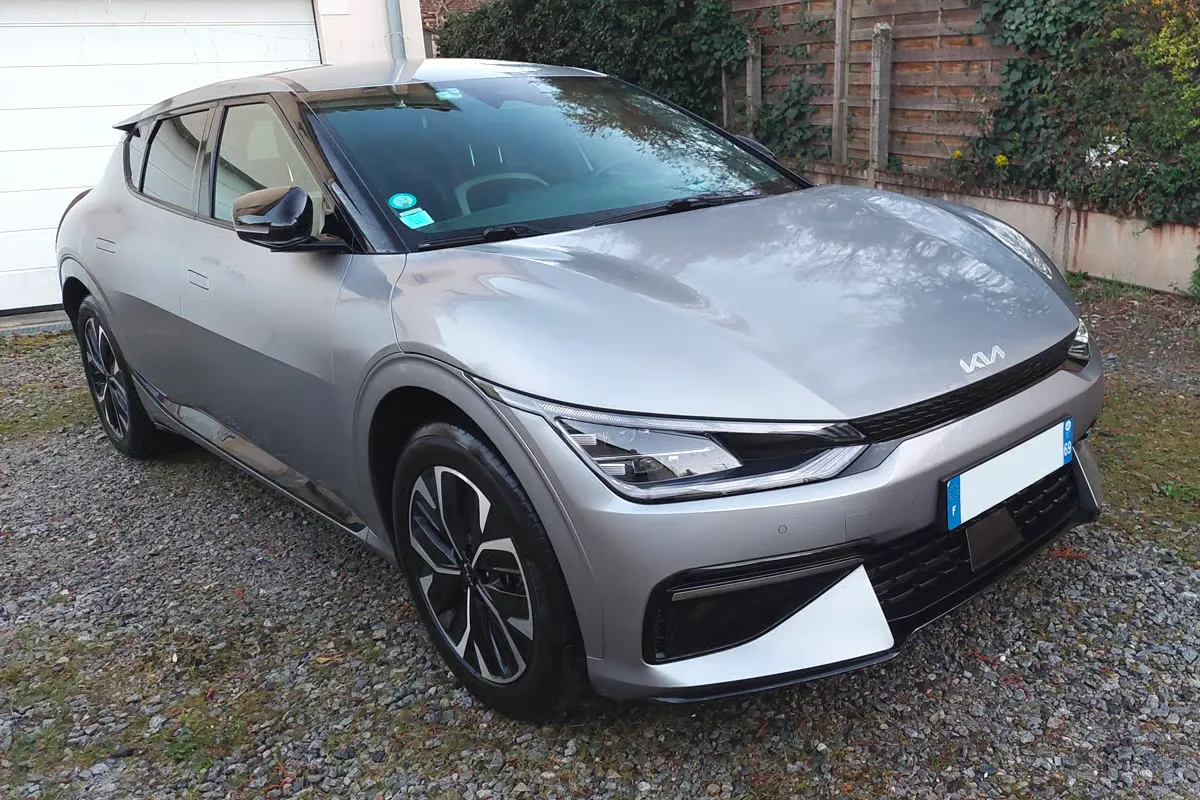
One month after his return, the EV6 was put up for sale: “It was bought back by Franck, a reader you interviewed at the beginning of the year and who became my friend. All I had to do was find another electric car. Wary due to the ICCU issue, I didn’t want to get another Korean model, even though the Kia EV3 could have worked for me. So I turned to Skoda. I initially ruled out the Enyaq because it was expensive and didn’t appeal to me before its facelift. I preferred the Elroq, which offers the best price, features, and its very good APP550 engine.”
From the Elroq to the Enyaq
This first experience with a Skoda electric vehicle was highly praised: “I had also tried the Elroq with my wife before buying it. It’s a very agile car, with plenty of small storage spaces inside, and an interior similar to that of the Enyaq, except for a smaller trunk. Just like with the Kia EV6, we went to Italy in it, accompanied by our two older children. Charging from 20% to 80% takes only 25-26 minutes. This car has incredible torque [NDLR: 545 Nm with a power output of up to 210 kW (285 hp) using a 77 kWh net battery], but since it’s rear-wheel drive, the experience is great, even better than with front-wheel drive.”
This car didn’t stay with our reader for long: “It was really excellent with its Charlie package. My father even said, ‘Your car is amazing!’ and took it from me. It was a model with lots of options that I managed to get at a significant discount by being in the right place at the right time. In addition to his Peugeot 3008 gasoline model, my father also had a Fiat 500e which was taken over by my son. I had to wait a year before I could transfer the Elroq to my father, as required by the CEE subsidy rules.”
That’s where Olivier chose the Enyaq: “The facelift had already been applied to 80% of this model, just like the Elroq. Same engine, same battery, same heat pump, though I find its efficiency isn’t very noticeable in winter. I got a 20% discount on the listed price for this Enyaq 85 Plus. I opted for the Lounge interior package and a pack that included a well-designed head-up display showing information from the Line Assist feature.”
Range and Fuel Consumption
Our reader received his Enyaq in May 2026, rated with a WLTP combined range of 581 km: “We’ve already traveled 7,000 km with it. We regularly go to the Jura from around Lyon to visit my father-in-law. That’s about 400 km round trip. The Enyaq has a longer range than the Kia EV6. It’s around 500 km in summer under real mixed-condition driving in the city, or 450 km in winter. On the highway, driving at speed limits, it’s between 250 and 300 km.”
The actual range figures for the Enyaq lead Olivier to say, “Before, we stopped to refuel; now, we plug in when we stop. I need to take a break every two hours. The charging curve for this electric car is very good up to 80%. After that, the power drops sharply. So I don’t charge any further, and 25 minutes at a charging station is sufficient. Since 2025, the Enyaq has a button to manually activate battery preconditioning about 30 minutes before reaching a charging station.”
Over 7,000 km, the average consumption recorded was 17 kWh/100 km: “I don’t drive many kilometers for work. The Enyaq is mainly used for long trips. On the full 200 km route to the Jura via highway, my consumption is between 16 and 17 kWh. At 130 km/h, it reaches 20 kWh, and at 120 km/h it drops to 18. Consumption remains quite low up to 110 km/h. With an electric car, you get the consumption you deserve: figures can be twice as high, which isn’t the case with a gasoline car.”
A highly praised car
For Olivier, the Skoda Enyaq “has a very good engine with incredible torque that can make the car accelerate quickly when overtaking is needed. It handles well on the road. It’s agile, comfortable, offers top-notch interior space, and has a large trunk. At Skoda, I appreciate the ADAS systems that aren’t too intrusive. For example, when moving from a 30 km/h zone to one at 50 km/h, the system doesn’t necessarily detect it, and there’s no excessive beeping like in other electric vehicles. Additionally, the assist features can be easily disabled.”
There is one thing he feels can be improved: “The infotainment system and GPS are very good, but when I drive long distances, I’d like to be able to choose my charging network, which I can’t do with the planner. I can check a network, like Ionity where I prefer to charge, only if I’m searching for a station, not as my first option. So I still use the old method with ABRP. The main advantage of GPS is getting automatic battery preconditioning. I avoid TotalEnergies stations.”
What does our reader think of Delphine Bouchet’s perspective on her experience with the Skoda Enyaq? “I fully understand her disappointment. I sold my own Kia EV6 because of the ICCU issue, even though I considered it the best car I had ever owned. In 2021, I wouldn’t have chosen the Enyaq, as it was too slow when charging. But now, with the new engine, there’s been a real improvement. Enyaqs and Elroqs are selling like hotcakes these days.”
Decarbonizing the home as well
Since 2020, Olivier no longer owns any internal combustion engine cars: “Previously, my wife drove a BMW i3, but now she drives a Cupra Raval. Since 2019, I’ve seen the world of mobility evolve, with my family and colleagues buying electric vehicles, even those who didn’t want to at first. The carbon-intensive world is becoming stricter, and every complication, crisis, or war only confirms the correctness of my choices. It doesn’t horrify me that not everyone buys electric vehicles. What irritates me is that those who can afford brand new Mercedes, BMWs, and other cars with large internal combustion engines still don’t switch to electric ones.”
Also read
Testimonial – After two plug-in hybrids, Pascal still hesitates to go fully electric
Our reader also upgraded his home: “In 2012, we built a highly insulated house, but with a gas heater. At that time, the thermal consultants left us no choice. But for me, gas is just as limited as oil, and it’s produced in unstable areas or zones of pseudo-conflict. That’s why we later made investments to eliminate carbon from our household needs, including cars and the house. Now, we have an air-to-water heat pump for heating, and an air-to-air one when we need to lower the temperature.”
And then there are also solar panels: “They were assembled in Lyon by Rhône Solaire Pro. We have 6 kVA of peak power, resulting in an annual production of 7,000 kWh, while our total consumption is 8,000 kWh, including charging our electric vehicles, the house, and the spa. With this subscription, our annual electricity bill is only 900 euros. To use our energy efficiently and avoid feeding it back into the grid, we use a MyLight subscription costing 40 euros per month to access a virtual battery of 900 kWh.”
Automobile Propre and I would like to express our sincere gratitude to Olivier for his excellent hospitality, responsiveness, and very interesting insights shared after we asked our readers for their experiences.
For your reference, any offensive comments directed at our interviewees, their lives, choices, and/or opinions will be removed. Thank you for your understanding.
Author’s Note
Contrasting Delphine’s disappointment with the Skoda Enyaq with Olivier’s high satisfaction with his own unit five years later serves to highlight that experiences can vary greatly from one driver to another even with the same car model. While many of us are likely aware of this, I felt it was better to illustrate it through two complementary perspectives.
For our sympathizer from Lyon, it was a completely different model that disappointed him, but which seemingly delights his new owner, who is also a reader of Automobile Propre. He might be able to confirm this for us here. The world of electric vehicles, especially among our readers, can sometimes be quite surprising. I know that I’m currently driving an electric car that was previously used by yet another reader. Even better, I took photos of it at a dealership when it was brand new to illustrate an article. I realized this later on. How funny these little nods are!
Another very interesting aspect of this testimony is the use of a virtual battery to better manage the utilization of one’s solar power production. At 40 euros per month, it is a solution worth considering when seeking a certain level of energy independence—even though it involves an intermediary in the process.
Philippe SCHWOERER