
A T&E study predicts strong competition in the EU electric truck market.
Ahead of the IAA Transportation, a new T&E analysis warns that European truck manufacturers will face fierce competition by 2030: A quarter of the electric truck market could be lost to new competitors from China and the U.S. within three years, according to the report.
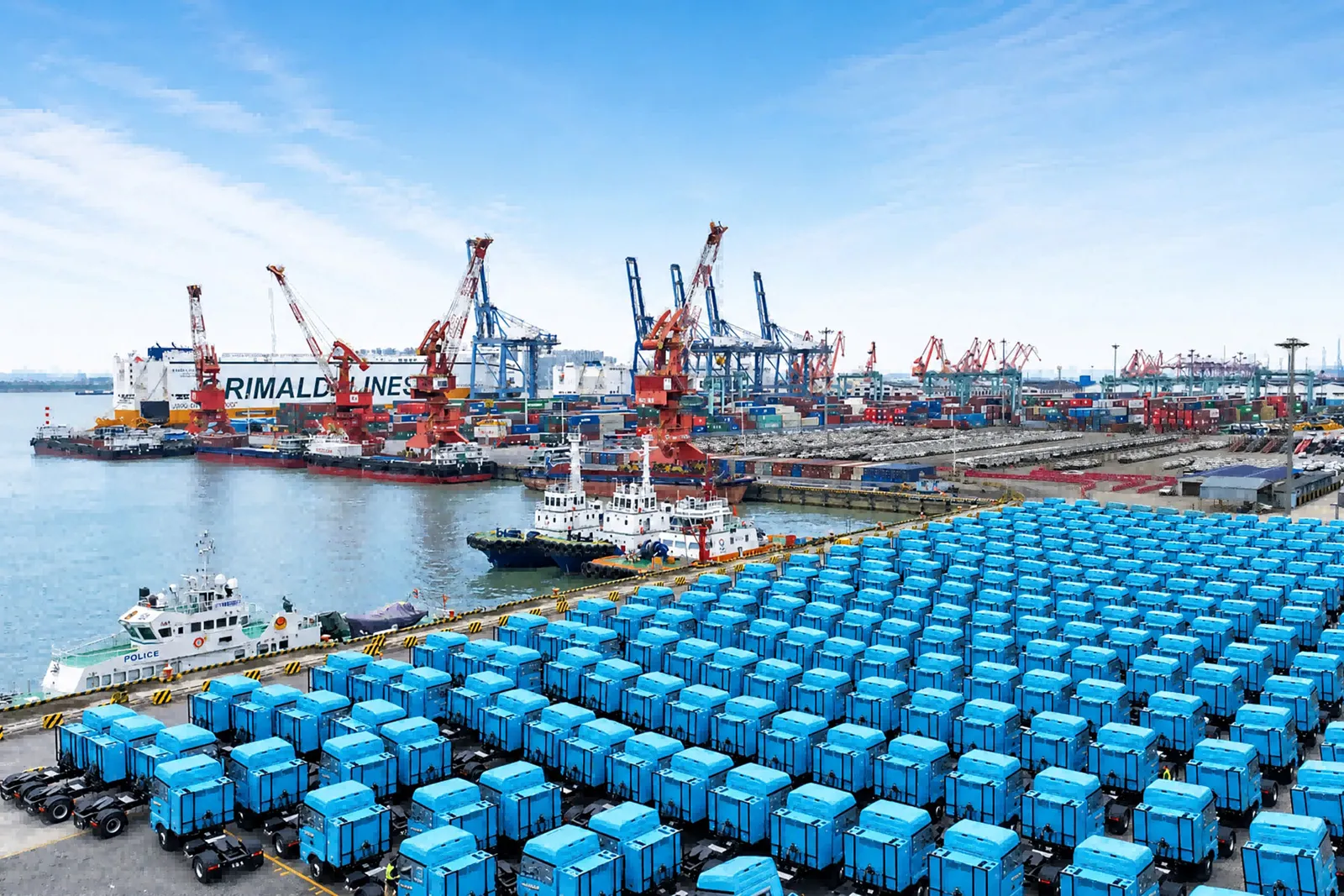
Electric Sany trucks ready for shipment.
Image: SANY Truck
The organization Transport & Environment presents a competitive analysis of the development of Europe’s electric truck market. To prepare this, the researchers examined the costs, key technical aspects, and manufacturers’ goals — and used this information to develop a model. The background is that the EU truck market, with an annual volume of 245,000 vehicles, is currently dominated by a few established manufacturers — specifically Daimler Truck, Traton along with its subsidiaries Scania and MAN, Iveco, DAF, and the Volvo Group with its subsidiaries Volvo Trucks and Renault Trucks. At the same time, the share of electric trucks is increasing: although it remains at a very low level for now, the growth rate is so high that electric trucks are expected to account for an increasingly significant portion of new registrations in the coming years.
And it is this particular segment of the market that the T&E organization has examined in greater detail in its modeling. The main message of their analysis: Chinese and American truck manufacturers could capture a quarter of Europe’s electric truck market by 2030 if local manufacturers do not accelerate electrification efforts. T&E states outright: “EU manufacturers can only maintain their market leadership by setting ambitious fleet emission targets for commercial vehicles.” In other words, the analysts advise taking proactive steps toward electrification.
Several importers on the verge of entering the EU
The background is that a number of new commercial vehicle manufacturers from China have registered for IAA Transportation (where we provide an overview of the major electric truck exhibitions), with these companies set to enter Europe primarily with electric trucks. Among them are Sany, Sinotruk, SuperPanther, FAW Trucks, Foton, and others. Some of these are startups, while others are established manufacturers with decades-long industrial foundations. Additionally, these players can benefit from an advantage in experience due to the more mature electric truck market in China.
From beyond the Atlantic, Tesla, as the first American manufacturer of electric trucks, is simultaneously announcing serious plans to expand into Europe. However, since the technical details and prices for the European version of the Tesla Semi will not be disclosed until the exhibition, it is still difficult to determine its market positioning. Therefore, even for T&E specialists, only the U.S. specifications of the Tesla can serve as a reference point. This can also be considered a weakness of the study: when it comes to the prices and technical specifications of future competing models as well as the manufacturers’ goals, analysts are forced to rely on information that is currently incomplete or only briefly mentioned.
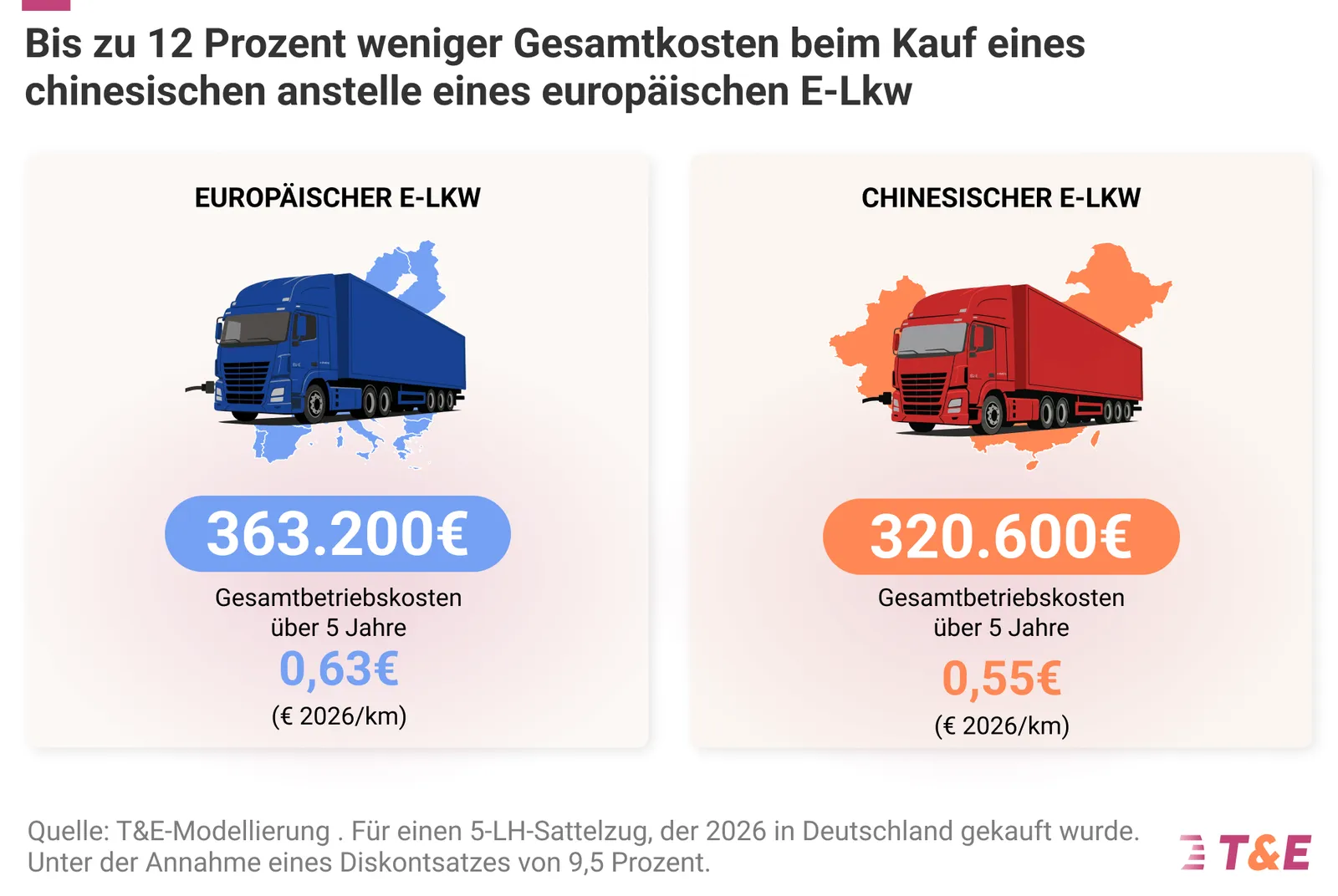
This factor should be kept in mind when considering the results. In the analysis presented, T&E concludes that the total operating costs of a Chinese electric truck can be up to 12 percent lower compared to an equivalent European model. “This translates to savings of up to 43,000 euros over a period of five years.” To arrive at this estimate, the research team examined typical heavy 4×2 tractor units used for long-distance transport that were purchased in Germany in 2026 (assuming a discount rate of 9.5 percent). Here is the accompanying graph:
This lower TCO could prove decisive for potential customers, especially since “electric trucks from new competitors perform just as well in key metrics such as range, charging time, maximum payload, and energy efficiency as European trucks,” the T&E report adds. Moreover, “the new providers hope to capture up to a quarter of the electric truck market by 2030.” This can be inferred from their stated goals for the European electric truck market.
Johanna Braun, manager of truck and infrastructure e-mobility at T&E Deutschland, concludes: “Competitive electric trucks from China and the U.S. are already entering the European market, with more models planned. At this critical moment, truck manufacturers should learn from the mistakes of the automotive industry. Slowing down electrification now would give competitors from the U.S. and China an advantage, allowing them to gain a significant market share in Europe and around the world.”
Customers with high cost sensitivity
T&E makes this assumption on the premise that customers make their investment decisions for trucks primarily based on cost considerations. And lower overall operating costs of more than 10 percent could be decisive in the transportation industry, which operates with razor-thin profit margins of only 1.5 to 2 percent. “A German transportation company that chooses an electric truck from a new market entrant over a European model today could reduce overall operating costs from 0.63 euros/km to 0.55 euros/km (including residual value),” say the analysts.
As is typical of T&E, the organization links its research findings to warnings and policy recommendations: Given a market dominated by a few players, new competitive entrants could quickly capture a large market share by offering comparable quality at lower prices, writes the T&E team. The growing adoption of electric trucks in the EU is closely tied, in their view, to the CO2 fleet emission limits for trucks that took effect in July 2025 and falling battery prices. Therefore, the organization calls on the federal government to advocate in Brussels for maintaining ambitious CO2 fleet emission limits for trucks.
Johanna Braun summarizes: “The race for market leadership in electric trucks is in full swing. Chancellor Friedrich Merz should advocate for ambitious decarbonization goals at the European level if he wants to prevent a similar crisis in the truck sector as we are currently seeing among car manufacturers. Greater competition can benefit logistics companies and consumers. European manufacturers should stop wasting time resisting fleet emission limits and instead commit fully to electric trucks like their new competitors.”