
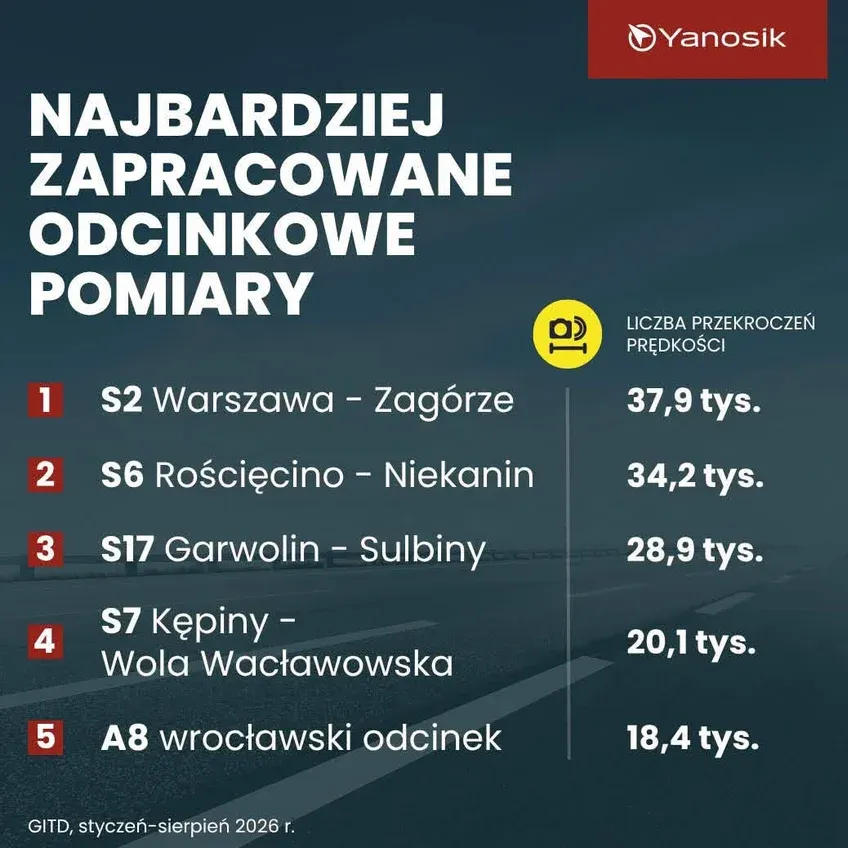
These segment measurements capture the most data. The leader recorded 37,9 thousand violations.
In the article:
OPP recorded the most speed violations on the S2 Warsaw-Zagórze route: 37,9 thousand.
116 fixed speed measurement devices are already in use in Poland, monitoring about 660 km of roads
CANARD also has 545 speed cameras, RedLight systems, and unmarked vehicles equipped with speed detectors
Fixed speed measurements during harvest season
According to data from the Main Road Transport Inspection Agency for the period from January to August 2026, compiled by Yanosik, the system on the S2 Warsaw-Zagórze route recorded the most speed violations. Cameras there logged 37,9 thousand breaches.
Second place goes to the S6 route between Rościęcino and Niekanin, with 34,2 thousand violations. Following that are the S17 Garwolin-Sulbiny route with 28,9 thousand, the S7 Kępiny-Wola Wacławowska route with 20,1 thousand, and the Wrocław section of A8, where devices recorded 18,4 thousand violations.
The result alone certainly doesn’t mean that S2 has the “least law-abiding drivers in Poland.” Traffic volume, the length of the monitored section, the applicable speed limit, and how long a particular system has been in operation all play a significant role. The more cars that pass through the OPP gates, the higher the potential number of recorded violations.
In total, all the fixed speed cameras in operation in Poland detected 482,000 cases of speeding from January to August.

OPP works differently from regular speed cameras
A traditional speed camera measures speed at one specific location. Sectional measurement is harder to “avoid” by braking momentarily in front of the camera. The system reads the license plate upon entering the monitored section and again upon exiting. The average speed is calculated based on the travel time and the length of the section. If it exceeds the allowed limit, the incident is sent to the Automatic Road Traffic Monitoring Center (CANARD) system.
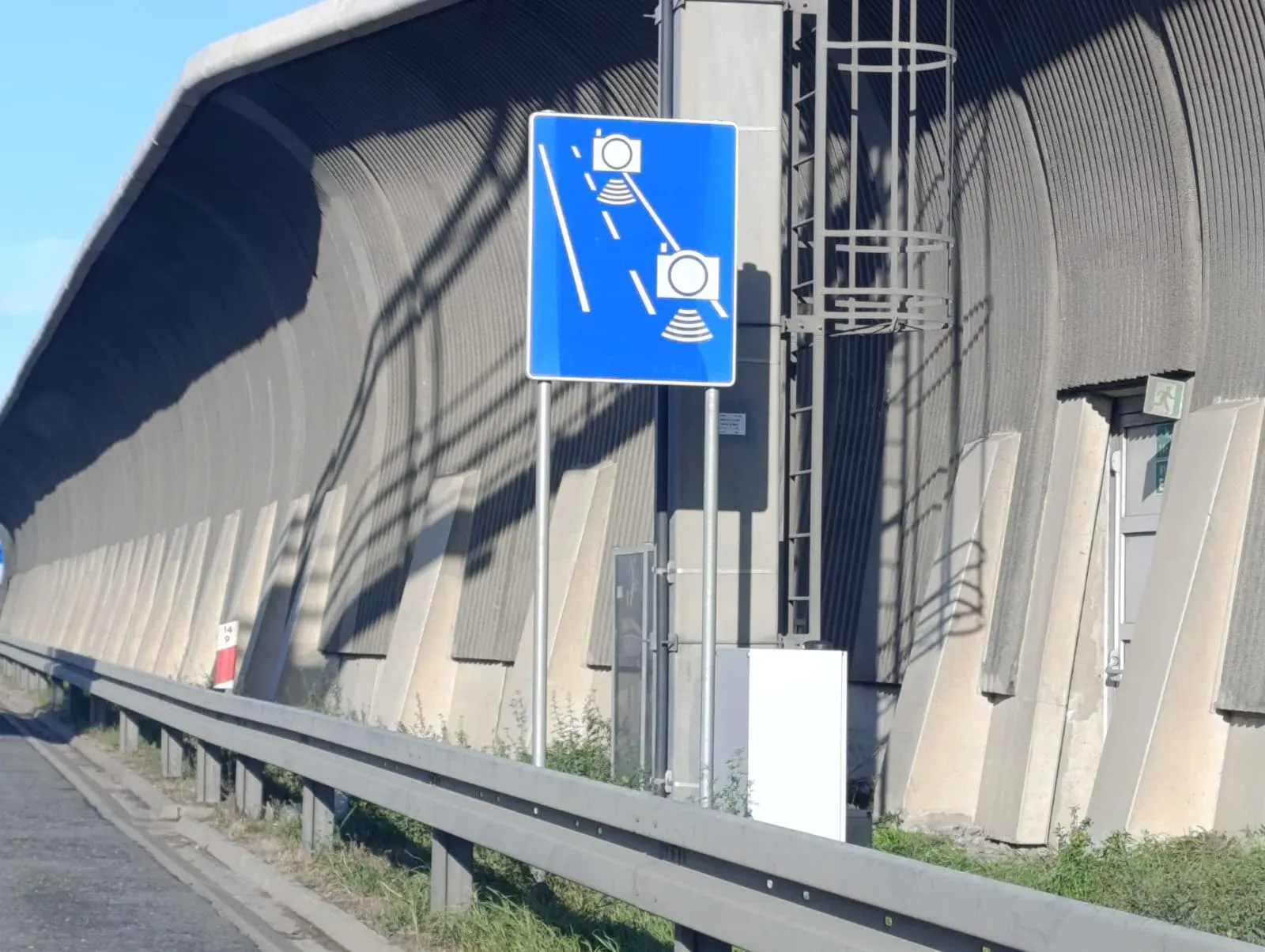
For example, the system on S2 Warsaw-Zagórze monitors a section 10.3 km long. Meanwhile, the OPP on S17 between Garwolin and Sulbin covers over 6 km of road.
There are already over a hundred section measurements
Just a few years ago, OPP was a relatively rare sight on Polish roads. Now the system has been significantly expanded. CANARD currently has 116 section speed measurement devices covering approximately 660 kilometers of roads. As part of the latest major expansion, 43 more units were installed, mainly on highways and expressways.

That’s exactly why motorways appear more and more often at the top of the list. The new systems are in use on routes such as S2, S6, S7, and S17, where traffic volume is high and drivers can easily reach high speeds.
Speed cameras are still far more numerous
OPP units are in frequent use, but by a large margin, traditional speed cameras make up the greatest number of CANARD devices. Currently, there are 545 of these in operation. They record the instantaneous speed and take a photo of the vehicle along with its license plate number.
As part of the expansion funded by the National Recovery Plan, 70 new fixed-speed measurement devices were also installed. The last of these were delivered in June 2026.
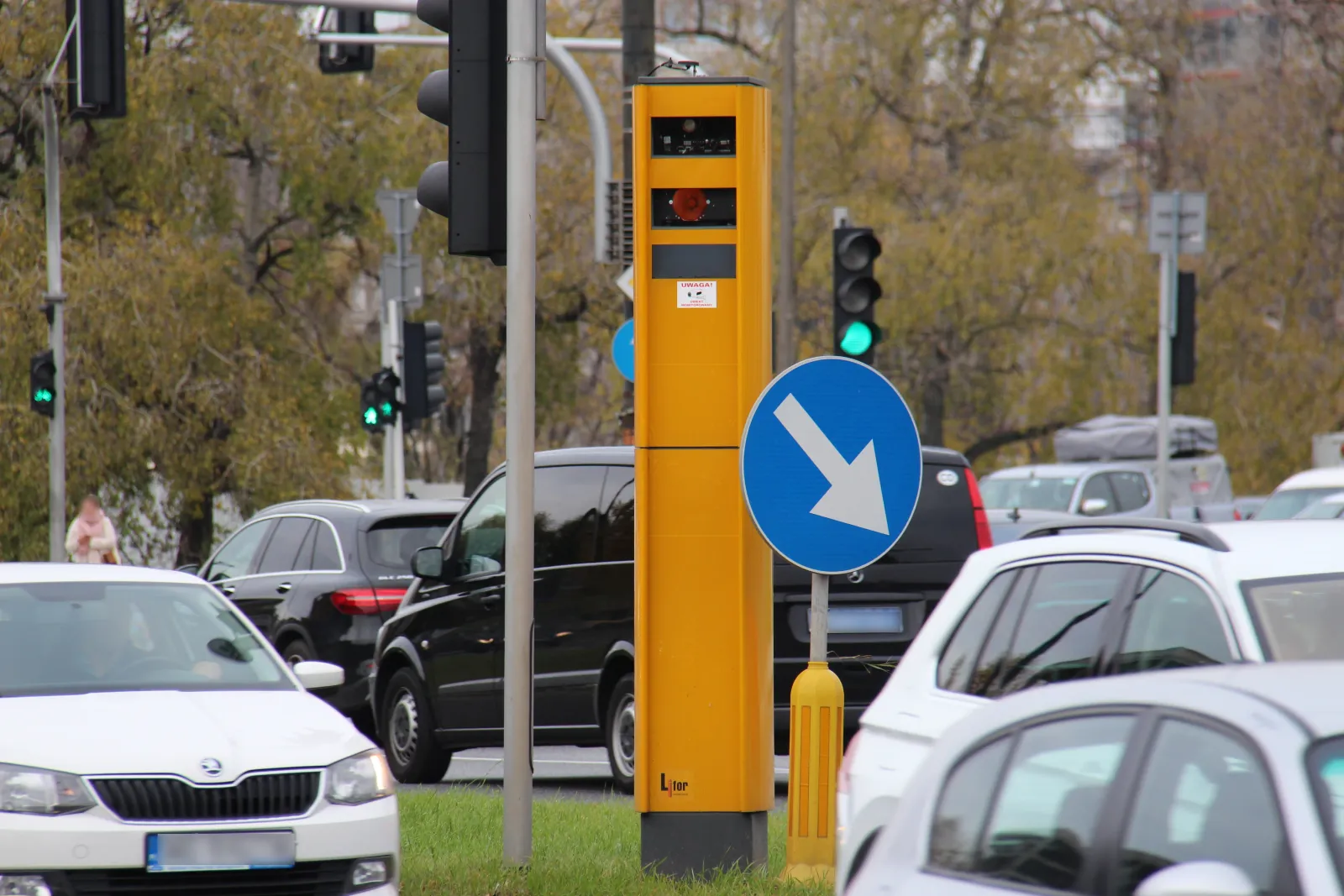
In the first half of the year alone, speed cameras recorded over 401,000 violations. The most active devices were located at Krzyszkowice, Rumianek, and on Zamenhoffa Street in Świdnica.
Red lights are also monitored automatically
Speed is just one part of the system. CANARD is also expanding RedLight, the devices that record driving on red lights, increasingly. Currently, automatic monitoring is in place at 60 intersections. The system uses several hundred high-resolution cameras that observe individual traffic lanes and traffic lights.
A similar technology has also been introduced at railway crossings. CANARD currently monitors 10 such locations. Thus, a driver can be recorded not only for driving through an intersection on red but also for ignoring signals at railway tracks.
There are still unmarked BMWs
Mobile inspections complement the entire system. CANARD uses 33 unmarked police cars, such as BMW 330i models. These vehicles are equipped with Videorapid 2A devices or LTI 20/20 TruCam II laser speedometers capable of recording footage. They are deployed, among other places, in areas where fixed speed cameras cannot be installed or where residents report issues with excessive speeding.
The network has become truly extensive
Tens of thousands of speed violations in a single section show that even well-marked cameras are not enough to ensure all drivers monitor their average speed.
It’s difficult to miss such locations: 116 operational OPP units mean hundreds of kilometers of roads are under constant surveillance. The days when it was sufficient to slow down just a few dozen meters before a speed camera are increasingly becoming a thing of the past.
Piotr Sobczyk