
Fast chargers have surpassed AC chargers in Poland. The public network has 13,454 charging stations, while there are already 158,365 BEV vehicles.
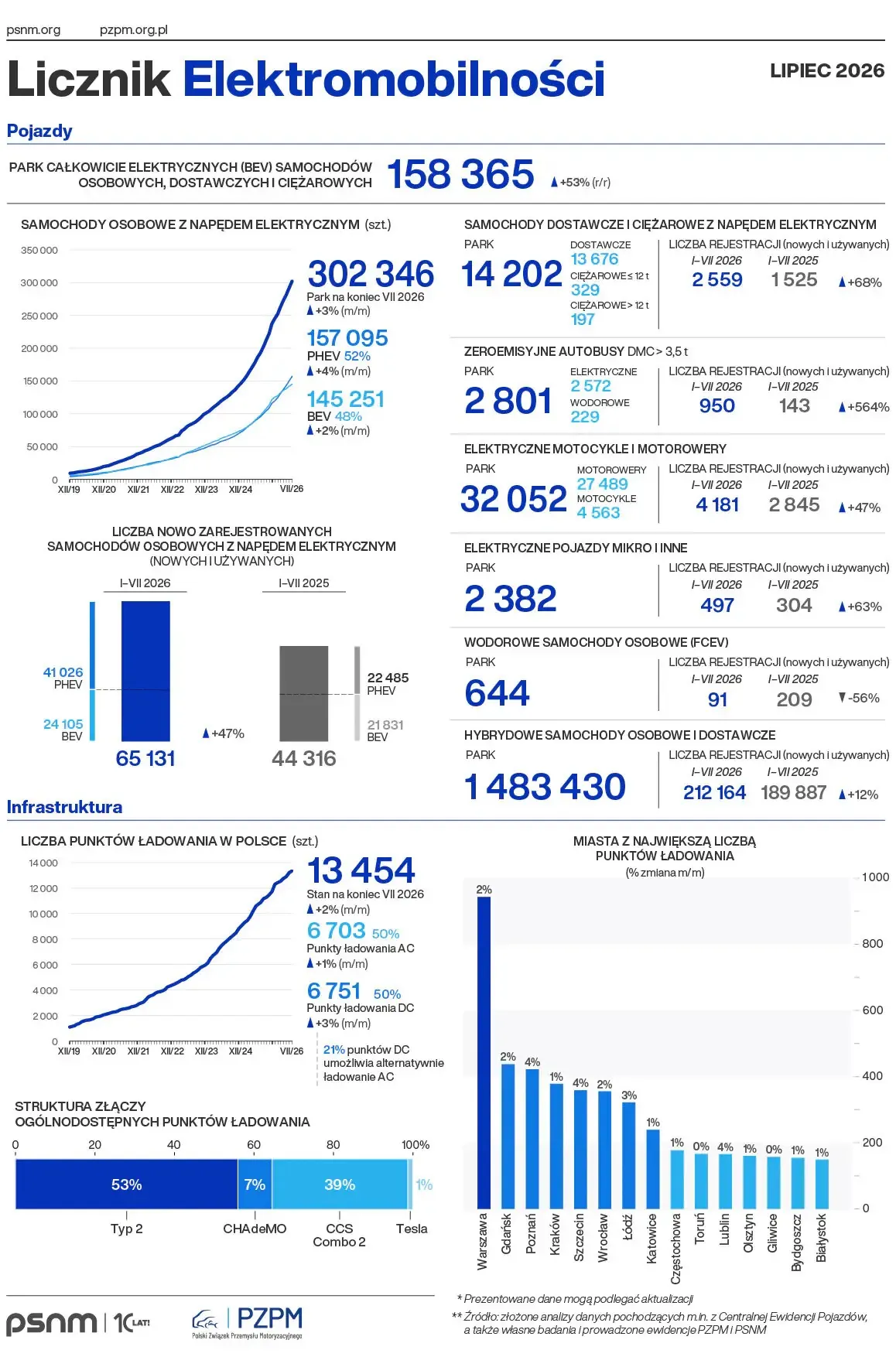
By the end of July 2026, there were 13,454 publicly available charging stations in Poland, of which 6,751 were DC chargers. This is the first time that fast DC charging stations have surpassed AC chargers in number.
Table of Contents
Show
Hide
At the same time, the fleet of electric vehicles is growing. According to the Electromobility Counter, 158,365 fully electric BEV vehicles are already on Polish roads, and including PHEVs, the total number of electric cars has risen to 302,346. For drivers, this is a clear signal: operators are finally investing where it matters most—on roads and time.
DC Ahead of AC for the First Time
The most important figure from the latest data is simple: 50.2% of Poland’s public charging infrastructure now consists of DC stations. In practice, this means 6,751 fast charging points, compared to 49.8% of AC stations with a capacity of up to 22 kW.
This is a more symbolic change than a revolutionary one, but it clearly shows the market’s direction. Until recently, the development of public charging networks relied mainly on AC chargers at shops, hotels, and parking lots. Today, investment focus is shifting toward charging solutions that actually shorten waiting times.
There’s another detail. At 21% of DC stations, AC charging can also be used as an alternative. This means some stations are more flexible than a simple division into AC and DC would suggest.
According to data cited by PSNM, more than one in ten public charging stations in Poland now offers a power output of over 150 kW. This still doesn’t mean we can charge a car to its rated capacity everywhere. The car must be able to handle that power, the battery must be ready, and the station cannot be sharing space with another car. But the overall trend is correct.
Where we stand with electric cars
As of the end of July 2026, there were 158,365 passenger and commercial BEV vehicles registered in Poland. In the first seven months of the year, their number increased by 22,737 units, representing a 23% better result than in the same period of 2025.
If we look at electric-powered vehicles more broadly, including both BEV and PHEV together, the fleet has grown to 302,346 cars. Of these, 145,251 are passenger BEV vehicles, while 157,095 are plug-in hybrids.
This shows an interesting market picture. PHEVs are still more numerous than pure BEV cars, though the gap isn’t large. From an infrastructure perspective, this means that the development of public DC charging is increasingly meeting the needs of drivers of fully electric vehicles, rather than those of occasionally charged hybrids.
In the commercial segment, 14,202 electric vans and trucks are already on Polish roads. This remains a niche compared to diesel vehicles, but it is here that fast charging along routes and in logistics corridors will become increasingly important.
It’s not just passenger cars. Buses and two-wheelers are also growing in number.
The Electromobility Counter also shows that the fleet of electric mopeds and motorcycles has risen to 32,052 units. This is a less media-covered segment, but it continues to grow steadily, especially in cities and in delivery services.
The situation is even more interesting when looking at public transportation. By the end of July, Poland had a fleet of 2,801 zero-emission buses. Of these, 2,572 were fully electric buses, while 229 were hydrogen-powered buses.
This is one of the areas where Poland has long progressed faster and more steadily than in the field of passenger cars. Local governments purchase buses because they have clear operating requirements and predictable charging needs. Private drivers, on the other hand, still often weigh the cost of purchase against the pace of network expansion.
In addition, the fleet of conventional hybrids is also growing. By the end of July, there were 1,483,430 hybrid passenger and commercial vehicles. This figure illustrates the scale of the entire electrified transportation market, but it also reminds us that full electrification of transportation in Poland remains a process, not an achievement already reached today.
Fast charging is finally keeping up with real needs
The most interesting insight from these data doesn’t relate to the sheer number of charging points, but rather their structure. The market is moving beyond a phase where it mainly mattered “how many charging stations there are” to one where it matters “how quickly and where a car can be charged.”
For EV users, the difference is significant. An AC charging point at a mall or hotel makes sense when the car stays parked for hours. On the road, such a point is of little use. Therefore, DC charging points exceeding 50% represent a signal that operators like GreenWay, Orlen Charge, Powerdot, Ekoen, and Ionity are increasingly focusing on road use rather than parking scenarios.
PSNM also notes that over 12% of public charging points are located along the TEN-T network. This is significant from the perspective of intercity travel and EU requirements for major transport corridors. Of course, the percentage alone doesn’t tell the whole story. The location of the stations, their reliability, the number of charging slots, and actual power output under load are also important factors. Just because a location has DC charging doesn’t automatically mean it offers the same comfort as the best hubs in Western Europe.
The troubling aspect is that it’s still easy to inflate numbers with charging points of limited usefulness. A charging point isn’t the same as a station, and a station isn’t the same as a hub. Two connectors on one device and eight HPC charging slots at a MOP site represent two different situations for drivers, even though both might appear quite good in statistics.
What do these numbers say about Poland’s EV market?
The good news is that the infrastructure is increasingly meeting the needs of battery vehicles. The less favorable news is that we are still in a phase of catching up rather than having a comfortable supply. If the BEV fleet continues to grow at double-digit rates, the DC charging network must also expand not only in numbers but especially in capacity and the scale of individual locations.
In short, Poland has stopped installing charging points mainly for statistics and is now putting up chargers that are useful for ordinary drivers on the road. How do you view this moment when DC charging finally surpassed AC: is it symbolic, or already truly noticeable on the roads?