
Supertest of the Volkswagen ID.3 Neo 58 kWh: charging and driving times, yet again misleading charging power!
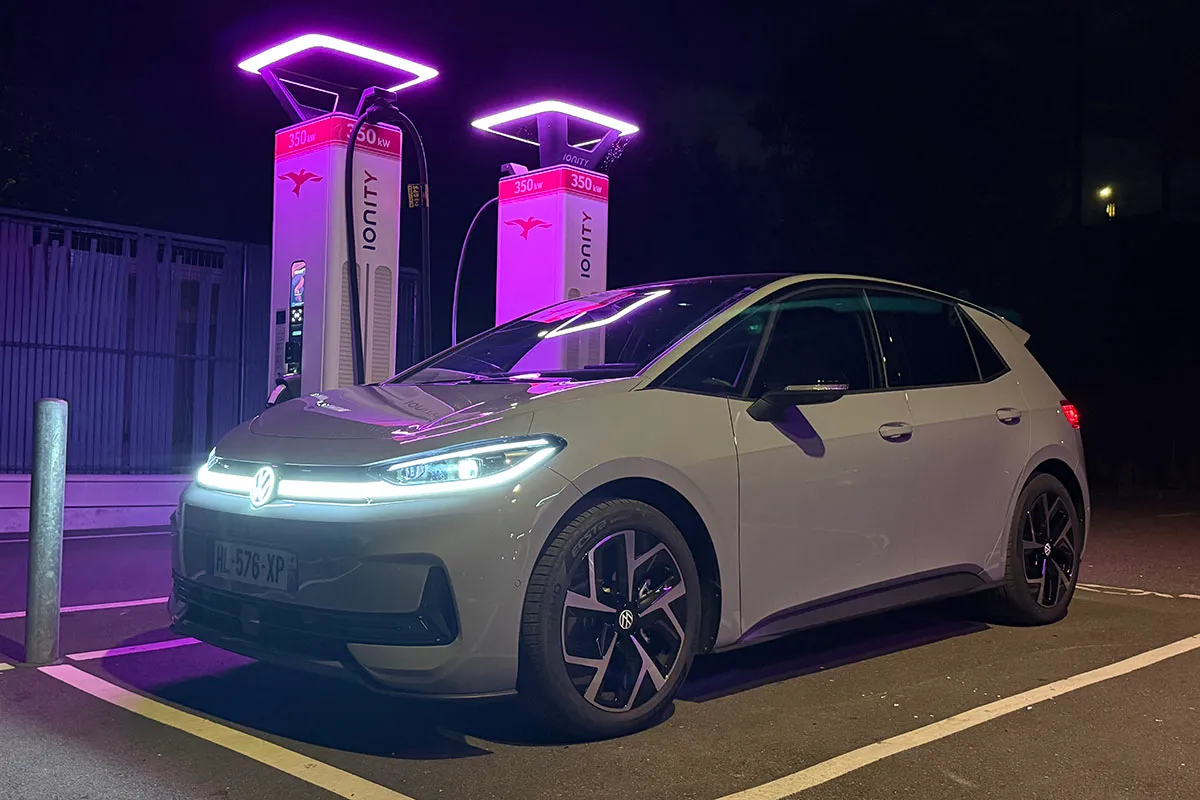

The new Volkswagen ID.3 Neo significantly improves its efficiency levels. Its charging performance is also outstanding.
Launched in 2019, the Volkswagen ID.3 is nearing the end of its lifecycle. In the meantime, it undergoes its third facelift, the most significant yet in its history. Along with a revised design and new driving position, this compact electric vehicle features updated drive trains. This applies to the 58 kWh version, which is now more efficient thanks to its new 140 kW (190 hp) electric motor producing 350 Nm of torque, codenamed APP350. The Neo also comes equipped with an LFP battery that charges much faster. Here’s a detailed overview.
Volkswagen ID.3 Neo 58 kWh: Recap of our tests
We published the first part of this Supertest last week. Here is a very brief overview of the figures:
WLTP range: 478 km
WLTP fuel consumption: 14.4 kWh/100 km (12.1 kWh/100 km net)
Mixed driving: 14.6 kWh/100 km – 400 km
Long-distance driving: 19.5 kWh/100 km – 300 km
Volkswagen ID.3 Neo’s charging curve: 10-80% in 22 minutes
Initially, the Volkswagen ID.3 58 kWh (NMC) model promised a peak charging power of 120 kW, allowing it to reach 10-80% charge in 32 minutes. It later received an update that increased the peak power to 165 kW, enabling a full charge in 24 minutes. With a claimed maximum power of 105 kW and a charging time of 26 minutes, this new version appears to be a slight step back. However, Volkswagen is being cautious here since the new battery can charge faster.
This is what our measurements revealed, showing a peak fast charging rate of 127 kW. More importantly, this maximum power is maintained for a longer duration, up to nearly 55% charge. This allows the battery to recharge more quickly, achieving 10-80% in 22 minutes.
10 to 80%
80 to 100%
10 to 100%
Charging time (in minutes)
22
16
38
Additional range (in km)
208
59
267
Typical charging curve
This results in an average power output of 115 kW at the outlet, compared to 76 kW for the first version. In the class of electric cars with a 60 kWh battery, and excluding the Mercedes CLA 200 (with an average power of 151 kW), none manage to exceed 95 kW on average according to our measurements. The charging process also performs well, requiring only an additional 16 minutes to fully charge the battery, bringing the 0-100% charging time to 38 minutes. With a full charge, this compact vehicle is as efficient as a latest-generation BMW iX3 when considering average power output.
Finally, note that the car is capable of accepting maximum power once the battery temperature reaches around 20 °C. However, this does not mean the charging time will be identical. As we observed with a battery starting at 18 °C (the weather conditions did not allow it to go lower), the car reached a peak power of over 120 kW before its performance declined. The charge from 10% to 80% then took just over 25 minutes at an average power of 103 kW. While not a major issue, it would be interesting to investigate this further in winter with colder battery cells. On the contrary, even with a battery starting at a very high temperature of 41 °C, the Neo can still accept full power and maintain the same level of range!
Range recovered: 245 km in 30 minutes
On our typical 500 km highway route, we measured an average final consumption of 19.5 kWh/100 km, resulting in a total theoretical range of 297 km. Depending on the charging curve, the Volkswagen ID.3 Neo can cover 150 km in 15 minutes and 245 km in 30 minutes. This is an impressive performance that places it among the higher-end models: its figures are identical to those of a Skoda Elroq 85 and far ahead of a Tesla Model Y Standard! Considering mixed-use range, the compact vehicle can regain 200 km of range in 15 minutes.
Charging Costs for the Volkswagen ID.3 Neo
Average charging: fast chargers delivered 43.8 kWh for a 10-80% charge, and 45.3 kWh when charging via AC at a public station with a 11 kW power output. In terms of combined range, the compact model has a direct usage cost of 9.5 €/100 km for DC charging (0.60 €/kWh) and 3.3 €/100 km for AC charging at home (0.20 €/kWh). On the highway, the cost rises to a maximum of 12.6 €/100 km, or 8.2 €/100 km with an operator subscription that reduces the unit price to 0.39 €/kWh, for example.
Fueling cost (10 to 80%)
Combined trip cost
Cost on highway
AC at home (0.20 €/kWh)
9.1 €
3.3 €/100 km
–
DC at public stations (0.39 €/kWh)
17.1 €
6.1 €/100 km
8.2 €/100 km
DC at public stations (0.60 €/kWh)
26.3 €
9.5 €/100 km
12.6 €/100 km
Charging and usage costs
Travel time for 500 km: 4 h 53
Initially, the car’s built-in planner schedules two charges for a total downtime of 42 minutes. Based on its predictions and our calculations, it seems to be relying on an average final consumption of nearly 19.7 kWh/100 km.
In reality, however, the charging times are much shorter than indicated. While we indeed performed two charges to reach our destination with 20% remaining battery charge, our total downtime was only 25 minutes. Combined with the usual travel time and a four-minute allowance per stop, this results in a total travel time of 4 h 53.
Apart from the Mercedes CLA 200, this ID.3 Neo 58 kWh is the only car under 60 kWh capable of crossing the finish line in less than 5 hours. In this category, the MG 4 Urban finishes in third place with a time of 5 hours and 12 minutes. In the compact segment, only the Kia EV4 does better (4 hours and 45 minutes), but it has an 81 kWh battery. The German car is tied with the Nissan Leaf, which has a 75 kWh battery.
Volkswagen ID.3 Neo Supertest: Summary
The Volkswagen ID.3 Neo is far more than just a minor refresh, with improved design both inside and out. By adopting cutting-edge technologies, including an LFP battery that charges much faster than expected and a more efficient electric motor, this compact vehicle significantly boosts its versatility. As a result, this mid-range version proves to be more than sufficient—when it comes to traveling, it rivals the best family cars. This puts pressure on the higher-end 79 kWh (NMC) version. With similar consumption, it should offer around 410 km of total range on the highway. This would allow the compact car to skip a charging stop... but only by 10 minutes over a 500 km journey according to our calculations!
In terms of price, the 58 kWh version would start at 40,500 € and rise to 42,700 € for the premium Style version. The additional 5,400 € cost for the 79 kWh version seems hardly justified. In short, it’s a benchmark in the electric car segment!