
Supertest of the 2026 Subaru Solterra: Is its progress finally enough for worry-free driving?
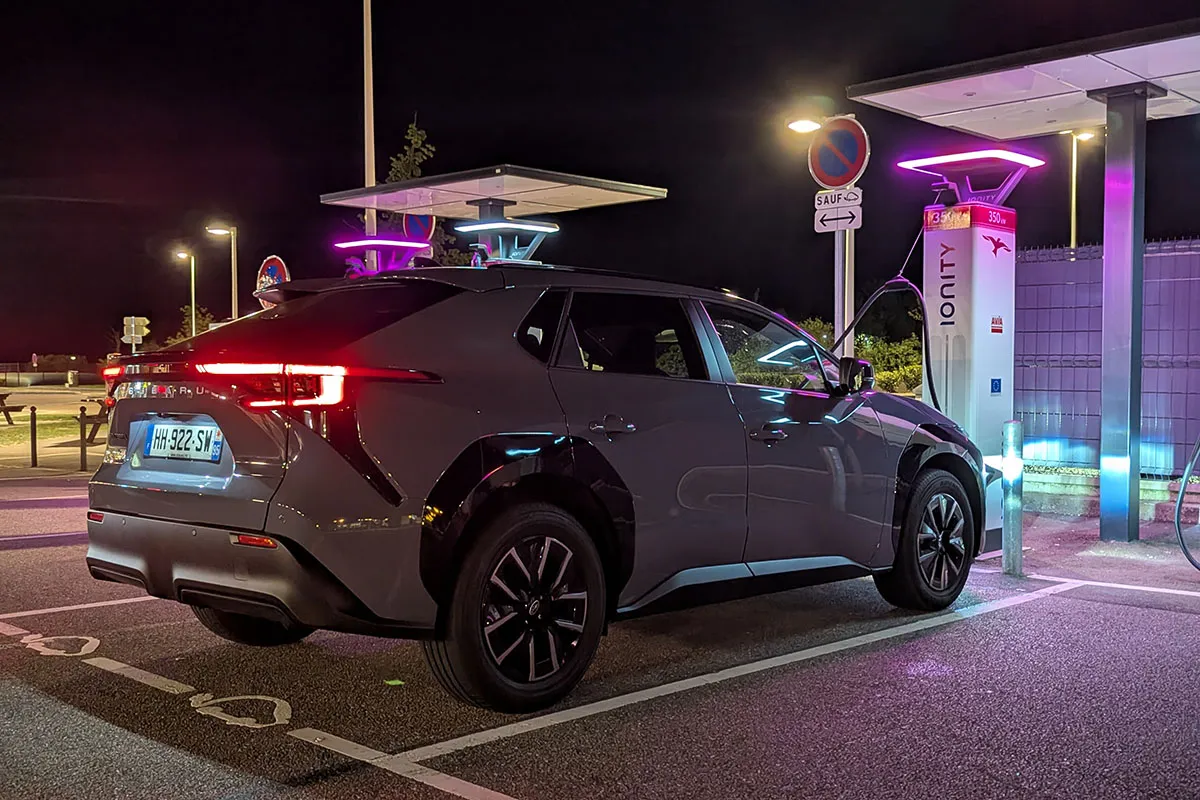
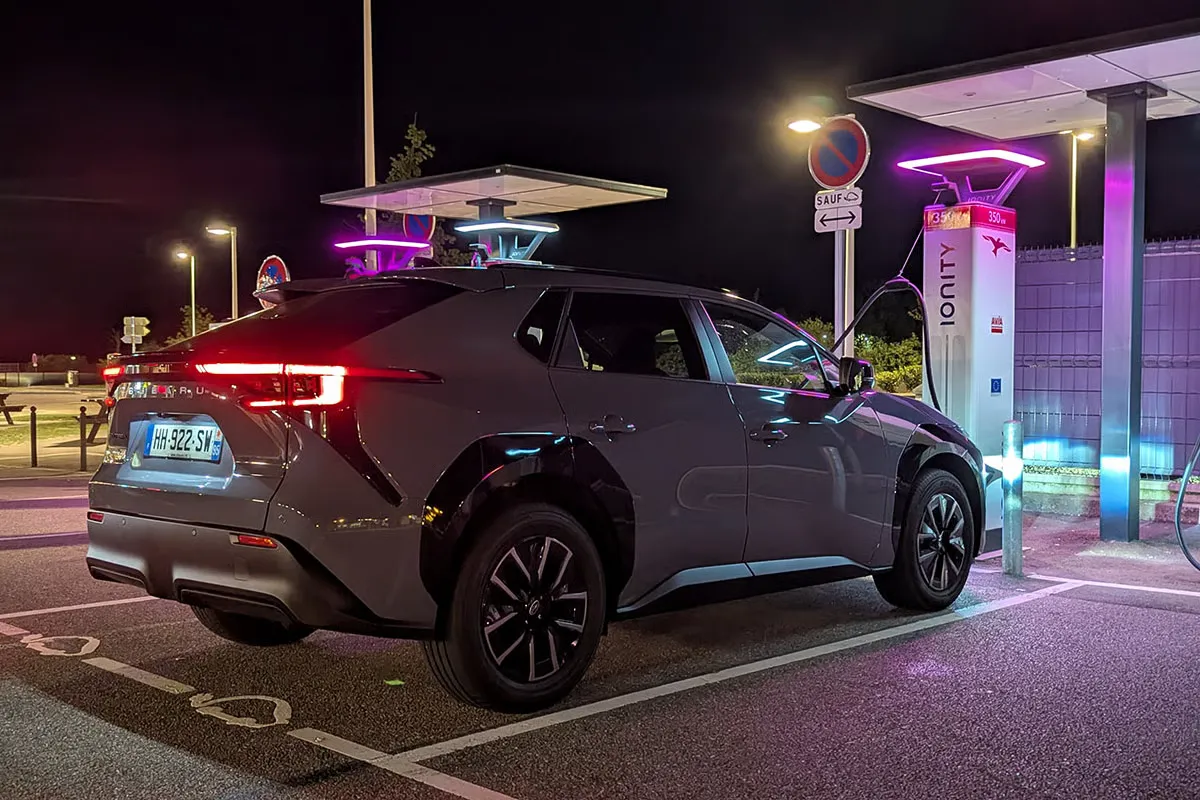
The Subaru Solterra is getting an update. More efficient and equipped with a slightly larger battery, it performs better at fast charging stations.
Following in the footsteps of the Toyota bZ4X, the Subaru Solterra undergoes a restyle to receive some cosmetic tweaks as well as significant technical improvements. The chassis has been revised with new electric motors, the transmission is different, the chassis has been optimized, and a new battery is installed under the floor. All these technical advancements help improve efficiency on one hand and increase range on the other. According to our tests, this new Solterra offers 15% more range. Let’s take a look at its performance at fast charging stations.
Also worth reading
Supertest Subaru Solterra 2026: measured fuel consumption and range, a pleasant surprise!
Subaru Solterra: quick recap of our measurements
We published the first part of this Supertest last week. Here’s a very brief summary of the figures:
WLTP range: 509 km
WLTP fuel consumption: 14.7 kWh/100 km (13.6 kWh/100 km net)
Mixed driving: 14.8 kWh/100 km – 430 km
Long-distance driving: 22.2 kWh/100 km – 285 km
Subaru Solterra’s charging curve: 10-80% in 29 minutes
The Subaru Solterra features new prismatic cells, allowing the total capacity to reach 73.1 kWh. Although the part numbers may change, the claimed maximum power remains at 150 kW. In reality, however, the battery can achieve higher power levels for longer periods of time.
Thus, the SUV can now handle 160 kW or more up to 35% charge level, beyond which the power output decreases. The decline is linear, with a residual power of just under 50 kW at 80% charge. Overall, the 10-80% charging process now takes 29 minutes, compared to 32 minutes before. While this is a small difference overall, it results in an average charging power of 101 kW at the charger, up from 86 kW previously. This represents a 15% increase, without altering the maximum power listed in the technical specifications. A full charge from 10% to 100% requires one hour.
10 to 80%
80 to 100%
10 to 100%
Charging time (in minutes)
29
31
60
Additional range gained (in km)
199
57
256
Typical charging curve
While the previous Subaru Solterra was on par with a Peugeot e-308 (84 kW average) or an e-3008 (86 kW), the new version rivals a MG S5 EV (100 kW) or a Renault Scenic E-Tech 87 kWh (101 kW). A Tesla Model Y Long Range is not far behind (105 kW), but the entry-level LFP battery version is out of reach (126 kW). It’s also worth noting that the Solterra now comes with an automatic or manual preconditioning system. Poor weather conditions prevented us from measuring fuel consumption and determining any differences between charging scenarios under cold and warm conditions.
Range recovery: 200 km in 30 minutes
On our highway test, we measured a total theoretical range of 285 km with a full charge. Considering the charging curve, this Japanese SUV can regain 140 km of highway range in 15 minutes and just over 200 km in 30 minutes. By strict numerical comparison, the Solterra falls right at the market average, on par with the MG S5 EV and Peugeot e-3008, and far behind the Skoda Elroq 85 (150 km in 15 minutes). In 30 minutes, it reaches the level of the Renault Scenic E-Tech. For reference, the previous version could recover 110 km in 15 minutes and 160 km in 30 minutes. Thus, the new Solterra sees an average improvement of 25%.
Subaru Solterra Charging Costs
Average fast charging stations deliver 49 kWh to achieve 10–80% charge. It is evident here that the available capacity is indeed lower than the actual usable capacity. Based on an average public price of 0.59 €/kWh for these chargers, the Subaru Solterra incurs a cost of 14.5 €/100 km on the highway, which is average for the market. With an operator subscription that reduces the price to 0.39 €/kWh, the usage cost drops to 11.4 €/100 km. In the case of AC charging at home, the combined cost is approximately 3.3 €/100 km.
Fueling Cost (10–80%)
Combined Trip Cost
Highway Cost
AC at Home (0.19 €/kWh)
10.4 €
3.5 €/100 km
–
DC at Public Stations (0.39 €/kWh)
22.7 €
7.6 €/100 km
11.4 €/100 km
DC at public chargers (0.59 €/kWh)
28.9 €
9.7 €/100 km
14.5 €/100 km
Charging and usage costs
Travel time for 500 km: 4 h 58
When starting with a fully charged car, the built-in route planner schedules a trip requiring three top-ups, including the first charge to reach nearly 50% capacity. The system being cautious, it reports a total time of 6 h 35, which is the same as that of a Renault Twingo E-Tech.
In reality, things were quite different, and we made two refueling stops. By making full use of the available fuel without hesitation, we managed to reach the first charging station at the Maison-Dieu service area, 300 km from our starting point. The gauge showed 0% just 2 km before entering the service area! A 90% charge here could have allowed us to reach our destination with nearly 20% of battery remaining. But we decided to make a second stop to speed things up, arriving with only 13% of the battery left.
With a driving time of 4 hours and 20 minutes and a four-minute allowance per refueling stop, the Subaru Solterra can complete our Lyon-Paris route in 4 hours and 58 minutes, as usual. This keeps it well under the symbolic 5-hour mark, making it just as comfortable to use in this type of scenario as a conventional car. The SUV doesn’t reduce the number of refueling stops compared to its predecessor, but it shortens the pauses by nearly 20 minutes.
It now performs as well as competing family SUVs and is no longer among compact and city cars. It achieves similar times to the Renault Scenic E-Tech and MG S5 EV, and is about ten minutes behind some benchmarks such as the Skoda Elroq 85 (4 hours 53 minutes) and Tesla Model Y Propulsion (4 hours 50 minutes). Finally, for those interested, we recorded four charges over a 1,000 km distance, resulting in a total time of 10 hours 40 minutes.
Supertest Subaru Solterra: The Verdict
True to the Kaizen philosophy, the Subaru Solterra evolves through small improvements to significantly enhance its existing foundation. Thanks to various enhancements aimed at reducing fuel consumption and boosting range just slightly, this Japanese SUV offers a bit more driving distance. Additionally, it now features an upgraded fast charging system that, though not among the best, provides greater versatility for the Solterra.
With 9% lower consumption, 18% improved range on the highway, and 17% more efficient charging, this SUV reduces travel time by 6%. This brings it back to market average levels. Notably, it is one of the most efficient all-wheel-drive SUVs on the market, except for the Tesla Model Y Long Range Dual (14.8 vs 14.4 kWh/100 km on mixed routes, 22.2 vs 19.6 kWh/100 km on the highway). But other models, like the BMW iX3 50xDrive, fall behind!
But the Subaru Solterra now faces the tough task of restoring its reputation to overshadow its questionable beginnings, as well as reducing its prices somewhat. Although it has no direct competitors, comes equipped with a wealth of features, and is capable of handling off-road terrain better than many electric 4×4 SUVs, the price of 48,990 euros for this test version (52,990 euros for 4XPerience+) might be too steep for a vehicle still struggling with its image.