
Supertest of the 2026 Subaru Solterra: Measured fuel consumption and range, a pleasant surprise!
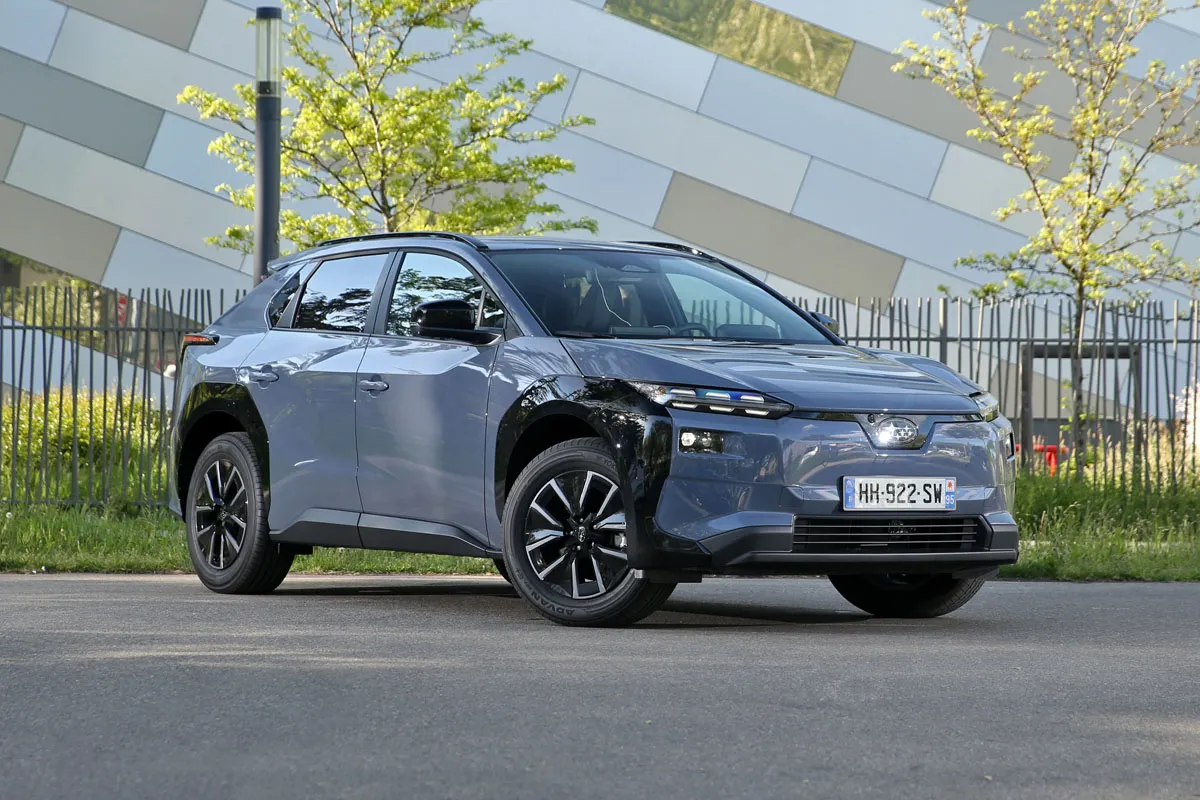
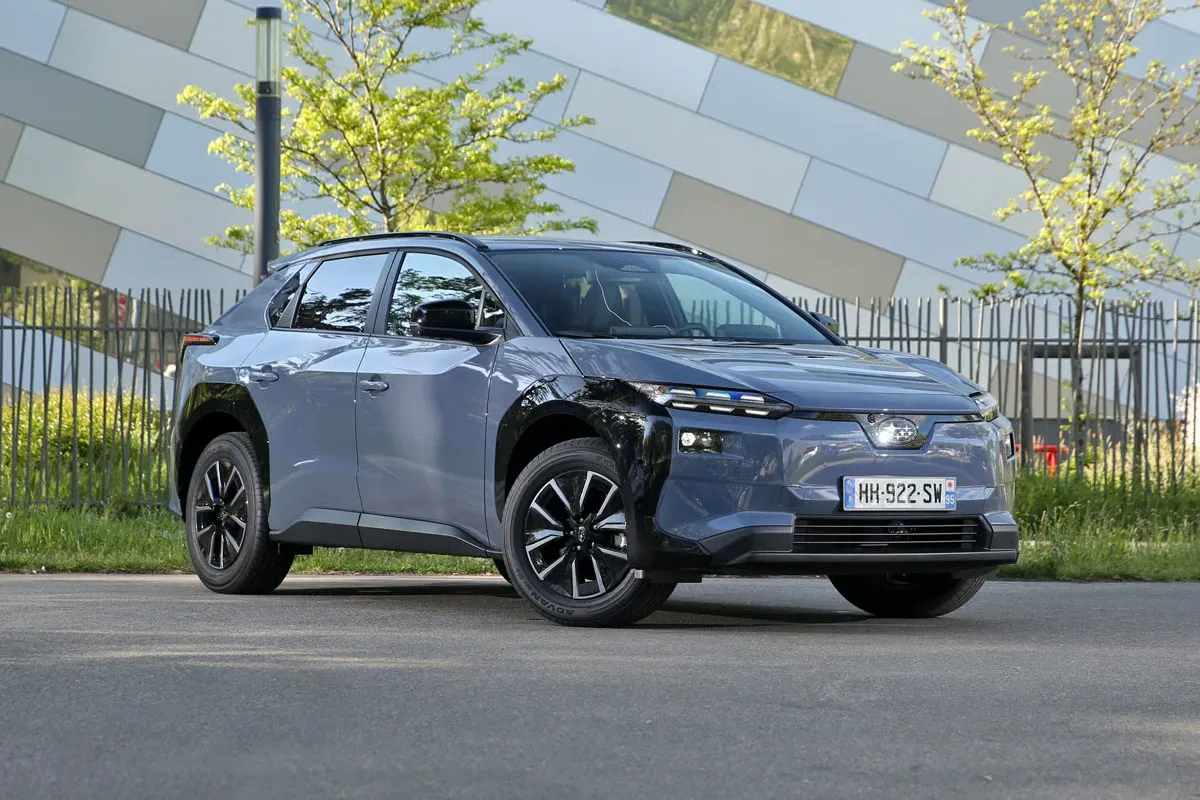
The Subaru Solterra follows in the footsteps of the Toyota bZ4X with a technical update. Is this enough to bring it back into the race?
Like its technical twin, the Toyota bZ4X, the Subaru Solterra had a difficult start due to its electric performance falling short of that of its direct competitors. But the Japanese automakers decided to move on from the past with a model restyle. In addition to cosmetic changes that also reduce the Cx value by 0.02, the SUV features a new drive train. Is this sufficient to help it climb back up in the Supertest rankings? We tested the new version to better compare it to the first iteration.
Also read
Subaru e-Outback Test: The rugged SUV is back — now electric!
Introduction to the Subaru Solterra
Still 4.70 meters long, the Subaru Solterra retains its all-wheel drive system powered by a pair of permanent magnet synchronous electric motors. Unlike the previous version and the recent Subaru E-Outback, the Solterra features different motor arrangements. At the front is the main motor, capable of delivering 167 kW (227 hp) and 268 Nm of torque. The rear motor, always active, provides up to 88 kW (120 hp) and 169 Nm of torque. In total, the Subaru Solterra offers 252 kW (343 hp), a significant improvement over the 160 kW (218 hp) of the first version.
According to the technical diagrams, we noticed that the front and rear motors in the AWD version are different. This contrasts with the previous Solterra configuration, which featured a pair of identical 1YM motors, each delivering up to 109 horsepower (80 kW). Engineers say this choice by Subaru was optimal for better power distribution in off-road conditions. Since such use is extremely rare, the brand preferred to differentiate the motors to provide a distribution better suited for road use. However, power is still continuously distributed to both electric motors. For reasons related to dynamic performance and driving experience, Toyota and Subaru refuse to install an asynchronous motor that can be disabled at steady speeds to save energy. Additionally, these two electric motors are now equipped with...
Silicon carbide inverters, advanced components that help reduce losses and lower energy consumption.The electromechanical system is powered by a new battery with a gross capacity of 73.1 kWh and a net capacity of 69 kWh. It replaces the 71.4 kWh version from the previous generation, featuring 104 NMC prismatic cells. These cells are still connected in series, following a 104s1p configuration. However, the Japanese engineers remain highly cautious by maintaining a significant energy reserve below 0%. According to our measurements, only 63 kWh is usable across the entire capacity range.
These improvements help increase the Solterra’s WLTP range. In this entry-level 4XPerience version, our test vehicle claims a combined range of 509 km, with an energy consumption including charging losses of 14.7 kWh/100 km. This represents a gain of 1.4 kWh/100 km compared to the first version. Let’s see the results in real-world conditions.
Additional specifications for the Subaru Solterra
Peak power: 343 hp – 252 kW
Net power (field P.2): 185 hp – 136 kW (-46 %)
Administrative power (field P.6): 10 hp
Operating weight (field G.1): 2,025 kg
Weight-to-power ratio: 6.17 kg/hp
WLTP range: 509 km
WLTP fuel consumption: 14.7 kWh/100 km (13.6 kWh/100 km net)
AC charging: 11 kW – 3 hours 30 minutes (0-100 %)
DC charging: 150 kW – 28 minutes (10-80 %)
Tires: Yokohama Advan V61 E+ – 235/60 R18 – A, B, 68 dB
All our fuel consumption measurements for the Subaru Solterra
Combined range: 430 km (14.8 kWh/100 km)
With an average outside temperature of 13 °C, the new Subaru Solterra achieved an average fuel consumption of 14.8 kWh/100 km over our 100 km mixed route test. This represents a reduction of 1.3 kWh/100 km compared to our previous measurement. The target was met! Considering the usable capacity, this gives a total range of 465 km. However, with only the actually usable capacity taken into account (as few drivers would continue driving with a 0% battery level), the SUV offers a range of 431 km. This falls within the typical market average, and the 15% deviation from the certified value seems satisfactory. For reference, our test under the specified conditions showed a deviation closer to 18%.
Route
Highway
City
Total
Average round-trip consumption (kWh/100 km)
15.2
17.6
11.8
14.8
Total theoretical range (km)
414
358
534
431
Mixed range – 13 °C outside.
Long-distance highway driving: 285 km (22.2 kWh/100 km)
On our 500-km route entirely on highways from southern Lyon to southern Paris via A6, the Subaru Solterra showed a fuel consumption of 22.2 kWh/100 km. Here, the difference is more noticeable compared to the previously less optimized version, with 2.3 kWh/100 km less consumption. With a full charge down to 0%, this results in an average range of 285 km. For comparison, this is similar to what the MG S5 EV can achieve with its 62 kWh usable battery capacity. These are the effects of better aerodynamics.
Also read
Test of the restyled Toyota bZ4X: improvements for this Japanese electric SUV
Instantaneous high-speed fuel consumption
To verify this, we measured fuel consumption at strictly fixed speeds with the air conditioning turned off to minimize the impact of various resistance factors. At 90 km/h and 110 km/h, the SUV exhibited fuel consumption rates of 14.3 and 18.6 kWh/100 km respectively, with the latter being 0.4 kWh/100 km better. However, the gap widens as the speed increases. At 130 km/h, we recorded a consistent fuel consumption of 23.8 kWh/100 km, which is 1.3 kWh/100 km lower.
90 km/h
110 km/h
130 km/h
Average consumption (kWh/100 km)
14.3
18.6
23.8
Instantaneous consumption readings
All our performance measurements for the Subaru Solterra
Acceleration and deceleration tests
With a weight of just over 15 kg but significantly more power, the new SUV boasts a weight-to-power ratio of 6.2 kg/hp compared to 9.6 kg/hp. Additionally, despite the different mechanical setup, the instant response of the drivetrain remains unchanged. This results in a 0-100 km/h time of 4.9 seconds according to our measurements (6.6 seconds previously), and a 400 m time of 13.3 seconds (14.8 seconds previously).
Mode
0-100 km/h
80-120 km/h
400 m
Eco
6.0 s
4.3 s
14.4 s
Normal
5.0 s
3.3 s
13.4 s
Power
4.9 s
3.2 s
13.3 s
0-60 mph in 80% load condition
To put this in perspective, the Subaru Solterra accelerates faster than an Audi Q6 e-tron quattro (6.2 kg/ch), and even faster than a MG Cyberster, which has a more favorable ratio of 5.8 kg/ch. A Tesla Model Y Long Range Dual achieves 0-100 km/h in 5.0 seconds and covers 400 meters in 13.1 seconds. Finally, it recorded 80-120 km/h in 3.3 seconds at 80% charge, which matches exactly the times of the Alpine A390 GT or the BMW iX3 50xDrive! This is enough to demonstrate the robustness of its mechanical setup. On the downside, the sensitivity of the right pedal and the power distribution often come as a surprise, which will likely annoy passengers over time.
Braking and energy recovery
In terms of braking performance, it is less impressive. The Solterra requires 67.6 meters to come to a stop from 130 km/h in an emergency brake test. This result can be attributed to its tires, which have very poor grip. The Vinfast VF 6, the worst performer in this test according to our data, needs 69.5 meters.
Mode
90-0 km/h
80-0 km/h
60-0 km/h
Mini.
1,690.6 m
1,398.5 m
833.8 m
Intermédier
376.6 m
301.9 m
176.7 m
Maxi.
221.0 m
175.1 m
99.2 m
Regenerative braking when releasing the brake pedal
In terms of regenerative braking, the SUV offers five different modes selectable from the controls on the steering wheel. The first mode isn’t entirely coasting, but it still allows the car to travel 1,690 meters from 90 km/h. The difference between the other levels is quite small. With level 2 yielding 377 meters, the most powerful mode covers the distance in 221 meters. Finally, there is no one-pedal function.
Comfort and Interior
Inside, the austere atmosphere remains despite upgrades to higher-quality materials. The screen has increased to 14 inches with excellent resolution. But tech enthusiasts will be disappointed: the graphics, menus, and apps are kept very basic. Right in front of the driver is the same instrumentation as the previous version.
The driver now has a dual-rim steering wheel that provides better handling in turns. The Subaru Solterra also gains in speed and precision. The same applies to the various controls, although, as seen, the accelerator can be too sensitive if not handled carefully. Additionally, improvements have been made in terms of vibration control and acoustic management, with noise levels dropping to 68 dB at 130 km/h—now within average ranges. Still on comfort, the climate control system is stable but lacks slight precision: setting 18 °C on the dashboard results in only 20 °C inside the vehicle.
Otherwise, the Subaru Solterra is no different from its previous version, offering a spacious rear cabin. The trunk has a capacity of 441 liters, which is average for its class and nothing more. Yet this once again proves that numbers aren’t everything in this regard, as it turns out to be very practical in use. The trunk’s layout and low loading threshold make loading easier, the flat floor allows many items to be stored comfortably, and its width, even between the wheel arches, makes things much simpler.
While it won’t wake anyone up at night with its still austere interior atmosphere despite efforts to improve quality, the Subaru Solterra makes a slight improvement in terms of powertrain performance. Thanks to the numerous changes made during this restyling, the SUV achieves better efficiency while offering higher range. During the technical presentation of this drive system, Toyota (with the bZ’X and Solterra being technically identical) indicated a 20% increase in range. Although the WLTP figure shows only a 9% improvement here, our tests show an average increase of 15% compared to the previous Solterra.
However, it remains regrettable that engineers chose to limit the actually usable battery capacity, hiding at least 6 kWh of net capacity below 0%. As a result, nearly 9% of the actual driving range is missing. It’s difficult to continue driving with a battery level at 0%—the power output is significantly reduced, making it akin to playing Russian roulette. All that’s left for us now is to see how the Solterra performs at fast charging stations and during long trips. We’ll discuss this next week.