
Supertest Lucid Air Sapphire: 1,251 horsepower, but is it as fast to recharge as it is to accelerate?
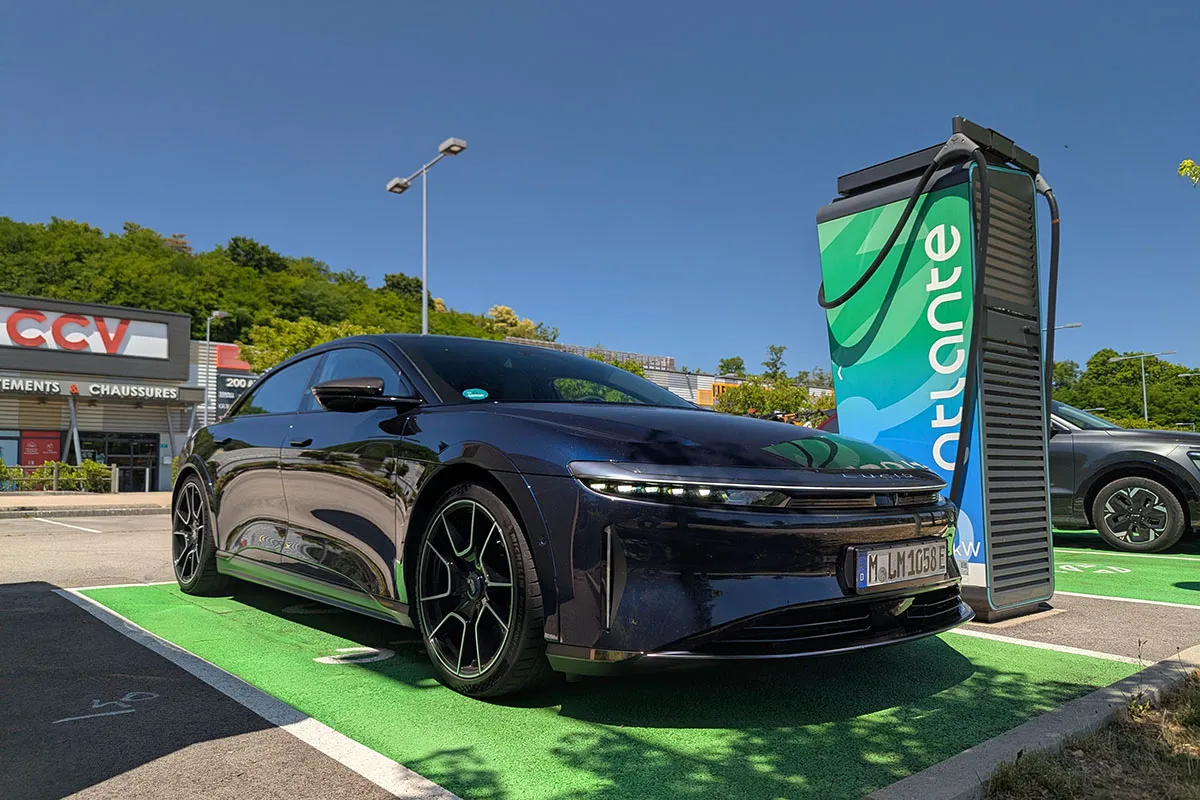
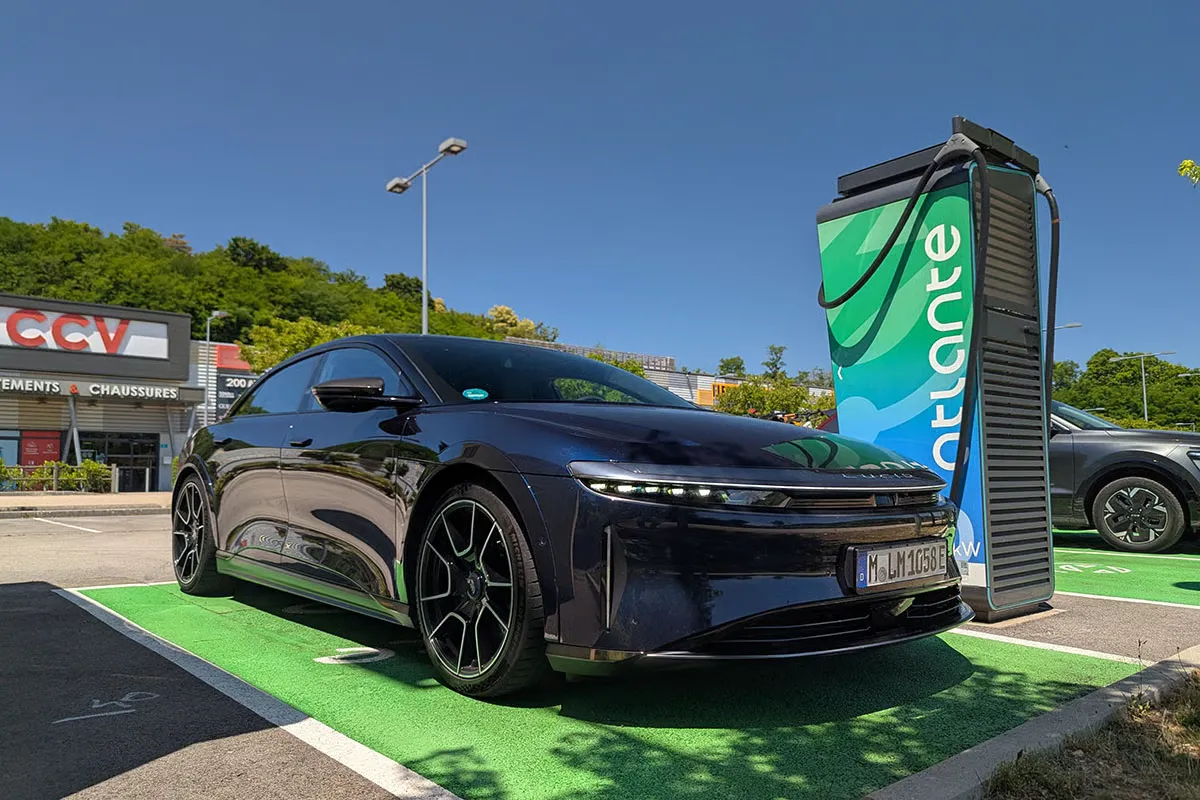
The Lucid Air Sapphire delivers an incredibly high level of performance. Let’s see if it performs similarly at fast charging stations.
Still unavailable in our region, the Lucid Air continues to evolve over the years. While its standard versions benefit from updates that further improve efficiency and thus range, the American luxury sedan also comes in an exclusive Sapphire version with 1,251 horsepower. Despite the technical advancements needed to deliver such power, the Sapphire still maintains quite impressive fuel consumption levels. All that’s left for us to examine is how it performs when refueling.
Lucid Air Sapphire: Recap of Our Tests
We released the first part of this Supertest last week. Here is a very brief overview of the figures:
WLTP range: 694 km
WLTP fuel consumption: 19.1 kWh/100 km (17.0 kWh/100 km net)
Combined cycle: 20.3 kWh/100 km – 580 km
Long-distance driving: 24.9 kWh/100 km – 475 km
Lucid Air Sapphire charging curve: 10-80% in 29 minutes
The Lucid Air Sapphire is equipped with a 118 kWh battery, operating at a nominal voltage of 810 V (up to 924 V). The brand remains quite vague about the maximum power output the vehicle can handle, but we have observed up to 316 kW in practice at sufficiently powerful charging stations. Despite its operating voltage, the Lucid Air Sapphire can achieve an 80% charge in 29 minutes. This translates to an average charging power of 175 kW. This is better than the 145 kW recorded by the 112 kWh Grand Touring model, but it ranks low among 800 V vehicles, on par with a Volvo ES90 Single (178 kW). For comparison, a Porsche Taycan has an average charging power of 265 kW, while the Lotus Emeya reaches 292 kW.
While it’s never necessary to charge to 100% at a fast charger, the end stage of charging remains rather impractical here. It takes an additional 12 minutes to reach 90%, or 1 hour and 1 minute to go from 80% to 100%! In total, fully charging the vehicle requires 1 hour and 30 minutes of downtime. This is quite long overall, but the advantage of high power ratios helps mitigate this: the final average power of 74 kW is identical to that of an Alpine A390 GT, and slightly higher than the average across all our Supertest measurements.
10 to 80%
80 to 100%
10 to 100%
Charging time (in minutes)
29
58
87
Range added (in km)
332
95
427
Typical charging curve
Like all Lucid models, the Sapphire is equipped with the Wunderbox, which houses all the power electronics. Among its components is a converter that allows the vehicle to connect to chargers with lower voltage, similar to Tesla’s Superchargers here that operate at 400 V. In this case, the converter limits output to no more than 47 kW, resulting in a 10-80% charge in nearly 2 hours!
Range added: 330 km in 30 minutes
Despite its modest fast-charging performance for a vehicle in the 800 V category, the Lucid Air Sapphire makes up for it when it comes to highway range. The sports car can cover 205 km in 15 minutes or 340 km in 30 minutes. In the latter case, it climbs to the top of the rankings, surpassing the Lotus Emeya (320 km in 30 minutes) and even catching up to its smaller Grand Touring sibling, which has a lower range but is slower to charge (342 km in 30 minutes). Nearly tied, the Air models rank fifth in our database in this category, with the Mercedes CLA 250+ holding the record (410 km in 30 minutes).
Travel time for 500 km: 4 h 35 (est.)
As we mentioned in the first part of this Supertest, we did not take our usual 500 km route from Lyon to Paris via the A6 highway. Instead, based on the data collected up to Beaune, where we turned east rather than northwest, we were able to estimate the travel time for 500 km at just under 4 hours and 35 minutes. According to our calculations, the Sapphire would therefore have a travel time two to five minutes longer than a Grand Touring model. This is similar to the performance of the best electric cars in this category, such as the BMW iX3, Mercedes GLC, or XPeng P7+.
Supertest Lucid Air Sapphire: Summary
The Lucid Air Sapphire demonstrates the brand’s expertise in electric vehicle technology. Despite its impressive performance levels and technical advancements to keep such a powerful vehicle grounded, it still boasts some of the best range figures among electric cars on the market. And upon closer inspection, while its energy consumption is high by absolute standards, it isn’t as significant as one might assume—some cars don’t perform much better with significantly lower power levels. This allows it to compensate for less impressive fast-charging capabilities compared to vehicles with even more advanced engineering.
This car can do it all: practical like an SUV, comfortable like a limousine, easy to drive like a GTI, powerful like a muscle car, and fast like a supercar — it checks every box. On top of that, it offers the ability to travel at speeds rivaling the best electric cars on the market. While this isn’t a criterion for its target audience, the technological demonstration showcased in this Supertest is astounding.
Is this the best car in the world? Allow me this (rare) subjectivity: yes! That said, the price is quite steep, requiring a check for 253,900 euros in France. It’s an extremely high price, but it matches what Porsche charges for its exclusive Turbo GT, which is ultimately less powerful, less fast, and less luxurious.