
Sunwoda will integrate the 15C-Battery into the Megawatt charging ecosystem.
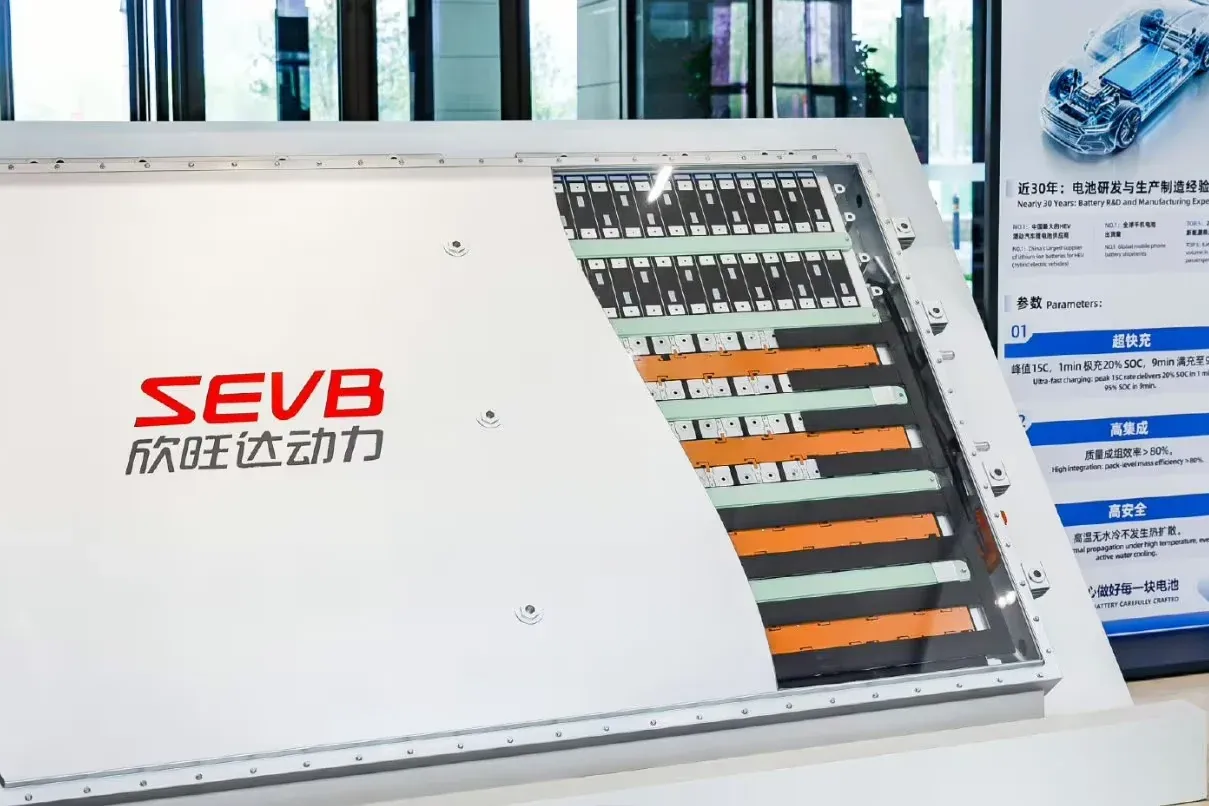
Sunwoda is advancing its plans for ultra-fast charging. The Chinese battery manufacturer aims to build a charging ecosystem around its 15C battery, introduced in spring, which will include a total of 10,000 megawatt charging stations by the end of 2027.
Sunwoda’s 15C battery is designed to charge from 10 percent to 97 percent in just nine minutes.
Image: Sunwoda
In addition to the charging infrastructure, the company also revealed further details about its 15C battery system. At room temperature, the battery is said to be able to charge from 10% to 70% within five minutes and from 10% to 97% within nine minutes. Sunwoda claims that one minute of charging is sufficient to extend range by another 100 kilometers. According to CN EV Post, the manufacturer also promises a range of over 700 kilometers—likely based on China’s CLTC testing cycle.
The battery technology is not entirely new, however. As early as April, Sunwoda introduced the Xingchi Supercharge Battery 2.0. The LFP battery shown back then had an energy capacity of 98.8 kWh and a voltage of 844.8 volts. With a maximum charging current of 1,800 amperes, the peak charging power calculated is slightly over 1.5 MW.
The 15C rating promoted by Sunwoda refers to peak performance rather than the entire charging process. If a 98.8-kWh battery were actually charged at 15C continuously, it would theoretically be fully charged in four minutes. In contrast, the charging range mentioned in spring—going from 50% to 95% in nine minutes—corresponds to an average C-rate of around 6.7, which remains a very high value for such a large charging range.
Even at low temperatures, the high charging speed is supposed to remain largely intact. At minus 20 degrees Celsius, Sunwoda states that it takes 15 minutes to charge from 10 percent to 97 percent. Additionally, the system is designed to meet the requirements for a 10-year or 300,000-kilometer warranty. For vehicles not used for commercial purposes, there should be no limit on the number of ultra-fast charging sessions. During its presentation in April, Sunwoda claimed that the Xingchi Supercharge Battery 2.0 has a lifespan of 1,500 cycles.
Sunwoda is developing its own megawatt charging ecosystem
The more significant aspect of the current announcement relates to infrastructure. Sunwoda has introduced an open platform that connects fast-charging batteries, stationary energy storage systems, photovoltaic panels, megawatt charging units, and liquid-cooled high-performance chargers. It is designed to support vehicles from various brands, rather than being limited to models equipped with Sunwoda batteries.
By the end of 2027, the fast-charging ecosystem is expected to include 10,000 megawatt charging stations. However, it remains unclear where these locations will be situated, what investment amount Sunwoda plans to allocate for this purpose, and to what extent the company intends to build the infrastructure itself or in partnership with others. Additionally, no details have been provided regarding the first vehicles equipped with the new battery system or a timeline for production commencement.
This move sees Sunwoda stepping more deeply into the fast-charging competition among Chinese manufacturers, which now also involves infrastructure development. BYD introduced its second generation of Blade Battery in March alongside a 1,500-kW charging system and corresponding vehicles. By the end of August, BYD reported having operational its 10,000th fast-charging station in China, with plans to expand the network to 20,000 stations by the end of 2026.
Other Chinese manufacturers are also boosting charging capabilities. Hongqi demonstrated in July a battery developed jointly with China Automotive New Energy Battery Technology (CNET) that achieved a charge rate increase from 10% to 70% in 3:41 minutes, though it has not yet set a date for mass production. Dongfeng recently showcased its own fast charger capable of 1,500 kW per charging point.
In addition to charging speed, Sunwoda also enhances monitoring of the battery system. The combination of “Smart Battery Cells 3.0,” an energy domain controller, and a AI-based cloud platform is designed to continuously monitor battery status and detect faults early. According to the manufacturer, more than 20 types of faults can be predicted two to ten days in advance with a precision rate of 99.77 percent.