
Switzerland has invented an innovative charging system for electric buses with 90% efficiency, requiring no large batteries and minimizing charging time.
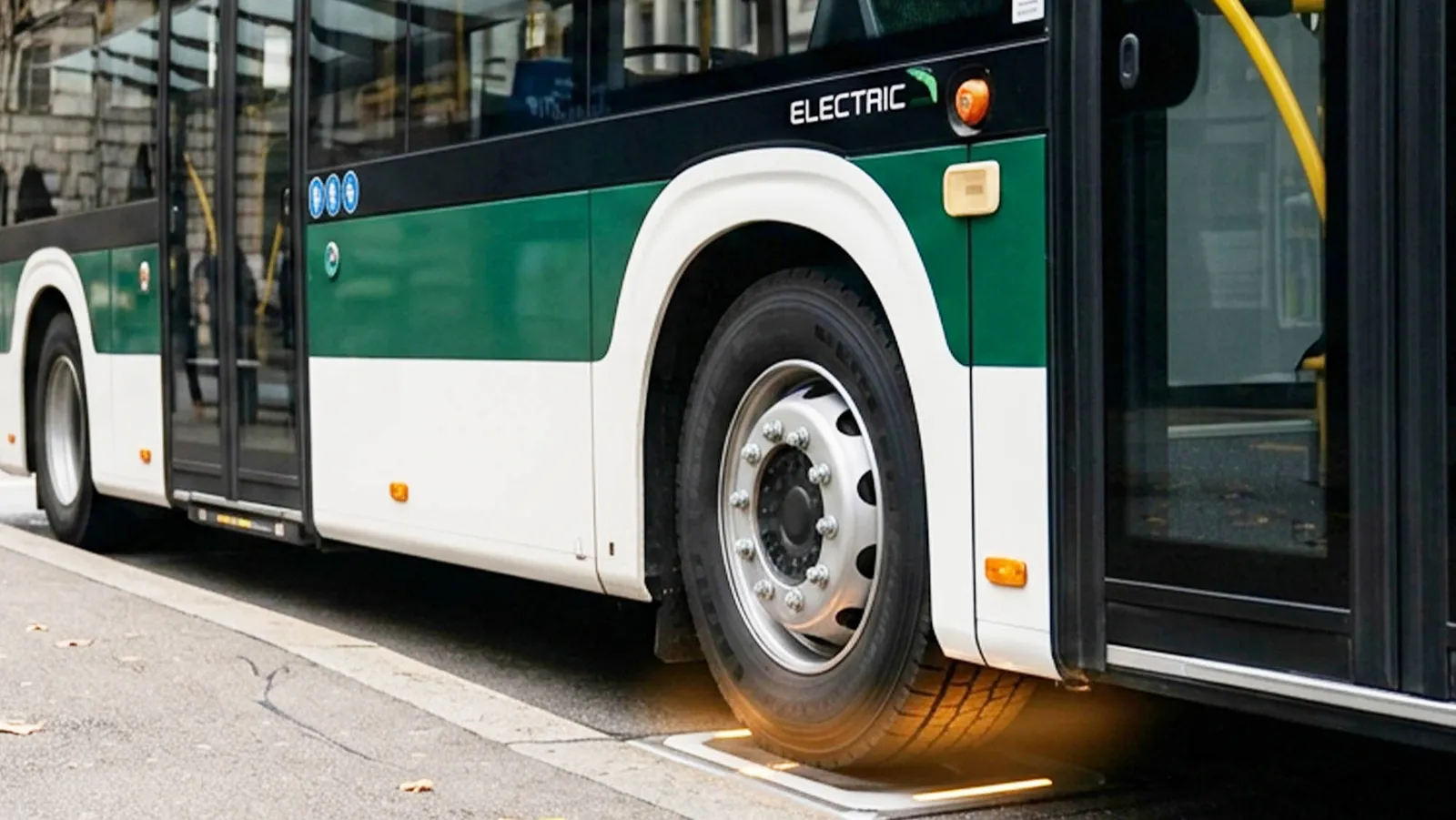
The electrification of public transportation faces a significant challenge: ensuring that electric buses can operate throughout the day without relying on huge batteries or long stops to recharge them. A Swiss company proposes a different solution: transferring electricity from the road surface to the vehicle’s battery using its own wheels.
The technology, developed by Winduction, a company affiliated with the Swiss Federal Institute of Technology Zurich (ETH), utilizes wireless charging via magnetic induction. Its goal is to take advantage of the regular stops in urban transportation to recover energy and reduce dependence on large charging facilities in garages.
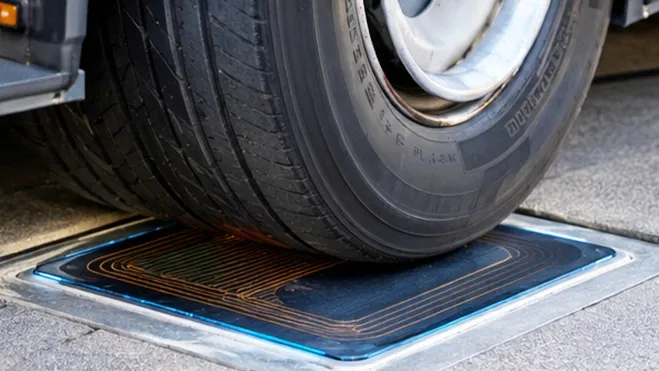
How wheel-based electrical charging works
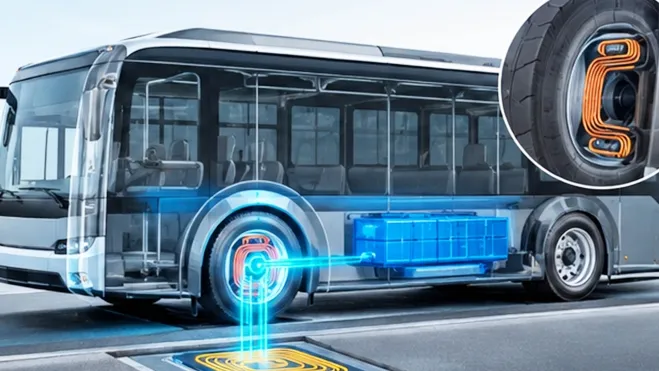
The Winduction system uses two sets of coils. The first is located on a plate installed in the pavement and connected to the electrical grid. The second is built into a specially designed tire meant to receive energy.
When the bus stops with one of its wheels on the plate, a magnetic field is generated that allows electricity to be transferred to the vehicle and ultimately to its battery. The entire process takes place without connecting cables or using a conventional plug.
The difference from other inductive charging systems lies in the location of the receiver coils. Instead of placing them at the bottom of the vehicle, Winduction integrates them into the wheels to reduce the distance between the transmitter and the receiver.
This proximity is important because it affects the efficiency of energy transfer. By bringing the two components closer together, the company claims its technology achieves over 90% efficiency between the charging pad and the vehicle.
This means that losses during energy transfer would be less than 10%, according to data provided by their developers. However, this figure should not be confused with the bus’s overall energy efficiency, which also depends on other factors such as battery losses and propulsion system consumption.
A special tire without steel structures
The integration of coils into wheels presents a technical challenge. Conventional bus tires contain steel belts that provide strength and stability, but they can interfere with the magnetic field used to transmit electricity.
The solution lies in developing steel-free tires that allow energy transfer without excessive heat loss.
Winduction is working with partners to develop these components. Their viability will be crucial for the project’s future, as the tires must meet the safety, strength, and durability standards required of a public transportation vehicle.
In addition, the system will need to prove its cost-effectiveness throughout the bus’s entire service life. Although the company believes that the higher cost of these tires will have a minimal impact on total operating expenses, this advantage must be evaluated under actual operating conditions.
Smaller Batteries and Lower Costs for Fleets
The main potential advantage of this technology is that it would allow charging to be spread out throughout the workday, rather than being concentrated at night in garages.
Currently, many electric buses require large-capacity batteries to cover their daily routes. These increase the vehicle’s weight, take up space, and raise acquisition costs. They also force transportation companies to install high-power chargers to power their fleets.
With inductive charging at certain stops, buses could recover some of the energy they consume while waiting to pick up or drop off passengers. This way, it would be possible to use smaller batteries, reduce weight, and lower the power requirements of charging stations.
The proposal could also increase the vehicle’s usable capacity and reduce the need for backup buses while others are stationary during charging.
However, the outcome will depend on the characteristics of each route, the frequency of service, energy consumption, and the power that can be supplied by each charging station.
Only Two Charging Points on a Line with 24 Stops
Winduction uses a bus line connecting Zurich Airport to the Oerlikon district as an example. According to the company’s calculations, it would be sufficient to install charging stations at two of the 24 stops along the route.
In that scenario, vehicles would accumulate approximately three hours of charging time over a 16-hour operating day.
This approach would allow for the distribution of electricity demand throughout the day and reduce the need to charge multiple buses simultaneously in garages. It could also help make better use of the electricity available during peak solar production hours.
These figures refer to a case studied by the company and do not guarantee that any bus line can operate with only two charging points. Viability will depend on the specific conditions of each service.
First tests with passengers are scheduled for 2028
The technology is still under development and has not yet been deployed commercially on a large scale. Winduction is preparing test facilities in Winterthur, Switzerland, to verify the combined functionality of various components and move toward a bus fully adapted to the system.
The company plans to carry out its first pilot project in 2028, aiming to test the technology under real conditions and transport passengers.
Until then, fundamental aspects such as the durability of special tires, the reliability of recharging during stops, maintenance costs, and actual economic savings remain to be verified.
If tests confirm the predictions, inductive charging through the wheels could become an alternative for certain urban routes. Its main benefit would not be eliminating batteries, but rather reducing their size and using stop times to recover energy without disrupting service.