
Switzerland installs a floating solar plant in the Alps with 1,400 bifacial floating panels that will be able to produce 22,000,000 kWh.
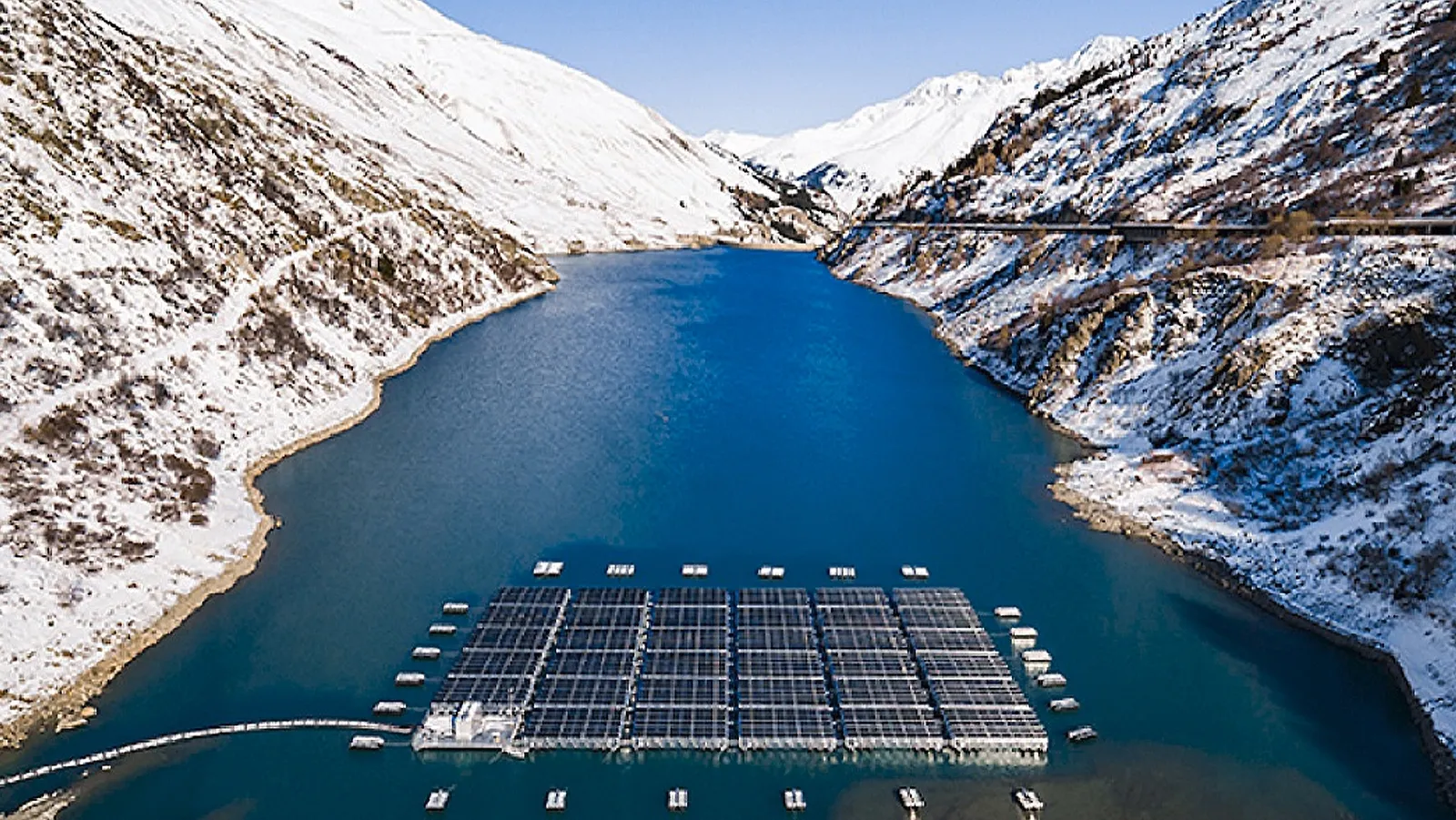
Solar energy has found an unusual location in Switzerland. At the Lac des Toules reservoir, located at 1,810 meters above sea level in Bourg-Saint-Pierre, a floating photovoltaic plant has been operating since December 2019 and is considered the first of its kind in an alpine environment.
The project, developed by Romande Energie with the support of specialized companies, aims to demonstrate that high-altitude reservoirs can also be utilized to generate renewable electricity.

Bifacial panels to harness radiation from the Alps
The demonstration facility has approximately 2,240 square meters of photovoltaic surface and 1,400 bifacial solar panels distributed across 35 floating structures. Its installed capacity reaches 448 kWp.
Unlike conventional solar plants, these platforms are designed to move vertically with changes in reservoir levels and can rest on the bottom when water levels drop significantly.
A key aspect of this project is the use of bifacial photovoltaic modules, which can generate electricity from both their front and back sides. This technology allows utilization not only of direct solar radiation but also of some of the light reflected by the surrounding environment.
Elevated locations also offer certain advantages for photovoltaic power generation. Higher ultraviolet radiation, lower temperatures, and the albedo effect of snow can enhance module performance. Studies conducted before commissioning even suggested output that could be up to 50% higher than that of a comparable installation in lower areas.
However, the results obtained during the first few years of operation were more moderate. Romande Energie recorded an average output of around 1,400 kWh per kWp installed, compared to the initial estimate of 1,800 kWh/kWp.
This represents an approximate 30% improvement over a conventional installation on flat ground, but it falls short of the most optimistic projections.
The main challenge is not capturing solar radiation, but ensuring the installation continues to function in one of the most demanding environments for photovoltaic infrastructure.
The level of Lac des Toules can vary by about 15 meters throughout the annual operation cycle of the reservoir. The floating structure must adapt to these changes and, during certain periods, remains supported on the bottom. Additionally, the plant is exposed to temperatures as low as -25 ºC, heavy snowfall, ice, and winds that can reach 120 km/h.
Experience has also revealed some limitations. Snow accumulation and ice formations caused several days of downtime and damaged around a dozen panels.
The effects of the mountains on sunlight and shadows between modules also reduced production compared to initial estimates. The project has included modifications to address these issues, including solutions aimed at limiting the formation of snowdrifts.
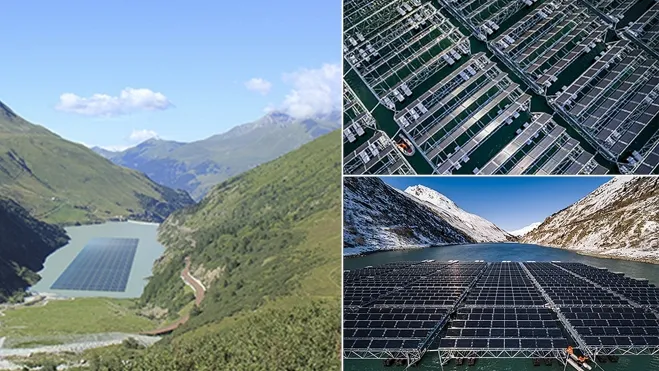
From pilot project to a larger solar plant
Romande Energie’s goals extend beyond the current demonstration unit. The experience gained aims to serve as a foundation for a floating photovoltaic installation with much greater capacity.
The expansion project aims to cover slightly more than one-third of the Lac des Toules surface and achieve an annual production of over 22 million kWh, enough to meet the average energy needs of more than 6,200 households. Initial estimates suggested an expansion capacity of around 12 MWp, compared to the 448 kWp of the demonstration facility.
The interest in this project extends beyond Switzerland. Artificial reservoirs can provide an alternative for installing photovoltaic generation without occupying large areas of agricultural or natural land. Additionally, in the case of installations linked to hydroelectric power plants, existing electrical and access infrastructure can be utilized.
Lac des Toules aims to demonstrate the potential of floating solar power in high mountain areas and also to help overcome its own challenges. Snow, ice, changes in water levels, and mountain shadows require the design of specific structures and anchoring systems.
The main value of this installation lies not only in the electricity it generates. Its purpose is to show how well a combination of photovoltaic solar energy and hydroelectric infrastructure can function in extreme alpine conditions, providing a technical foundation for future floating solar parks in mountain reservoirs.