
Study: Higher CO2-Taxes Can Increase Productivity of the Green Economy
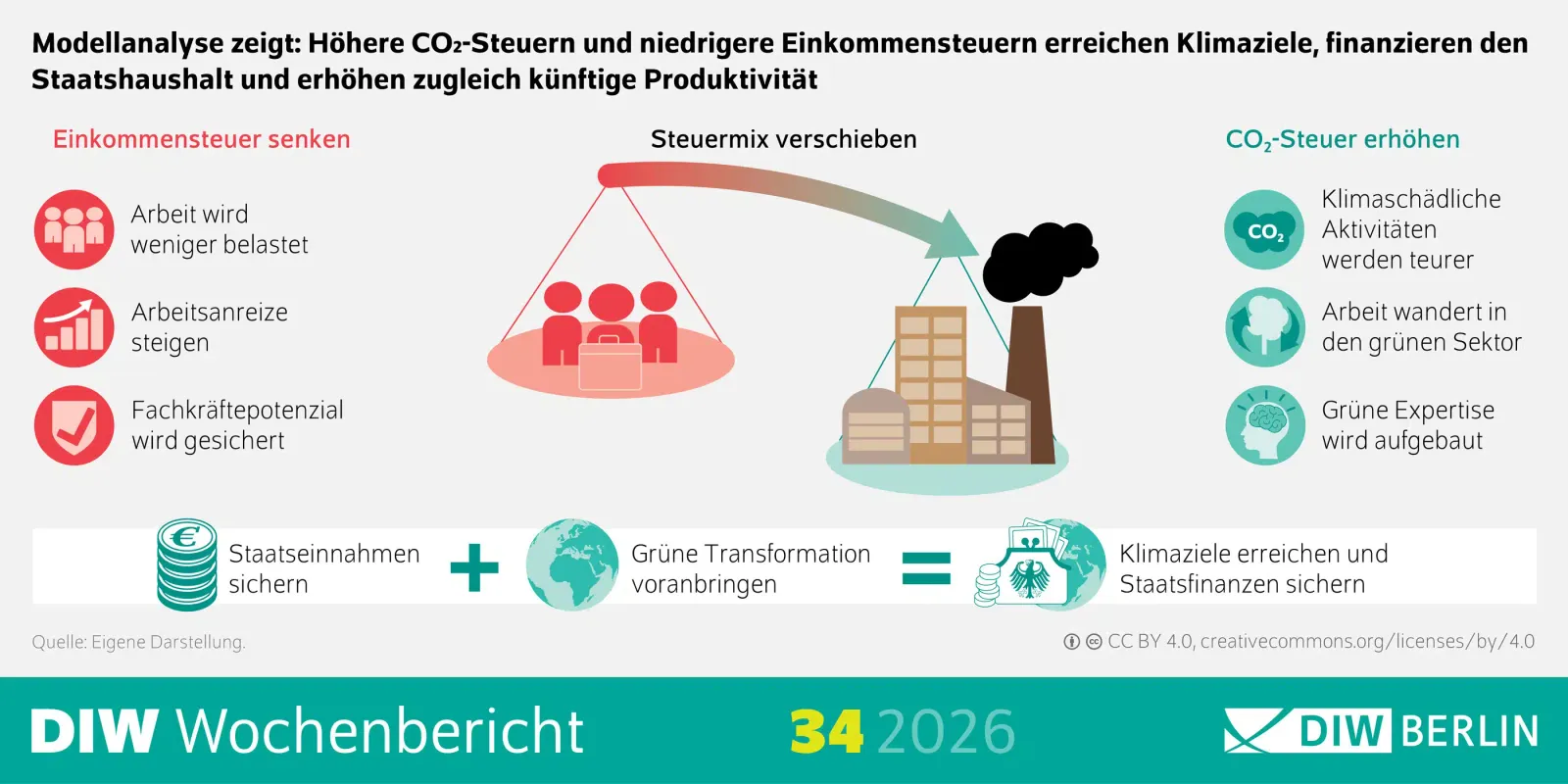
Image: Audi (illustrative)
Higher CO2 taxes can not only reduce emissions but also promote a climate-neutral economy. By increasing the cost of emission-intensive production, they redirect employment toward environmentally friendly sectors. There, workers gain experience and build knowledge in working with green technologies, thereby increasing their productivity in the long term. Therefore, even with strained public finances, it may make sense to finance the state more through CO2 taxes than through income taxes.
This is evident from a model analysis by the German Institute for Economic Research (DIW Berlin) based on U.S. data. According to the study authors, the underlying mechanism can be applied to other economies such as Germany. While there is no traditional CO2 tax here, the CO2 price is determined through emissions trading, which is a form of quantity control. However, what matters most for its regulatory effect is not the specific design but rather the fact that emissions have a price.
"The concern that higher CO2 prices will primarily burden the economy is overly simplistic. Those who focus only on the short-term costs of climate policy overlook the learning processes it triggers—and thus its potential to strengthen the economy in the long term," says Sonja Dobkowitz, a researcher in the Macroeconomics Department at DIW Berlin. "Therefore, a higher CO2 price is also an investment in future productivity."
"Higher CO2 prices channel labor into the green economy"
Many countries face a major challenge: public funds are scarce, yet they must stimulate the economy and achieve set climate goals. This may sound like a dilemma, but it can be resolved, as the study shows.
The state can generate revenue from both income taxes and CO2 taxes. However, both reduce take-home pay and thus diminish incentives to work. The CO2 tax is considered a less efficient source of revenue: it undermines not only its own basis but also that of income tax—the more it reduces fossil fuel consumption, the less remains to be taxed. At the same time, it shifts work to the currently even less productive green sector, which lowers wages and thus income tax as a second source of revenue.
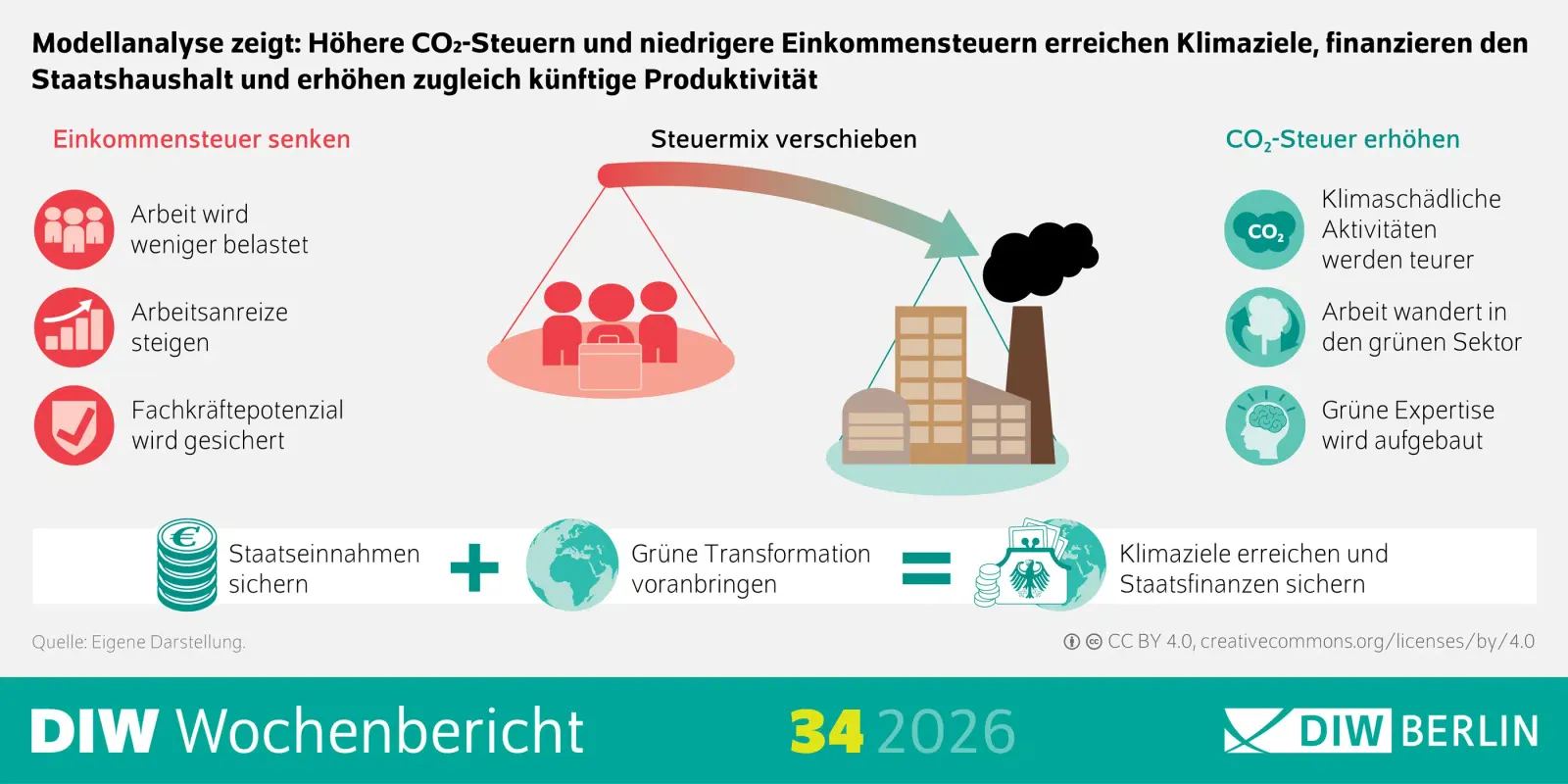
According to the analysts, however, the model results show that the regulatory effect of a CO2 tax more than offsets these drawbacks: A higher CO2 price shifts employment toward climate-friendly sectors. As workers gain experience with green technologies there, their productivity increases in the long term. Therefore, the model results suggest setting a higher CO2 price than would be warranted solely based on the social costs of emissions.
CO2 revenues should be used for lower income taxes
The additional revenue from CO2 taxation should, according to the study, be used to reduce income taxes. This would increase take-home pay and thus strengthen work incentives. In this way, the restraining effect of the CO2 tax can be counteracted, providing further momentum for the economy.
Since the model is based on an average household, it cannot reflect distributional effects. Because higher CO2 prices place a relatively greater burden on low-income households, such households need to be specifically relieved of that burden. However, how this should be implemented concretely was not the focus of the study. The model used also does not take into account possible consequences of higher CO2 prices, such as the relocation of energy-intensive industries abroad. In the long run, however, increased productivity leads to a competitive advantage, according to the study authors.
The mechanism outlined remains valid in all cases: higher CO2 taxes would help make the green transition more cost-effective. “A low CO2 price may seem convenient for short-term economic development, but it is not free,” says study author Dobkowitz. “It means giving up on part of the knowledge and productivity that will be essential for a climate-neutral economy in the future.”
Also interesting
About the author
Thomas Langenbucher is an expert in electromobility with experience in the automotive and financial industries. Since 2011, he has been covering electric vehicles, sustainable technologies, and mobility solutions for ecomento.de. Learn more.
Reader interactions