
Study: Europe’s battery capacity is not sufficient for localizing IAA production
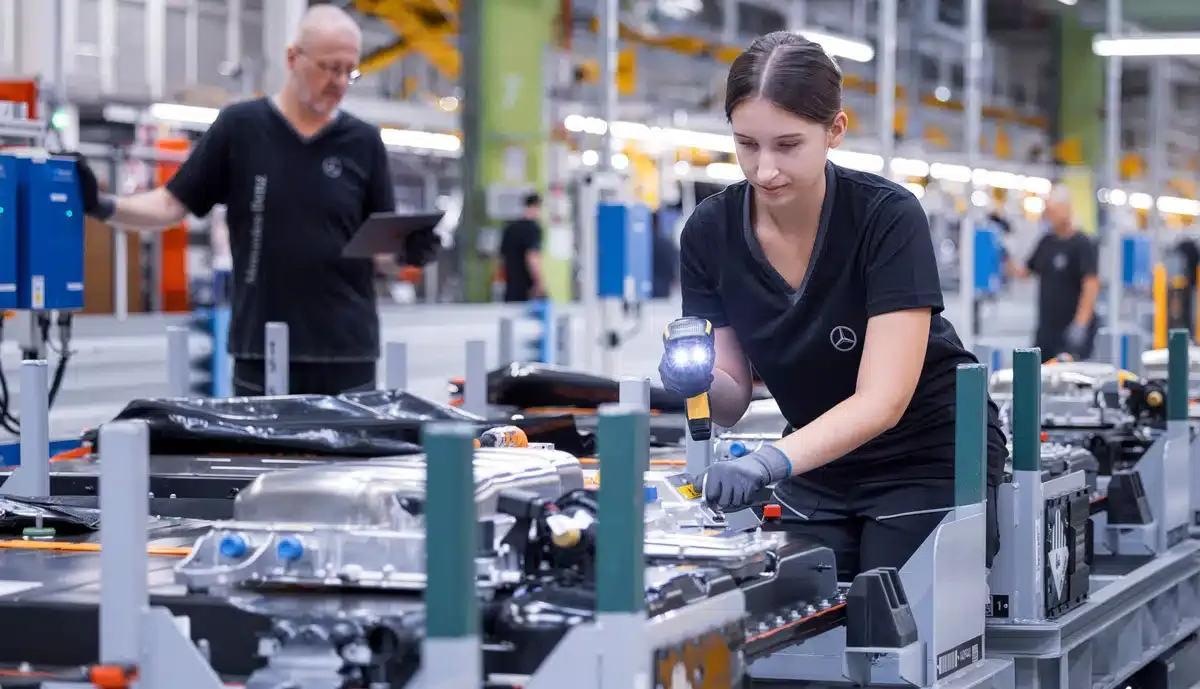

Image: Mercedes‑Benz (illustrative)
A study conducted by Mobility Global at the request of the European Automobile Manufacturers Association ACEA examines whether Europe’s battery supply chain is prepared for the localization requirements outlined in the EU’s Industrial Accelerator Act (IAA). According to the proposal, these rules are set to be introduced in two phases. By around 2027 to 2028, batteries must contain three components of EU origin, including the battery cells.
Three years after adoption, around 2030 to 2031, five components are expected to originate from the EU. These include battery cells, the battery management system (BMS), and cathode active materials (CAM). The analysis examines three scenarios with varying levels of demand for batteries manufactured in Europe.
The “Full market” scenario includes the electric light vehicle market, encompassing private buyers who receive purchase incentives. The “Public led” scenario covers the market without private buyers, including company vehicles, rental cars, fleets, dealers, and public procurement. The “Public core” scenario focuses solely on company vehicles and public procurement.
Europe’s battery supply will lag behind demand until 2032
In all three scenarios, it is expected that supply will fall short of demand, even though European battery cell production is set to rise to 306 GWh by 2032. Limited supply remains the key bottleneck for expanding the number of vehicles eligible for “made in the EU” incentives. If the IAA takes effect in 2028, around three million cars may not be able to receive these incentives due to insufficient supply.
In the case of medium- and heavy-duty commercial vehicles, the supply gap will widen further by 2032 to reach 23 GWh. Demand at that time will be roughly four times the available European supply. Meanwhile, most of the planned European gigafactories are focused on NMC battery chemistry (nickel-manganese-cobalt), while demand is shifting increasingly toward cheaper LFP batteries (lithium-iron-phosphate), whose chemistry composition is dominated by China.
Batteries manufactured in Europe are also significantly more expensive than imported battery cells. The announced production capacities remain subject to financing, approval, and implementation risks, and therefore cannot be equated with fully operational capacity. There are also ongoing shortages of cathode and anode active materials; according to the analysis, this deficit may not be resolved even with reduced demand until between 2038 and 2040.
According to the study authors, the results indicate the need for a realistic and economically viable approach to localization. The effectiveness of IAA thus depends not only on the localization requirements but also on whether Europe can establish the necessary precursor capabilities, competitive operating conditions, and required investment framework. These prerequisites are described as essential to practically meet the demands.
Also interesting
About the author
Thomas Langenbucher is an expert in electromobility with professional experience in the automotive and financial industries. Since 2011, he has been covering electric vehicles, sustainable technologies, and mobility solutions on ecomento.de. Learn more.
Reader interactions