
Study: But enough European battery cells by 2030
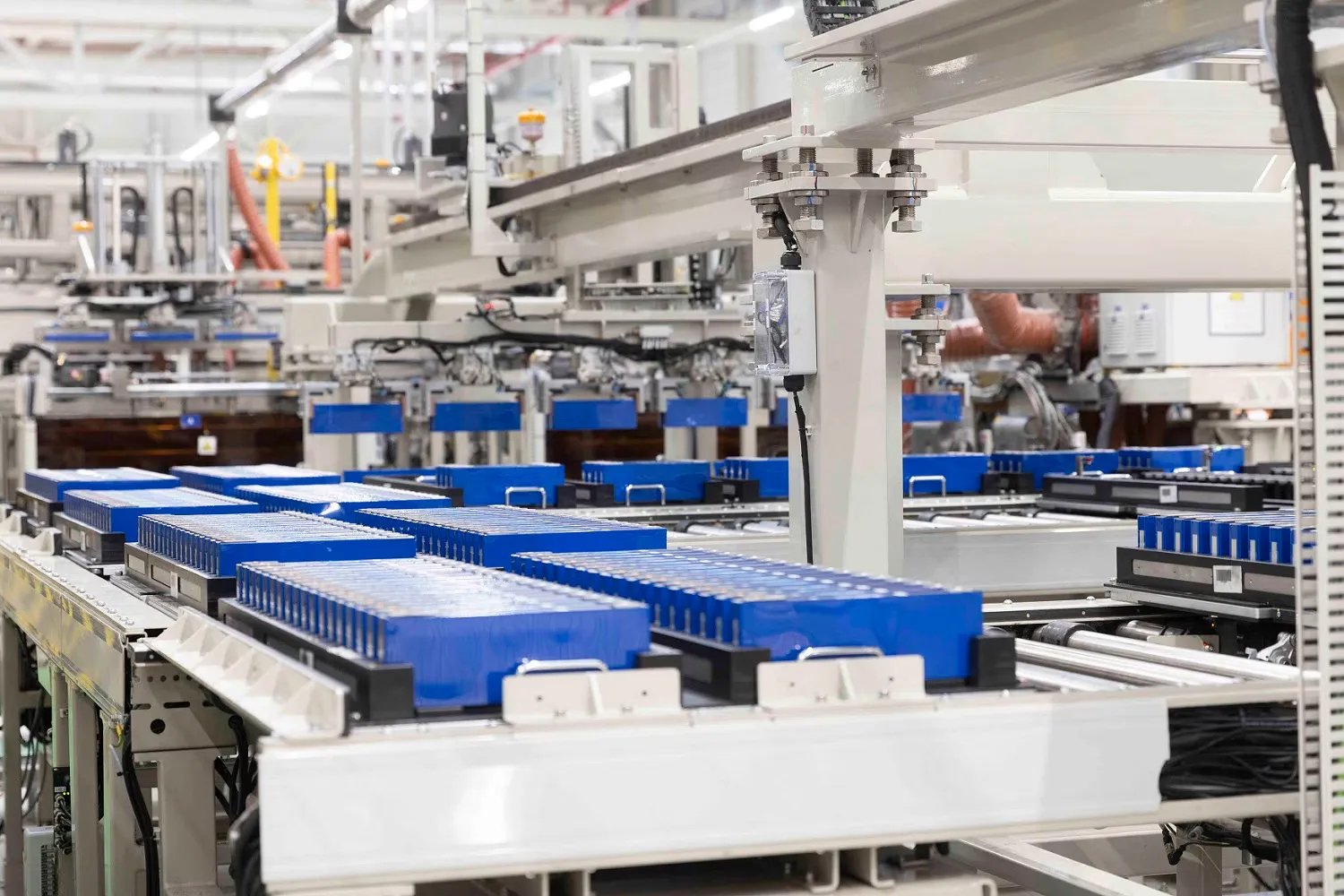
T&E concludes in an analysis of the EU’s planned local-content requirements for batteries that there will be sufficient “Made in EU” battery cells available by 2030. This contrasts with the current claims made by the auto manufacturers’ association ACEA.
View of CATL’s battery factory in Arnstadt
Image: CATL
For months, the EU and its member states have been discussing the draft “Industrial Accelerator Act” (IAA) proposed in March, which aims to boost production and competitiveness within the European Union. This legislation also affects the automotive and battery industries: for example, the EU Commission plans to introduce so-called local-content rules that give priority to “Made in EU” electric vehicles,即 those manufactured within the EU, in public procurement and funding programs.
Special conditions for local value creation within the EU are also intended for traction batteries in electric vehicles. This has sparked considerable concern recently, as the European automobile manufacturers’ association ACEA released a study examining whether Europe’s battery supply chain is capable of meeting the requirements of the legislative package. The outcome shows a significant gap. ACEA cites the time lag as an issue: it can take nearly a decade for a new battery factory to go from announcement to full industrial production. Even projects launched today might not reach full capacity until 2035. Therefore, ACEA calls for more time and a gradual introduction of local-content requirements, especially regarding battery cells and cathode active material (CAM).
Battery cells will soon be produced in sufficient quantities in the EU
However, the think tank Transport & Environment (T&E) has now released its own study concluding that by 2030, there will be enough “Made in EU” battery cells available. T&E itself emphasizes that the analysis contradicts recent claims by the automotive industry, namely ACEA.
According to this, European cell production is expected to be sufficient by 2027 to fully meet the needs of subsidized business vehicles and a significant portion of subsidized private vehicles. By 2030, both segments could be supplied with enough European battery cells—provided that projects with moderate implementation probabilities are also carried out. However, a quarter of the cell production capacities announced since 2022 have been canceled or put on hold. Germany is particularly affected, where the pipeline of projects for 2035 has halved according to T&E. The organization cites ACC in Kaiserslautern and Porsche’s closure of Cellforce as examples. On the other hand, VW’s subsidiary PowerCo was able to open its first cell factory in Salzgitter in December 2025, which will boost local value creation in the battery supply chain once operational.
It will significantly increase the output capacity.Notably, the ownership structure of European cell production is also noteworthy: According to T&E, more than 85 percent of the active capacity belongs to non-European companies, with South Korean manufacturers accounting for 72 percent of production. The South Korean manufacturers referred to are likely LG Energy Solution, Samsung SDI, and SK On, which have cell factories in Poland and Hungary respectively. Another significant cell manufacturer is the Chinese battery giant CATL, with its factory in Arnstadt near Erfurt and its second European factory in Debrecen, Hungary, which has just started trial production.
For the “Made-in-EU” requirements, it is not the manufacturer’s country of origin that matters, but rather the production location. In other words, having Asian battery cell manufacturers set up operations in the EU also helps meet the local-content criteria. What truly matters is local production within the EU.
"Since Northvolt’s failure, there has been considerable skepticism in Germany about whether it is possible to build a domestic battery industry. Yet our data show that Germany is already a key player in Europe’s battery ecosystem and possesses great potential. When debates take place in Berlin about the future of German industry, they often focus on products from the past such as internal combustion engines. It is time to shift attention to industries of the future, like the battery industry. Supporting an effective Industry Accelerator Act would be a crucial step in this regard," says Susanne Goetz, Senior E-Mobility Specialist at T&E Deutschland.
T&E identifies larger gaps in the precursor materials sector. For cathode active material (CAM), although 529,000 tons of annual European capacity is planned by 2030, only around 177,000 tons remain after weighting projects based on their likelihood of realization. The uncertainty is even greater for pCAM (cathode precursor material): Of the planned projects with a total capacity of 552.6 GWh in cell equivalent terms, T&E considers only 217.9 GWh likely by 2030. Therefore, the organization advocates for maintaining the cell and CAM targets set out in the Industry Accelerator Act, and introducing minimum quotas for pCAM and anode active material starting in 2032.
