
Study: Battery trucks are becoming competitive on more and more routes
There are already several use cases today where battery-electric trucks outperform their diesel counterparts in terms of overall operating costs. By 2030, this could apply to 70 to 90 percent of road freight transport in Germany, according to a new study by the Potsdam Institute for Climate Impact Research.
The study titled “Cost competitiveness of alternative heavy-duty truck technologies under real-world utilisation profiles” was recently published by the research team at the Potsdam Institute for Climate Impact Research in the scientific journal “Nature Communications.” The main finding of the article is that, under the baseline assumptions regarding costs and technical maturity set by the team, electric trucks in Germany will surpass comparable diesel trucks in terms of total operating costs over 70 to 90 percent of the kilometers traveled in heavy-duty road freight transportation by 2030.
As an introduction, the analysts emphasize that previous studies have often focused on average payload ranges or long-haul transportation, yet the logistics sector is highly heterogeneous and encompasses a wide range of truck usage patterns. Therefore, this new study was designed with a broader scope. It evaluates the economic viability of battery-electric trucks (BEV) and fuel cell trucks (FCEV) using microdata from four million trucks across Europe. The researchers link these real past usage profiles with TCO projections for heavy trucks within a “scenario-based framework.” In other words, they created an optimistic, a moderate, and a pessimistic scenario for TCO developments. Further details on the methodology can be found in the source link below this text. Additionally, it’s important to note that the study uses BET instead of BEV as an abbreviation — un
Similarly, FCET and ICET apply to fuel cell trucks and internal combustion engine vehicles (see chart).
According to the study, BEVs can achieve cost savings compared to diesel trucks on “most road kilometers in key European markets” by 2030. The researchers compared BEV trucks with small and large batteries, fuel cell trucks, and diesel vehicles, using 160,000 kilometers per year in their calculations.
In the medium scenario, the version with a small battery will be competitive in terms of TCO for 91 percent of road freight transport by 2030, while the version with a large battery will achieve this for 69 percent. In the optimistic scenario, nearly all usage profiles will become economically viable by 2030, with TCO savings of up to 0.50 euros per kilometer. In pessimistic scenarios, BEV trucks will only reach cost parity with diesel trucks on 14 percent of routes (small battery) or 3 percent (large battery).
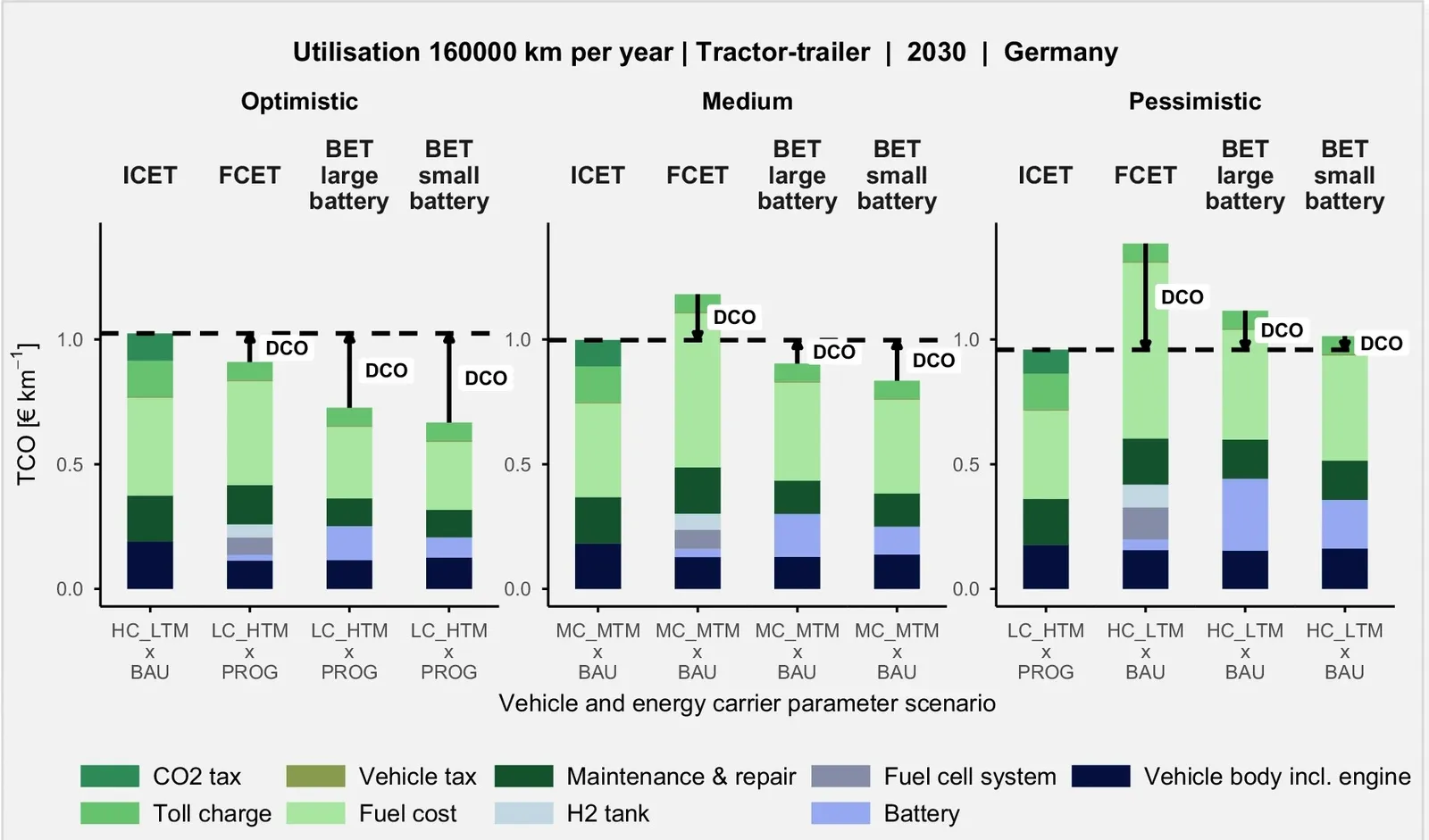
The calculated TCO is the result of a complex balance between drive efficiency, energy costs, battery size, and usage intensity. The research team emphasizes: “Higher annual mileage favors BEVs in terms of cost competitiveness, but it often comes with higher maximum daily distances, which can exceed the range if fast charging capabilities are limited.”
Here, technical feasibility comes into play, with the still incomplete charging infrastructure also having an impact: Considering the maximum daily distances of BEVs and limited charging options, the TCO advantage in a moderate scenario drops to a minimum of 21 to 25 percent for the share of economically viable roadsharing activities by 2030, according to the Potsdam Institute for Climate Impact Research.
But: Thanks to the rapid expansion of fast-charging infrastructure and improvements in direct range, this minimum threshold could rise significantly again by 2035—to 63 to 77 percent. “This analysis highlights the importance of a coordinated, EU-wide expansion of fast-charging infrastructure for the acceptance of roadsharing technologies. Additionally, increased development of fast-charging infrastructure reduces the required direct range and makes it possible to use smaller batteries,” emphasizes the team at the Potsdam Institute for Climate Impact Research.
What about fuel cell trucks? According to the study authors, they face fewer limitations in terms of range and operational capability. However, their advantage over internal combustion engines in operating costs is less significant due to lower efficiency, and they also require higher initial investment costs. In other words, “By 2030, FCEVs will only be competitive with internal combustion engines under the most favorable conditions, covering 79 percent of road freight transport, with cost savings being less than half those of battery-electric trucks.”
In direct comparison with BEVs, fuel cell trucks will only become competitive under very specific conditions: if there are limited improvements in the costs and technical parameters of BEVs in the future, if electricity prices remain high, and if FCEVs experience favorable cost trends due to exceptionally low hydrogen prices. However, according to the study authors, such low hydrogen prices can only be expected if there is substantial importation via sea routes around 2030, followed by imports through pipeline connections later on.
The researchers interpret their findings as indicating “that the ranges for vehicle costs, technical maturity, and energy source prices remain wide.” Uncertainties among customers and financial institutions regarding factors such as the lifespan of batteries and fuel cell stacks could affect key economic assumptions like residual values. In this context, existing policy tools such as CO2 emission standards or toll exemptions are “critical to promoting the adoption of zero-emission vehicles despite initial market and infrastructure barriers.” According to analysts, AFIR also supports the rapid expansion of charging networks, while CO2 pricing through ETS2 will further improve market conditions for the profitable operation of zero-emission vehicles.