
Study: Autoindustrie baut deutlich mehr Stellen ab als durch E-Mobilität erwartet
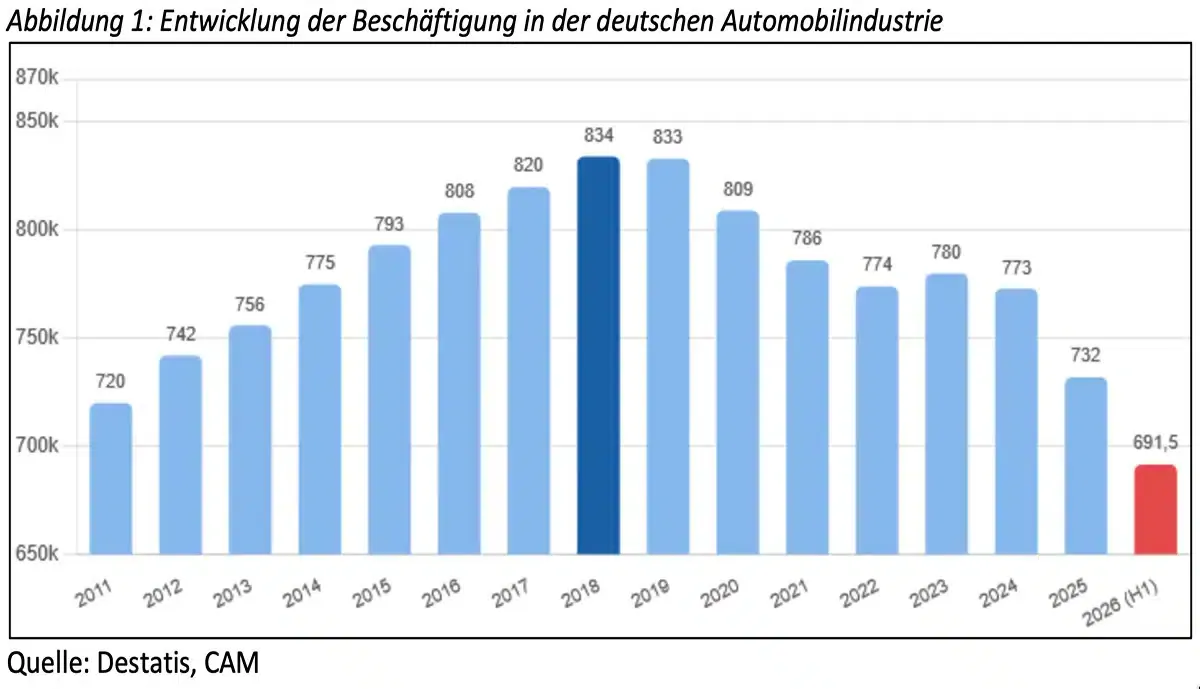
Image: VW (illustrative)
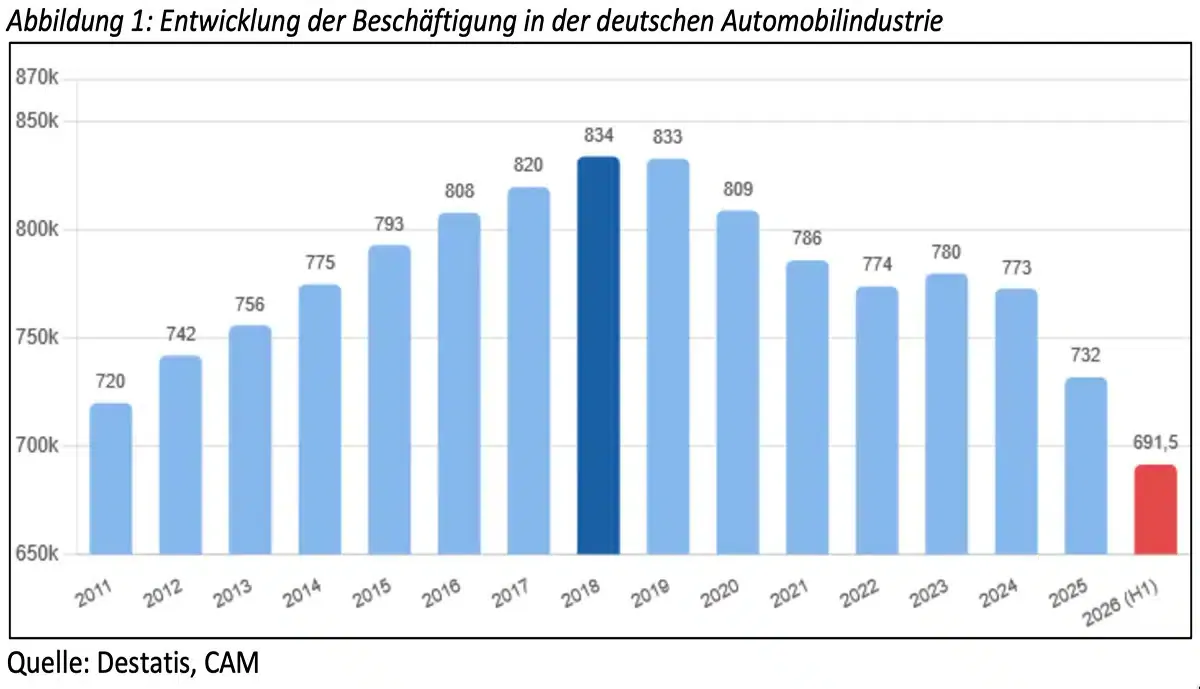
The ongoing decline in employment in Germany’s automotive industry since 2019 was predictable, but it is now much more severe than what the transition to electric vehicles alone could explain. This is shown by a recent analysis by the Center of Automotive Management (CAM).
According to latest data from the Federal Statistical Office, by the end of the first half of 2026 only around 691,500 people were employed in the industry — the lowest level since records began in 2005. Compared to the peak of 834,000 employees in 2018, this represents a loss of about 142,500 jobs, or a 17 percent decline.
"We already demonstrated in our CAM study from 2017 on ‘Employment Trends in Electromobility in Germany’ that the shift to electric mobility would cost jobs — this effect was expected and has indeed occurred," said study leader Stefan Bratzel. That investigation estimated the employment impact at a 50 percent market share for battery and plug-in electric vehicles to result in a loss of 135,000 jobs, or 17 percent, compared to 2016.
This exact magnitude has now been reached — even though the actual share of purely battery electric new registrations (BEV) in Germany in the first half of 2026 was only around 25 percent, with plug-in hybrids (PHEV) at 11 percent, well below the 50 percent figure assumed in 2017.
"The job losses we see today far exceed what would be explained by the mere shift to electric powertrains," says Bratzel. "We are already observing a decline in employment that our previous study had only anticipated at a much higher level of electrification. This shows that a significant portion of the decline is not due to the transformation itself, but rather to Germany’s deteriorating competitive position—high energy and labor costs, regulatory burdens, and increasing competitive pressure from Chinese manufacturers, even in traditional export markets."
According to the analysis, suppliers are particularly affected: their employment dropped by 7.6 percent by the end of the first half of 2026, while vehicle manufacturers saw a decline of 6.1 percent — both figures well above the overall average for the manufacturing sector (-2.7 %).
"The transformation itself would not have required such early and rapid workforce reductions," said Bratzel. "It is all the more important to address the specific conditions at each location now, rather than attributing job losses solely to electric mobility. At the same time, the automotive industry must reduce its dependencies in the fields of electric mobility and software/AI, and bring critical or specialized components of value creation that are important for employment to Germany. In the medium to long term, new growth areas such as autonomous driving and robotics must also be boldly developed."
Also interesting
About the author
Thomas Langenbucher is an expert in electromobility with professional experience in the automotive industry and finance sector. Since 2011, he has been covering electric vehicles, sustainable technologies, and mobility solutions for ecomento.de. Learn more.
Reader interactions