
Stellantis and NVIDIA are collaborating on self-driving cars

Stellantis, NVIDIA, and the British company Wayve are collaborating on autonomous vehicles in Europe. The partnership was announced on October 23 in Paris with support from the French government. France aims to accelerate the development of autonomous vehicles and ensure they actually hit the roads.
Stellantis and NVIDIA target fully autonomous driving
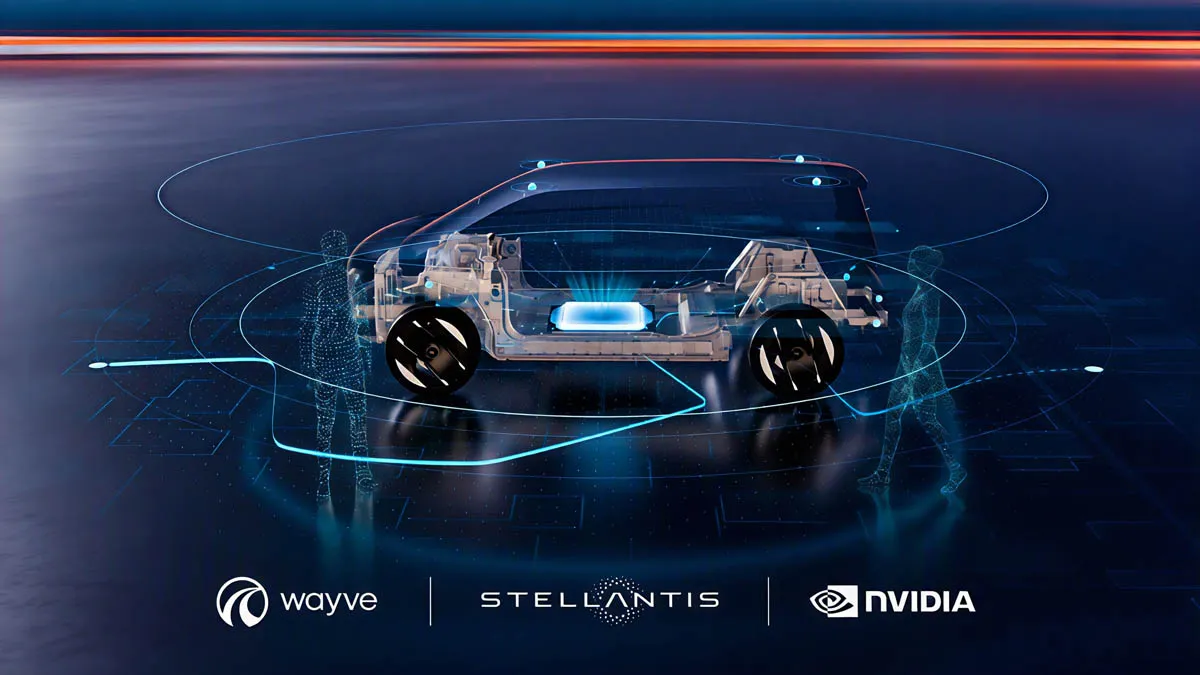
The partnership brings together three companies, each providing a crucial component of the technology. Stellantis supplies the vehicles, Wayve develops the artificial intelligence, and NVIDIA provides the computer systems and sensor technology. Together, they aim to create vehicles that can drive completely autonomously under certain conditions, without the need for a driver.
Stellantis makes available its so-called L4-Ready Platforms, vehicle platforms that are already prepared for level 4 autonomous driving. This means a car can drive independently within a defined area or under specific conditions, without the need for a driver to intervene. Think, for example, of robotaxis that transport passengers in a city. To make this possible, Wayve’s AI Driver software is combined with NVIDIA’s Hyperion architecture, in which computers, sensors, and software work together. The safety-focused NVIDIA Halos OS is also part of this technical foundation.
With this, the three companies have control over almost the entire development process, from chips and artificial intelligence to the vehicle itself. Stellantis also brings its experience in automobile production and vehicle development, so that the technology can ultimately be applied on a larger scale.
France sees opportunities for autonomous taxi services
The fact that this partnership was announced in France is no coincidence. The country has one of the largest European markets for app-based taxi services, offering interesting opportunities for robotaxis. Additionally, France invests heavily in artificial intelligence. At the AI Action Summit in Paris in 2025, investments of 109 billion euros were announced, and Stellantis already has extensive development activities in France. For Wayve, which operates from London, France is therefore an interesting base for further expansion in Europe.
The French government also sees autonomous mobility as an opportunity to strengthen its own technological position. That doesn’t mean all the technology comes from Europe, as NVIDIA is an American company. The key point is that France and the rest of Europe should play a greater role in the development, deployment, and regulation of self-driving vehicles. The partnership with Stellantis and Wayve fits well within this ambition.
From years of testing to actual use
Self-driving cars have been tested for years, but moving toward widespread use turns out to be quite complicated. The technology has advanced significantly, but regulations, traffic safety, and public acceptance also need to be in place. French Transport Minister Philippe Tabarot therefore wants to further adjust the regulations to accelerate the introduction of autonomous vehicles. He emphasizes that no compromises will be made regarding safety and data protection.
Cities, transportation companies, and unions are also involved in these plans, as the arrival of robotaxis affects not only passengers but also those who earn their living as drivers. Therefore, the relevant parties want the development of autonomous mobility to be supported more broadly so that workers and local communities can benefit as well. France has already carried out more than 200 experiments with automated mobility and aims to take the next step toward transportation services that can actually be used by passengers.
The timing for the first self-driving vehicles resulting from the partnership between Stellantis, Wayve, and NVIDIA to hit the roads is still unknown. However, France has separate plans for autonomous transportation services in the Paris region, with the first pilot projects set to begin by 2028.
Volvo also chooses NVIDIA’s technology
Stellantis is not the only automaker turning to NVIDIA for the development of self-driving cars. Recently, Volvo announced it is expanding its partnership with the American chip developer. The two companies have been working together for about ten years and now aim to take the next step toward autonomous driving. Like Stellantis, Volvo will use NVIDIA Hyperion and Halos OS, but the Swedes also opt for the Alpamayo Stack. This software is designed to help cars independently assess traffic situations and make the right driving decisions.
Volvo plans to introduce this new technology in the next generation of vehicles as part of its largest product rollout in history. The brand is adopting a gradual approach, allowing drivers to delegate more and more driving tasks to the car. Ultimately, the technology should be able to handle complex traffic situations independently, though it is not yet known in which model the systems will appear first. We covered these plans in more detail in our previous article on Volvo and NVIDIA.
Hyundai also uses NVIDIA for robots and factories
Hyundai Motor Group, which includes Kia and Genesis, is also now working closely with NVIDIA. This partnership began in early 2025 and goes far beyond just autonomous vehicles. Hyundai uses NVIDIA’s powerful computer systems to develop and train AI models, while the Omniverse platform is utilized to digitally replicate factories. In such a virtual environment, production processes can be tested and improved before the changes are implemented in actual factories.
In addition, robotics plays a crucial role. Hyundai aims to use NVIDIA technology to have robots learn in virtual environments how to perform certain tasks first, so they are better prepared for real-world applications. The same approach is used for autonomous vehicles, where various traffic scenarios are simulated digitally before testing on public roads. We have previously written at length about this broader collaboration with Hyundai.
NVIDIA gains increasing influence over the automotive industry
NVIDIA has already secured several major automakers such as Stellantis, Volvo, and Hyundai, although each uses the technology in its own way. Stellantis, together with Wayve, focuses heavily on autonomous mobility services, Volvo emphasizes safety and automated driving in passenger cars, while Hyundai applies artificial intelligence to robots and factories as well. Yet these partnerships share one clear commonality: automakers are becoming increasingly dependent on specialized companies that supply the necessary chips, computer systems, and software for technological advancements.
For NVIDIA, this is a particularly interesting position. The American company no longer provides just computing power; it also plays an increasingly important role in developing the systems that determine how cars perceive their environment and respond to it. For manufacturers, such collaboration can significantly accelerate the development of autonomous vehicles, although ultimate responsibility for safety and approval naturally remains with the respective parties.
The partnership between Stellantis, Wayve, and NVIDIA further demonstrates that the automotive industry aims to go beyond merely experimenting with autonomous driving technology. France offers an attractive environment for this, with a government willing to adjust regulations and a large market for autonomous transportation services. However, the first results still need to be proven. After all, developing a vehicle that can drive independently is different from getting thousands of driverless cars to operate safely through busy European cities. That is where the biggest challenge lies in the coming years.
Text: Arjan Hordijk