
FSD (Supervised) statistics for THE NETHERLANDS: 3.5x fewer collisions than humans, 14.9x fewer automatic emergency brakes
Tesla released statistics for FSD (Supervised) Full Self-Driving in the Netherlands after two months. It appears that a human supervisor in semi-autonomous driving mode reduces the likelihood of being involved in an accident by 3.5 times, or over 70 percent. But upon closer inspection, we find that outside of highways, the safety level increases “only” by 1.6 times, or about 64 percent.
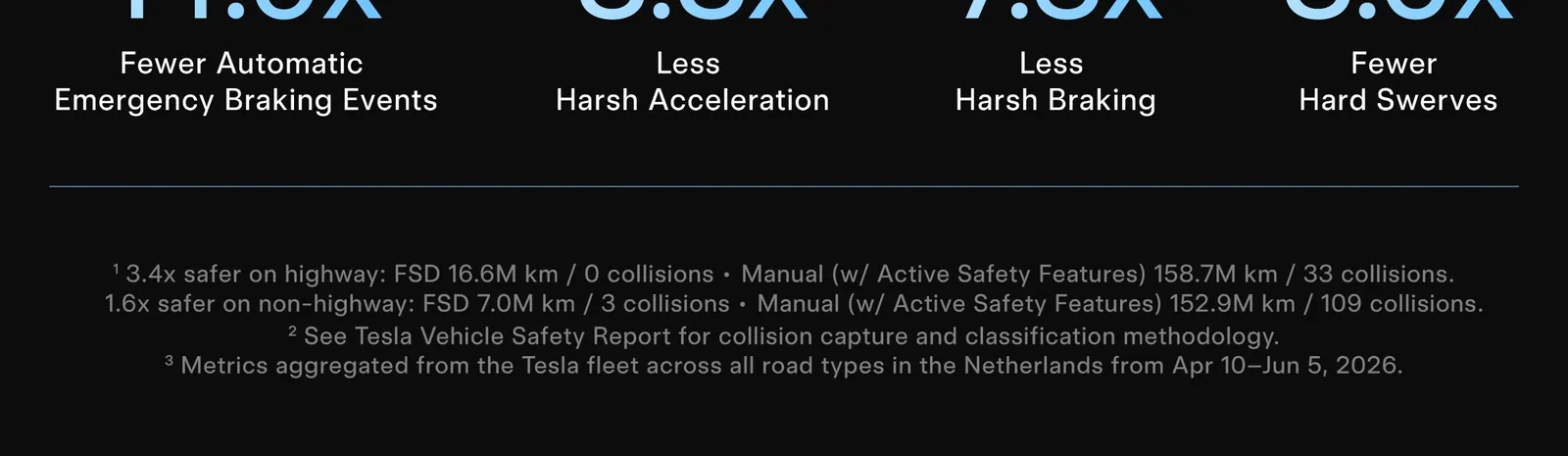
During highway drives with FSD (Supervised) enabled, zero traffic accidents were recorded over 16.6 million kilometers. Outside of highways, including in cities, there were 3 accidents per 7 million kilometers. FSD users traveled a total of 23.6 million kilometers, compared to Tesla drivers who covered 311.6 million kilometers during the same period (source). It’s difficult to determine whether FSD users drove as much as other Tesla owners—if so, either about 7.6 percent of Elon Musk’s car buyers purchased FSD (Supervised), or there were twice as many, but FSD was only suitable for half of those distances.
The single percentages of users compared to all cars that have hit the market align with data released for the United States. In other words, statistically only one in a dozen people wants to be driven by Tesla’s technology. Of course, this may also depend on who can afford it and who is willing to pay for this feature.
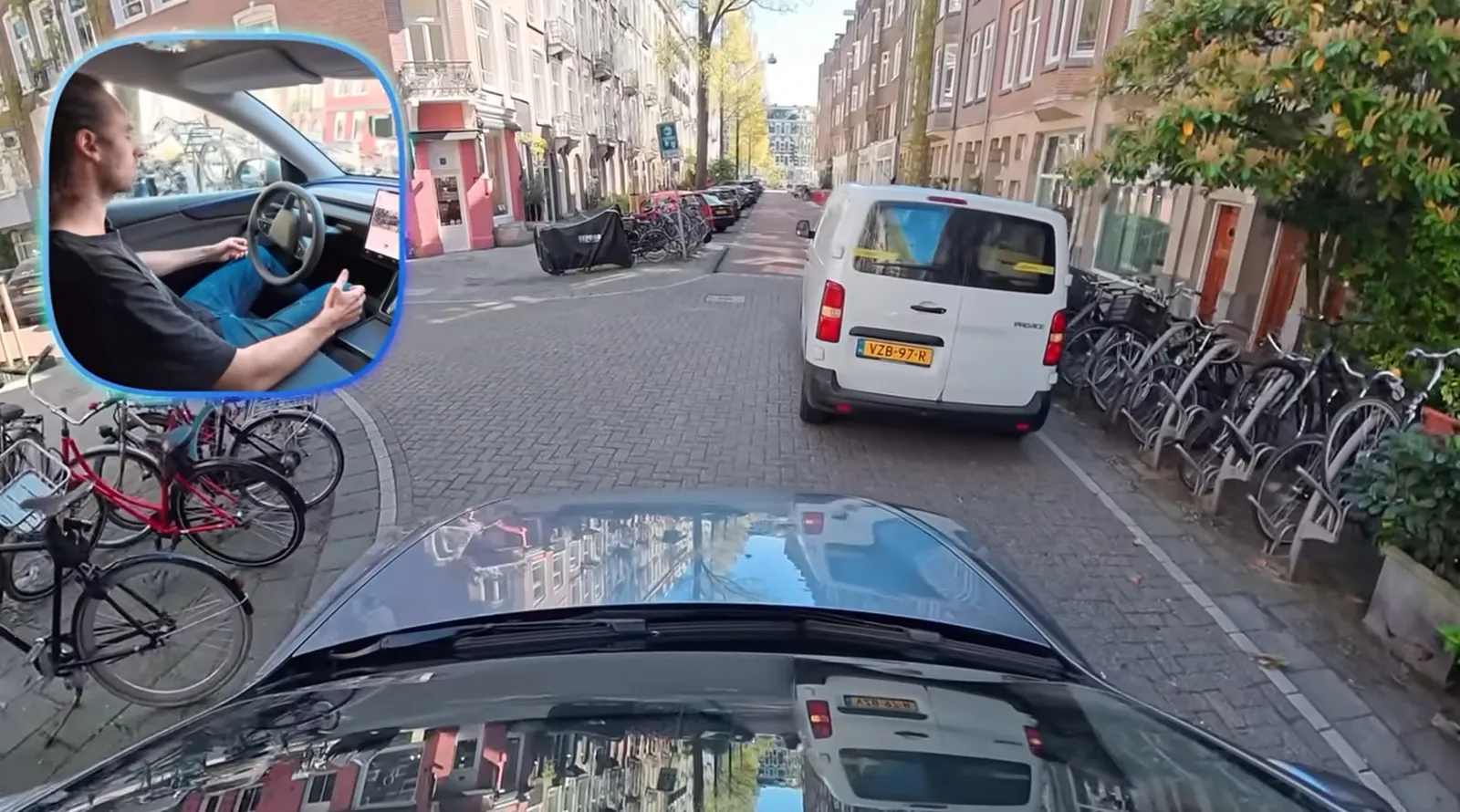
FSD (Supervised) driving in Amsterdam (c) Joel Eggimann / YouTube
FSD (Supervised) increases safety by at least 3.4 times on highways and 1.6 times off them. Here are some more interesting statistics: Dutch Tesla drivers experienced an average of 1 collision per 1.4 million kilometers (off highways) during the study period, while with FSD (Supervised) activated and monitored by a human, this dropped to 1 collision per 2.3 million kilometers. Overall, there were 3.5 times fewer collisions on all types of roads. The other figures are less striking.
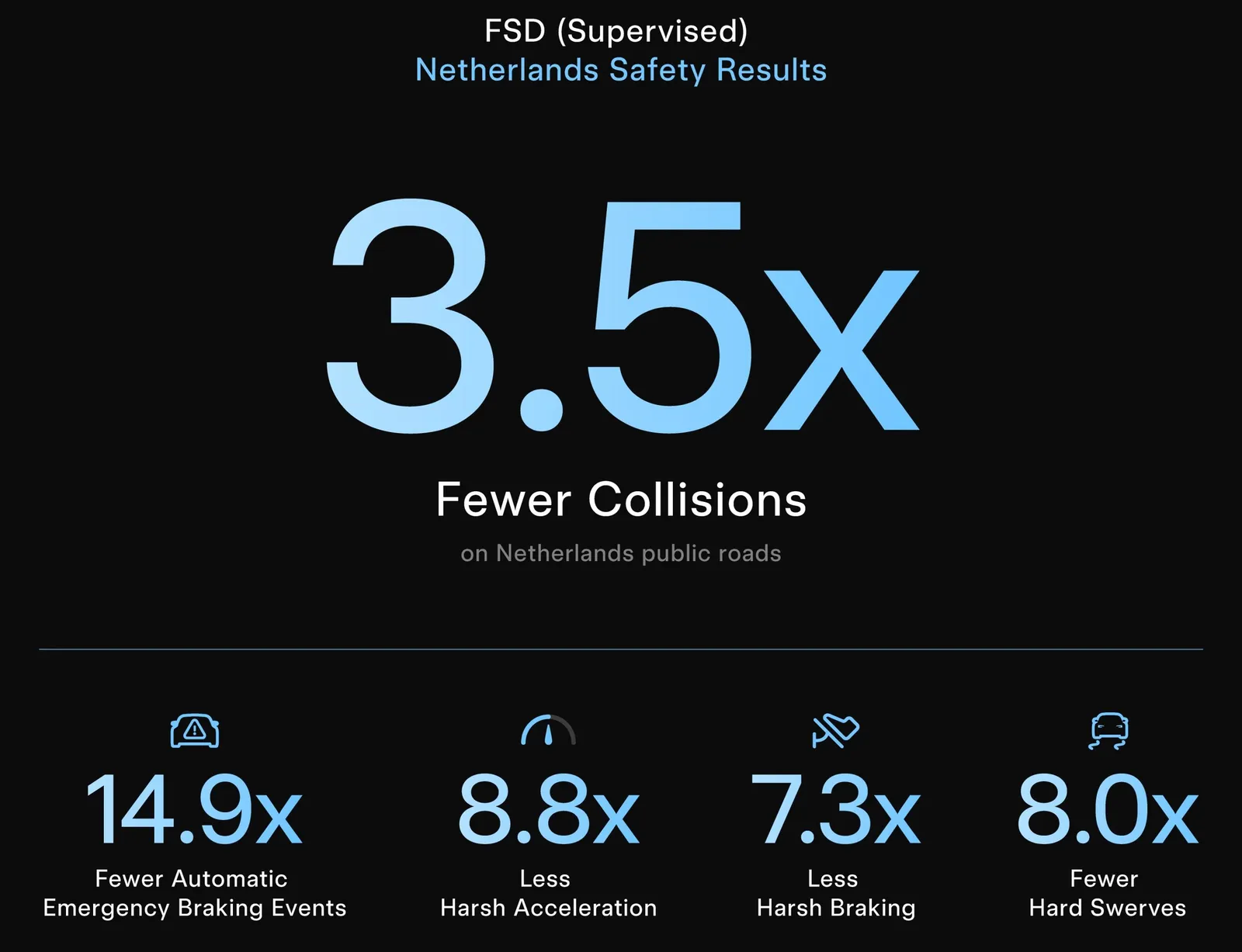
The manufacturer claims there were almost 15 times fewer emergency brakes, almost 9 times fewer sudden accelerations, over 7 times fewer sharp brakes, and 8 times fewer sudden changes in driving direction. The second parameter indicates that the vehicle drives more gently than a human, while the third and fourth suggest how much higher the computer’s level of attention can be compared to a human [related to field of view and focus on a specific area? That makes sense – editor]. The most surprising is the first figure, as if FSD (Supervised) were far more cautious and avoided situations that could be potentially risky.
Editor’s note from Elektrowozu: The system was approved in Estonia based on a license from Lithuania, and phase 5,000 kilometers of testing was completed in Belgium. Ahead of Poland’s long weekend, the authorities in Flanders (Belgium) stated they were awaiting documentation from the Dutch RDW. It was also already known that approval in one region of the country would mean automatic permission to operate the system nationwide. Denmark has also just issued a license, with the option to download the package set to become available soon.
S
FSD Supervised now approved in Denmark
Rollout will begin soon pic.twitter.com/Xpxwcme10k
— Tesla Europe, Middle East & Africa (@teslaeurope) June 9, 2026
Article rating
Reader ratings
[Total: 6 votes Average: 4.7]
Don’t miss new content — CLICK and FOLLOW Elektrowoz.pl on Google News. You might also be interested in the following ads: