
Nuremberg city relies on electric construction machinery for the demolition work.
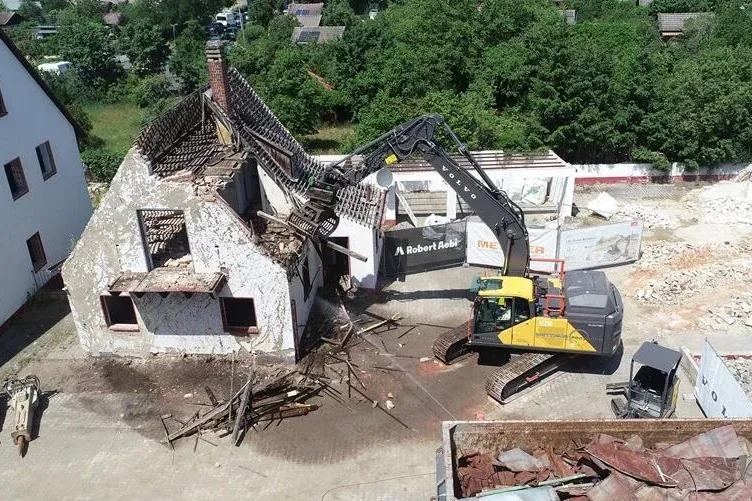
Nuremberg is having a former greenhouse demolished using electric construction machinery and electric trucks. The city required zero-emission operations in the tender process. It is following a demolition project carried out by Siemens in the neighboring city of Erlangen as a model.
The city is currently testing a largely CO2-free demolition process on the approximately 7,000 square meter site of the former Sauerbrey greenhouse in Nuremberg’s Westpark. According to Nuremberg, it has launched Bavaria’s first public tender for such a demolition project.
The requirements are comprehensive: all machines, equipment, and vehicles used must operate without emissions. Electric, hydrogen-powered, or other CO2-free propulsion systems are permitted. Conventional internal combustion engines are excluded even in hybrid form or when using alternative fuels. Additionally, fossil fuel-powered generators may not be used for charging.
Metzner Recycling (supported by Robert Aebi Nürnberg) was hired to carry out the decommissioning. In practice, the company relies on the following fully electric machine fleet: a Volvo EC230 Electric crawler crane, an ECR18 Electric compact excavator, and a L20 Electric wheel loader from Volvo CE. For logistics purposes, a Volvo FM Electric with a dump truck is also available.
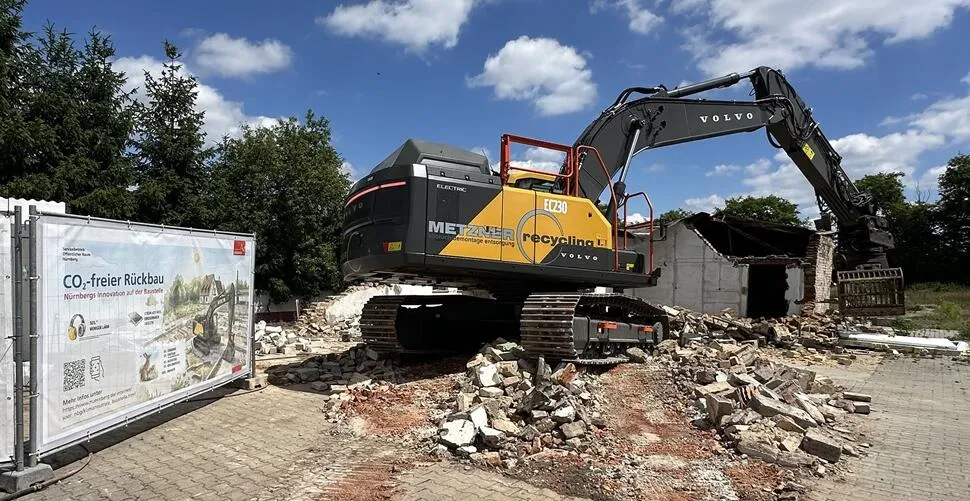
No special charging infrastructure was built for this purpose. The electric machines and vehicles are powered by the regular construction electricity supply. This project aims to demonstrate that a emission-free construction site operation is possible without complex additional energy infrastructure. At the same time, electric machines reduce noise and local pollutant emissions such as fine dust and nitrogen oxides, which is beneficial for nearby residential areas.
This approach is not entirely new in the region. Nuremberg takes its model from a fully electric building demolition that was completed in 2025 at the Siemens Technology Campus in nearby Erlangen. There, companies such as Volvo CE, Metzner Recycling, Robert Aebi, and Volvo Trucks largely electrified the entire construction process—from demolition and processing to logistics.
"By carrying out the CO₂-free demolition of the former Sauerbrey nursery, we in the city of Nuremberg are deliberately exploring new territory," says Mayor and Head of SÖR Andreas Krieglstein. The city aims to show that sustainable practices can begin as early as during building demolition. Circular economy also plays a role in this project. The construction materials generated are sorted so that suitable materials can be reintroduced into the recycling loop as much as possible. Once the work is complete, the site itself will be repurposed: Nuremberg purchased the former nursery land to expand the Westpark eastward by about 7,000 square meters and create additional public green space.
The Nuremberg project thus transfers the experiences from Erlangen to municipal practice. What matters less is whether electric construction machinery can handle demolition, as this was already demonstrated in the Siemens project. The novelty lies primarily in a municipality mandating emission-free construction site operations through its procurement processes, thereby creating a model that can generally be applied to other public construction projects as well.