
SPIRIT-E project concludes that e-trucks can serve as mobile power banks
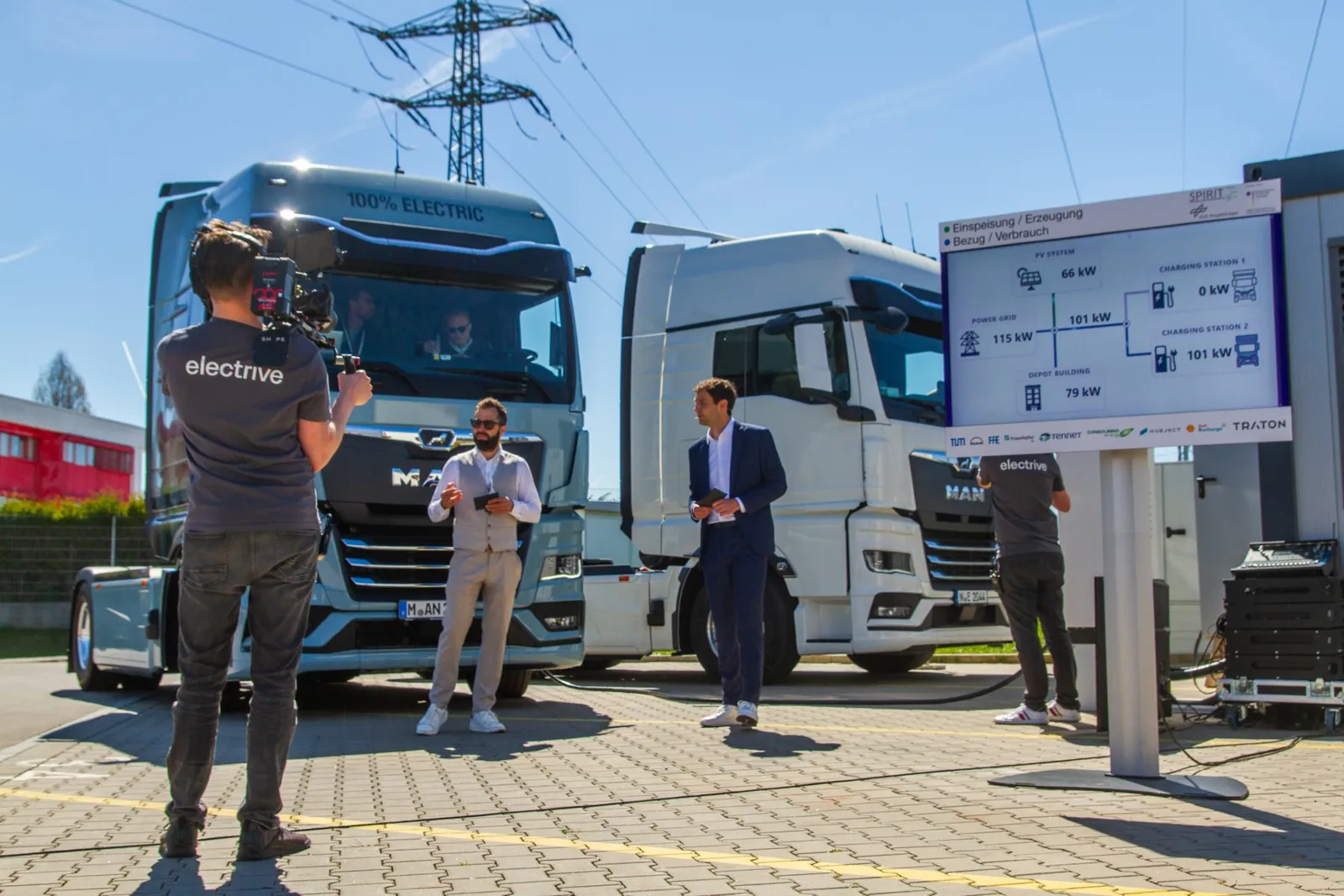
Electric trucks can not only charge using electricity but also store and discharge it selectively - like a power bank on wheels. This is demonstrated by the SPIRIT-E project after three years of research. The consortium has now presented the results of its joint work at a public online closing event.
Image: MAN
The SPIRIT-E project ran from August 2023 to October 2026. Funded by the German federal government and led by the DLR (German Aerospace Center), this research initiative aimed to identify existing barriers to the electrification of heavy-duty transport and develop practical solutions. On one hand, the project team pursued the approach of opening private charging infrastructure at logistics sites to third parties, including the creation of reservation options (a practice already widely adopted today). On the other, SPIRIT-E tested how bidirectional charging and reservable private charging infrastructure could be integrated into existing energy systems to drive sector coupling between the energy and transport sectors.
Shell Business Recharge Solutions (SBRS), a Shell Group company, developed the corresponding bidirectional DC charging infrastructure within the project, thereby establishing the technical foundation for all Vehicle-to-X applications. The consortium also included the Technical University of Munich (TUM) as the lead partner, the Fraunhofer IEE, the Research Centre for Energy Economics, TenneT, Hubject, Consolinno Energy, and MAN Truck & Bus.
The solutions were tested in a real-world laboratory at the Schmid logistics company in Obertraublingen near Regensburg. In spring 2026, the project team carried out the world’s first live demonstration of bidirectional charging for an electric truck. This was a major milestone: electrive broadcast the demonstration live on 24 April. You can watch the recording here (DE). The star of the show: a MAN eTGX with 480 kWh of usable battery capacity. Using SBRS’s bidirectional DC charging station, this truck fed power back into the grid at a rate of up to 350 kW.
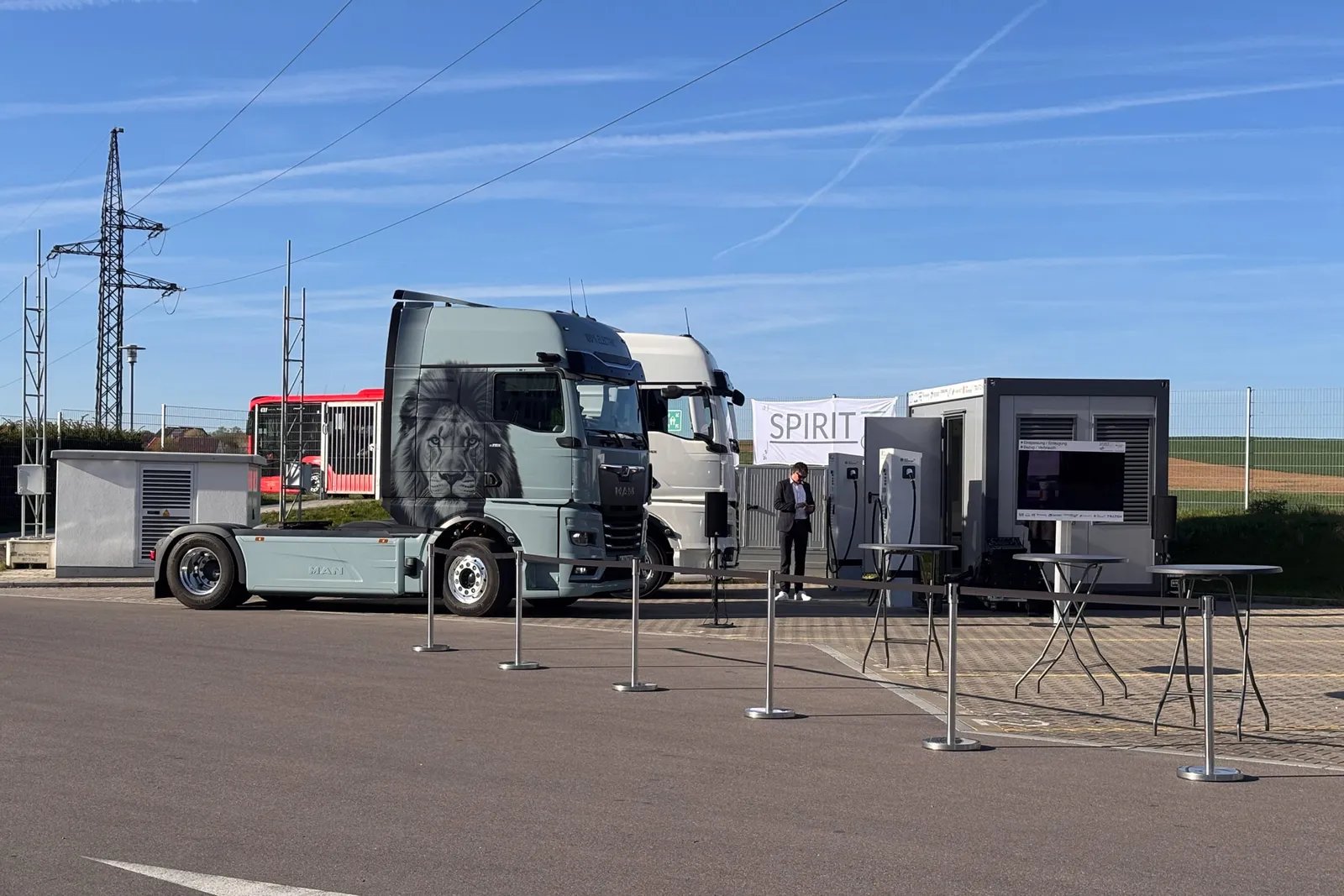
Image: Peter Schwierz
- 1/4
- 2/4
- 3/4
- 4/4
After three years of project runtime, TUM has now concluded that electric trucks could open up opportunities to reduce energy costs and alleviate financial pressure on logistics companies: “Their batteries can also serve as energy storage for the depot or the public grid.” The university primarily conducted accompanying research as part of the project.
SPIRIT-E also included the integration of mobile batteries into the electricity market: in a specially created test environment, the project partners simulated how vehicles could absorb energy at low electricity prices and sell it back when prices are higher. “This could provide freight carriers with an additional source of revenue in the future,” explained TUM. To make this work, the consortium developed and tested the necessary interfaces between trucks, charging stations, energy management systems, electricity marketers, and grid operators, including a reservation system for charging stations.
Fundamentally, the project participants tested three different bidirectional applications: the truck supplied power to other vehicles (Vehicle-to-Vehicle), supported the power supply of the company site (Vehicle-to-Site), and fed energy back into the public grid (Vehicle-to-Grid). Communication between the vehicle and charging infrastructure was based on the international standard ISO 15118-20.
The Chair of Automotive Technology at TUM primarily investigated, as part of its accompanying research, whether and how logistics companies can reliably operate their fleets electrically and how the transition can be made economically viable. According to the university, the research was based, among other things, on real-world driving data from six German heavy-duty fleets, totalling 2.15 million recorded kilometres. The key findings are summarised briefly below:
- Reserving charging points: If electric trucks can reserve public charging points in advance on long-haul routes, planning reliability increases. The time loss compared to diesel trucks drops to around 1 to 4 per cent in the median, depending on the scenario.
- Planning fleet and depot together: With private charging infrastructure at the depot, a significantly larger portion of the fleet can be reliably operated electrically compared to relying solely on public charging. Those who additionally incorporate photovoltaics and battery storage can save 25 to 44 per cent more than with a mere switch to electric trucks.
- Rethinking dispatch planning: If route planning takes charging flexibility into account, charging processes can be deliberately scheduled during low-cost periods. Depending on the order structure, this reduces the fleet’s total costs.
- Intelligently integrating the depot into the energy system: Intelligent integration into the power grid and electricity market reduced the total costs of the examined fleets by an average of 1.7 cents per kilometre. With bidirectional charging, the savings were even 6.1 cents per kilometre.
According to TUM, the use of stored electricity at the company’s own site is particularly promising. “For example, electric trucks can charge using surplus electricity from a photovoltaic system during the day and supply that electricity again later. This can increase the amount of a company’s electricity demand that it meets from its own generation. The vehicles can also cover short-term spikes in electricity demand, helping to avoid costly peak loads,” the researchers stated.
The project team considers savings potential of around ten per cent in energy costs to be realistic. “For a truck traveling 100,000 kilometers a year, that is equivalent to the energy cost of driving 10,000 kilometers,” they explained. The extent to which a logistics company benefits depends primarily on mileage, downtime, and electricity prices. Vehicles in regional transport, which regularly return to the depot, are particularly suitable.
At the closing event, the project team emphasised that the biggest hurdles now lie less in technical implementation and more in grid integration and economic framework conditions. For instance, the existing grid connection capacity at many company sites is insufficient for charging larger electric truck fleets. “Flexible grid connection agreements, battery storage, or shared charging infrastructure can help overcome these constraints,” was the unanimous opinion.
However, uniform standards for marketing the stored electricity are also lacking. Many providers use proprietary technical solutions that are not compatible with each other. In the view of the project participants, it must also be clarified how tasks and revenues are to be distributed among logistics companies, vehicle manufacturers, and electricity marketers.
“SPIRIT-E has shown that heavy-duty electric trucks can be much more than just new electricity consumers. Technically, they can be integrated into the energy system as flexible storage systems. The task now is to standardize and scale the solutions that have been tested and turn them into viable business models. This will require researchers, grid operators, industry, the logistics sector, and policymakers to work together,” summarised Prof. Markus Lienkamp, Head of the Chair of Automotive Technology at the TUM School of Engineering and Design.