
Sono Motors declares insolvency
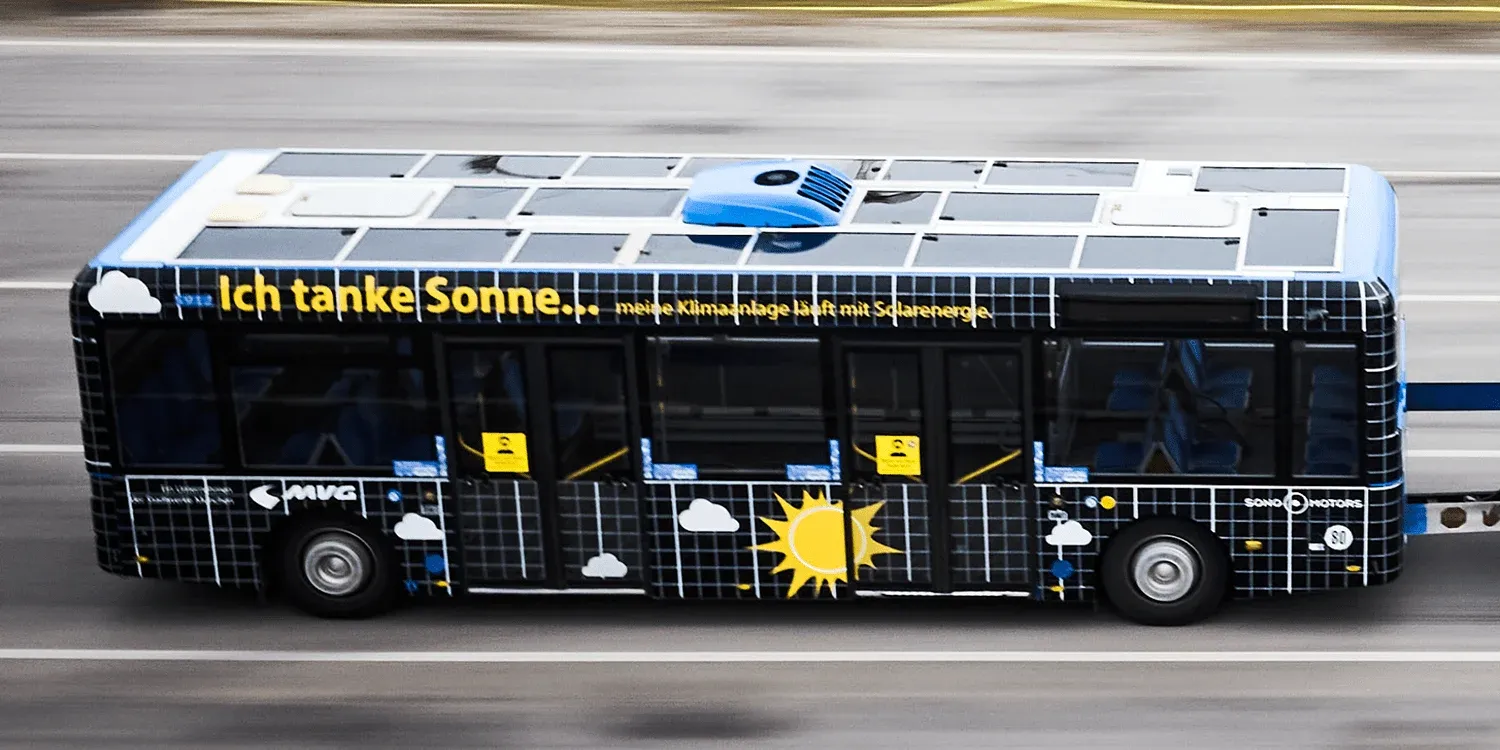
Sono Motors GmbH ceased its operational business and initiated insolvency proceedings as of July 31. This marks the end of a ten-year journey for the Munich-based company, which once made global headlines with its solar-powered car, the Sion. Now the Sono Solar brand, plus all intellectual property and power electronics are now for sale.
On Monday, Sono Motors’ insolvency was announced with a brief statement in Munich. The company ceased operations on 31 July, and insolvency proceedings were officially opened. The statement revealed that the company had pursued talks with investors “intensively until the very end”, but a viable financing solution ultimately failed to materialise. All that remains is a notice of sale.
The two managing directors, Denis Azhar and Jan Schiermeister, are now offering the core technical portfolio to buyers in three packages: the solar integration of the Sion, the power electronics including the solar charge controller for vehicles, and the Solar Data Services. This also includes hardware components and technical documentation. “A decade of solar mobility know-how is truly unique,” Azhar stated.
What exactly is being sold?
The core of the offering is not the solar module itself but the electronics behind it. A solar charge controller balances the highly fluctuating voltage of the modules with the vehicle’s onboard power system voltage, continuously determining the optimal operating point at which the cells deliver maximum power. On a rooftop, this is a manageable task. However, for a lorry driving under bridges, past rows of houses, and through tree-lined avenues, sunlight and shade alternate in milliseconds. Partial shading can significantly reduce the efficiency of a poorly designed system. Sono Motors spent years attempting to solve this very problem.
The practical benefit lies less in propulsion and more in powering auxiliary systems. Refrigeration units, stationary air conditioning, and the onboard power system in buses and refrigerated transport vehicles operate even when the vehicle is stationary. By partially powering these systems with solar energy, diesel can be saved or, in pure electric vehicles, range can be extended without enlarging the battery. According to its own statements, Sono Solar was the first company in Germany to receive a General Operating Permit for solar integration in commercial vehicles. This approval is part of the package and is likely more valuable to a buyer than any patent.
An ending six months in the making
The trigger for Sono Motors’ demise dates back six months. In March 2026, Sono Group N.V. announced its withdrawal from the solar business. This step was finalised on 4 May: the subsidiary Sono Motors GmbH was transferred to entities controlled by Azhar and Schiermeister. The parent company no longer holds any shares and, according to its own statements, has no further operational obligations.
What Sono Group N.V. is now focusing on is remarkable: the publicly listed company now operates as a treasury company, purchasing Bitcoin and aiming to generate returns through options trading. The proceeds from a financing round in March were “immediately used” to buy Bitcoin, according to an 8 May statement. The capital was described as funds that would otherwise have been “partially absorbed by legacy solar operations”. This shift in priorities could hardly be stated more clearly. The two managing directors thus took over a company without financial backing and had just under three months to find a new investor.
Ten years, two insolvencies
This is now the brand’s second collapse. Sono Motors launched in 2016 (DE) with the promise of building a car that recharges itself on the go. The Sion was co-financed through crowdfunding and deposits from future customers, most of whom later had to write off their money. In February 2023, the vehicle programme was discontinued, and in May, an application for protective shield proceedings was filed with the Munich District Court. Around 300 of the approximately 400 employees were laid off, followed by another 48 shortly afterwards.
As investor talks stalled in early November 2023, the remaining 50 or so employees were also set to receive their notices. By the end of the month, however, a turnaround occurred: investment agreements were signed with New York-based hedge fund Yorkville. The dismissed employees were offered re-employment, which the majority of the workforce accepted. The company also realigned its focus towards vehicle manufacturers and fleets. The founders, Jona Christians and Laurin Hahn, stepped back, and a new management team – including Schiermeister, then still as Head of Technology – took over.
By August 2025, two processes were running in parallel: the company rebranded as Sono Solar, while the insolvency administrator auctioned off the remnants of the vehicle programme. A total of 267 lots were put up for sale, including ten Sion prototypes starting at 600 euros, without documentation or road approval.
No technical failure
In the end, the failure was not due to the technology. Sono Motors repeatedly demonstrated that solar cells can be seamlessly integrated into vehicle bodies and roofs. Additionally, the operating permit for commercial vehicles was a genuine advantage. What was missing was a market growing quickly enough. Fleet operators calculate in terms of payback periods, and a retrofit solution must pay for itself within a few years. With fuel prices barely justifying the investment, solar on vehicles remains an added benefit rather than a key selling point. Lightyear failed for the same reason, while Aptera continues to pursue its ambitions.
Whoever purchases the remnants of the company will acquire patents, test results, and an approval, but not an ongoing business. The team has disbanded, and customer relationships have likely suffered as well. The package is therefore probably only truly valuable to a supplier or manufacturer already planning to integrate solar into vehicles and looking to save years of development time.
“We genuinely hope that this collective work will find a continuation in the market through an acquisition of the technology. We remain convinced that solar will be an integral part of vehicles in the future,” said Jan Schiermeister as a farewell.