
Solaris will deliver ten more O-buses to Saint-Étienne in 2027
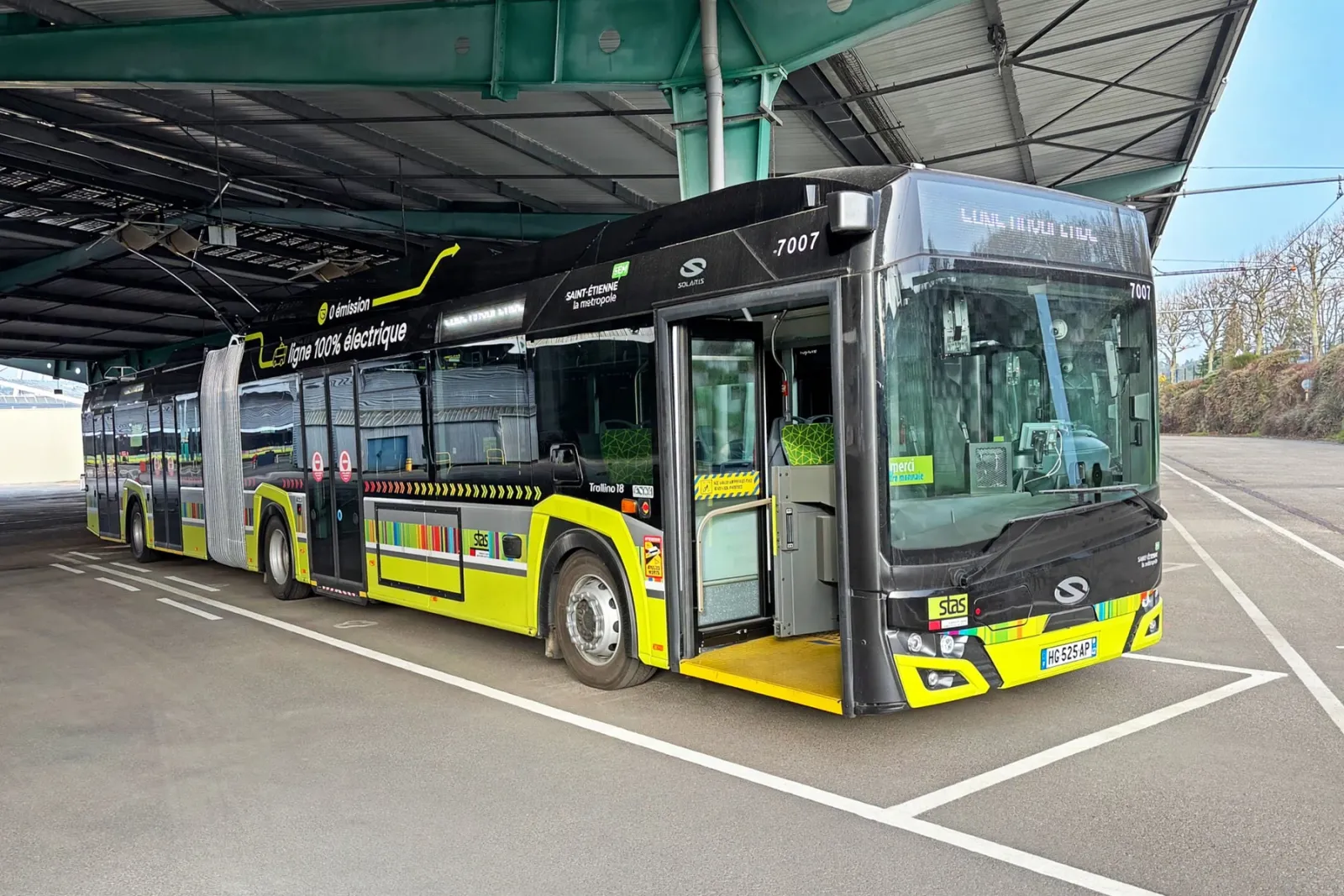
The Saint-Étienne Métropole is expanding its trolleybus fleet by ten articulated buses of the Solaris Trollino 18 type, which will be delivered by the end of 2027. In total, 41 Solaris trolleybuses will then operate in this French city. Thanks to batteries, the new buses can also travel on sections without overhead wires.
Image: Solaris
The Polish manufacturer Solaris has signed another order from Saint-Étienne. The Métropole, a municipal union surrounding the city in the Loire department, has ordered ten Trollino 18 type trolleybuses through the Centrale d’Achat de Transport Public (CATP), a central purchasing agency for France’s public transport. The articulated buses are scheduled to be delivered by the end of 2027 and will operate alongside the Solaris vehicles already in use. Solaris does not specify the cost of the order in its press release.
The story of Solaris and this French city dates back to 2019. At that time, Saint-Étienne ordered 22 Trollino 12 buses at a cost of 17 million euros, including an option for two additional buses. It was Solaris’ first order for overhead bus systems from France. Škoda provided the propulsion system. Additional batteries with over 40 kWh capacity already allowed short trips without overhead wires back then. In the following years, 23 of these twelve-meter-long buses were delivered. In 2025, eight articulated buses of the Trollino 18 type were added. With this new delivery, Solaris’ fleet in Saint-Étienne now totals 41 vehicles, including 18 articulated buses.
Details on the new buses
The new Trollino 18s are 18 meters long and have a power output of 250 kW (340 HP). Under normal operation, they draw electricity from overhead wires through two poles on the roof. Additionally, they are equipped with batteries that allow them to travel on sections without power lines. The industry calls this In-Motion-Charging: the bus charges while moving along the wires, and runs on its battery when away from them. This is a significant advantage for cities, as they don’t need to equip every street with poles and wires and can extend routes without having to build new overhead lines. However, Solaris does not disclose the size of the batteries in these new buses or how far they can travel without power lines.
Buses no longer have outside mirrors; cameras take over that function. In addition, there are a range of assistance systems: one system monitors whether the driver is tired or distracted, an intelligent speed assistant helps maintain the speed limit, a lane change assistant assists with changing lanes, and a detection function alerts to pedestrians and cyclists. Through the eSConnect telematics system, operators can also continuously monitor the condition of the fleet from a distance and plan maintenance accordingly.
Competition from China
For Solaris, this order comes at a time when competition from China is growing increasingly fierce. In the ICCT ranking for the first quarter of 2026, Yutong held a slight edge over Solaris with around 15 percent market share in zero-emission buses within the EU. This marked the first time a Chinese manufacturer topped this ranking list from the International Council on Clean Transportation.
Solaris is expanding its capacity: In June, the manufacturer opened a new final assembly hall in Środa Wielkopolska near Posen, which allows for an additional production of around 500 buses per year. The goal is to reach 2,000 vehicles annually. In 2025, Solaris delivered 1,631 buses, 86 percent of which were low-emission or zero-emission, including battery-powered, fuel cell, and tram buses. The company is part of the Spanish rail vehicle manufacturer CAF, and the buses are developed and built in Poland.
_Sources: solarisbus.com (Solaris press release)_