
September was BYD’s strongest month of the year so far
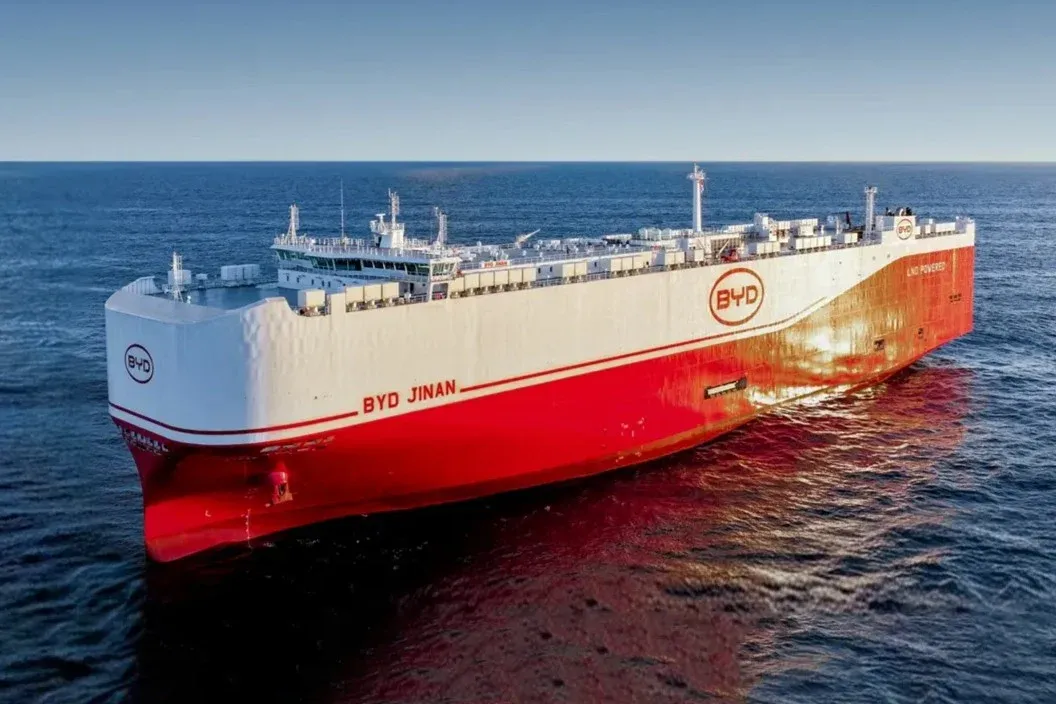
With a total of 463,561 'NEVs' delivered, Chinese manufacturer BYD recorded its strongest month of 2026 so far. The number of all-electric vehicles increased significantly, while plug-in hybrids declined. Once again, exports to Europe and other markets played a key role.
With ships like the BYD Jinan, BYD exports its vehicles
Image: BYD
The 463,561 vehicles delivered represent an increase of just under 17 per cent compared to the same month last year. At the same time, this also marks a 5.3 per cent increase over the 440,293 units in August.
Particularly encouraging from an electromobility perspective: Sales of BEVs continued to rise significantly. After BYD surpassed the quarter-million mark for fully electric vehicles for the first time in August, delivering 256,230 BEVs, the figure climbed a further 6.6 per cent to 273,143 electric cars. Compared to the same month last year, the increase in BEV sales was even more substantial: BYD reports growth of 33.2 per cent.
Plug-in hybrids performed less strongly, even if the impression on German roads might suggest otherwise. While around 61.5 per cent of BYD’s new registrations in Germany have been PHEVs since the beginning of the year, according to the Kraftfahrt-Bundesamt (link in German), the global PHEV share of BYD’s sales currently stands at just 39.6 per cent. In absolute terms, the Shenzhen-based manufacturer delivered 183,570 PHEVs in September – a decline of 2.4 per cent compared to September 2025.
BYD increases overseas share from 18 to 39 per cent
From a global perspective, the balance between domestic and overseas sales is always of interest. In September, the pendulum swung slightly back towards the Chinese market: around 61 per cent of sales were attributed to the domestic market, with 39 per cent going to overseas markets or exports – though these figures can no longer be equated precisely, as BYD has now established local production facilities in Brazil, Indonesia, Thailand and Uzbekistan, and is currently ramping up its new plant in Hungary. For comparison: in August, the overseas share was still 43 per cent, with the domestic share at 57 per cent. Conversely, this represents a massive increase in exports compared to the previous year, when only 18 per cent of all BEVs and PHEVs were sold abroad.
The absolute figures also bear this out: 180,700 vehicles were exported, representing a 153.6 per cent increase over the previous year. At the same time, domestic sales rose from 250,827 to 282,861 units, an increase of 12.8 per cent. Together, these figures explain the aforementioned rise in total sales.
Further insights come from the cumulative figures since the beginning of the year: from January to September 2026, BYD delivered a total of 3,131,576 units, a decrease of 3.9 per cent. However, overseas business grew by 92.7 per cent to 1,342,960 vehicles. Globally, BEVs accounted for a slight majority, reaching 1,629,957 units, while BYD sold 1,448,587 PHEVs.
